/-/https/www.sciencebuddies.org/Files/21464/5/sb-logo.png)
/-/https/www.sciencebuddies.org/Files/21464/5/sb-logo.png)
My daughter has an assignment to model a movement of the human body. Some examples provided are lifting a book by bending the elbow, kicking a soccer ball by bending and straightening the knee, or nodding then straightening the head. She is in the 7th grade and I don't think this is supposed to be overly complecated.
We are basically in the planning stage. She has to provide details of how she will model the bones in the movement, the muscles involved in the movement, how the "bones" will be connected to each other, and how the muscles will be connected to the bones.
I think the "muscles" are supposed to work to make the movement happen. I was hoping we could do something realitively simple using something like wood or cardboard, rubber bands, screws and such.
Any suggestions would be greatly appreciated. Thanks in advance.
Suggestions for Science Project
Moderators: AmyCowen, kgudger, bfinio, MadelineB, Moderators
-
deleted-71576
- Former Expert
- Posts: 238
- Joined: Thu Jan 05, 2006 6:28 pm
First, your daughter should pick a movement that interests her. Suggest that she think of things she does in a normal day. Something will likely ring a bell as to being a fun movement to model.
Different joints in the body have different abilities to move, and are more or less complex than others. For example, a knee just moves forward and back, but a hip joint or shoulder, being a more complex ball and socket joint, moves in 3 planes at once. And there could be some creative choices (eating a hamburger, whistling, winking, rolling your eyes).
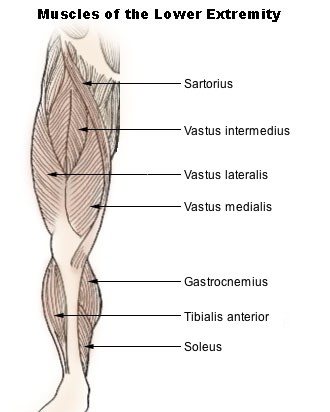
She will have to research anatomy to find the muscles, and tendons that connect to the joint of interest. Going to a library and finding a copy of Gray's Anatomy would be a good way to see what the shin bone is actually attached to.
Yahoo Education has Gray's Anatomy online. Here is a reference in it regarding the mechanics of muscles:
http://education.yahoo.com/reference/gr ... ect?id=102
This section is a little complex, but it has a plethora of useful information in it.
I would also suggest doing searches on Answers.com, Google, and look in Wikipedia (which would be a great place to start.) Search terms to use would include: muscle movement, extensor muscle, flexor muscle, tendon, muscles, kinesiology, amongst others.
As a hint, here's the link to Wikipedia on muscle:
http://en.wikipedia.org/wiki/Muscle
This will contain lots of links to jump off to.
As to what materials to use, anything that moves and has sufficient strength will work. Keep in mind that bones have to be strong, and muscles have to be flexible when you are using materials. And the connection of muscle to bone (the tendons) have to not tear off the bones.
This can be as simple or as complex as your daughter wants to make it. The more she puts into it, the more of an educational experience she will get out of it.
Different joints in the body have different abilities to move, and are more or less complex than others. For example, a knee just moves forward and back, but a hip joint or shoulder, being a more complex ball and socket joint, moves in 3 planes at once. And there could be some creative choices (eating a hamburger, whistling, winking, rolling your eyes).
She will have to research anatomy to find the muscles, and tendons that connect to the joint of interest. Going to a library and finding a copy of Gray's Anatomy would be a good way to see what the shin bone is actually attached to.
Yahoo Education has Gray's Anatomy online. Here is a reference in it regarding the mechanics of muscles:
http://education.yahoo.com/reference/gr ... ect?id=102
This section is a little complex, but it has a plethora of useful information in it.
I would also suggest doing searches on Answers.com, Google, and look in Wikipedia (which would be a great place to start.) Search terms to use would include: muscle movement, extensor muscle, flexor muscle, tendon, muscles, kinesiology, amongst others.
As a hint, here's the link to Wikipedia on muscle:
http://en.wikipedia.org/wiki/Muscle
This will contain lots of links to jump off to.
As to what materials to use, anything that moves and has sufficient strength will work. Keep in mind that bones have to be strong, and muscles have to be flexible when you are using materials. And the connection of muscle to bone (the tendons) have to not tear off the bones.
This can be as simple or as complex as your daughter wants to make it. The more she puts into it, the more of an educational experience she will get out of it.
Alan Lichtenstein, MD
Anesthesiologist
Mens et manus
Veritas
He who laughs last...Thinks slowest.
Anesthesiologist
Mens et manus
Veritas
He who laughs last...Thinks slowest.
-
carolinethorn
- Former Expert
- Posts: 393
- Joined: Tue Sep 20, 2005 2:40 pm
Hi,
Sounds like a fun project. As Alan described there are loads of ways you can go with this.
I think that wood or a hard durable plastic would make good bones that would be strong but not too heavy. Maybe dowel rods if you wanted to glue a ball joint or socket to the end or short sections of 1" x 0.5" for hinge joints.
How about partially inflated balloons for muscles - I am kind of thinking of the arm where you could have a round balloon that would be the bicep and a long type of balloon for the tricep. You squeeze the balloon and it simulates contraction.
The tendons need to be strong and only slightly flexible/stretchy - if they are too stretchy the muscle won't lift the joint. Maybe a fabric tape.
I think rubber bands would be good ligaments. They would hold the muscles in place but be very stretchy to allow the muscle to contract when squeezed.
I think its going to take some playing around to get the best combo of materials and how to fix them together. Keep a log of what you try and take pictures as you go along. You may find that if you attached the correct number of tendons in the places they would be in real life that nothing happens but if you move them to get a better pivot its works (NB: if you look at some artifical limbs the mechanics can be very different to what is possible in a human body). I would start as simple as possible with two bones, hinge and one muscle and see if you can get that functioning and then build onto it, substitute different materials to see if they work better or worse and experiments around. Have some fun and keep a good notebook describing what you do!
Best of luck,
Caroline
Sounds like a fun project. As Alan described there are loads of ways you can go with this.
I think that wood or a hard durable plastic would make good bones that would be strong but not too heavy. Maybe dowel rods if you wanted to glue a ball joint or socket to the end or short sections of 1" x 0.5" for hinge joints.
How about partially inflated balloons for muscles - I am kind of thinking of the arm where you could have a round balloon that would be the bicep and a long type of balloon for the tricep. You squeeze the balloon and it simulates contraction.
The tendons need to be strong and only slightly flexible/stretchy - if they are too stretchy the muscle won't lift the joint. Maybe a fabric tape.
I think rubber bands would be good ligaments. They would hold the muscles in place but be very stretchy to allow the muscle to contract when squeezed.
I think its going to take some playing around to get the best combo of materials and how to fix them together. Keep a log of what you try and take pictures as you go along. You may find that if you attached the correct number of tendons in the places they would be in real life that nothing happens but if you move them to get a better pivot its works (NB: if you look at some artifical limbs the mechanics can be very different to what is possible in a human body). I would start as simple as possible with two bones, hinge and one muscle and see if you can get that functioning and then build onto it, substitute different materials to see if they work better or worse and experiments around. Have some fun and keep a good notebook describing what you do!
Best of luck,
Caroline
-
deleted-71576
- Former Expert
- Posts: 238
- Joined: Thu Jan 05, 2006 6:28 pm