Hi dominiqueolivia,
No problem! I'm glad you found my explanation helpful. If you have access to a physic teacher, they may also be able to help you with local resources.
As for your questions...
First, am I able to cite you in my research plan?
You generally want to cite peer-reviewed literature or books to support scientific assertions. Any chemical engineering thermodynamics textbook will have a section on thermodynamic cycles. I recommend the "
Fundamentals of Chemical Engineering Thermodynamics" text, as it tries to make thermodynamics more understandable at the undergraduate level. Section 5.3 reviews the vapor compression cycle.
If discussions with other scientists/engineers have shaped the direction of your project, you can include that as an acknowledgment rather than a citation.
For the AWG it would require a motor correct? Where would that be placed?
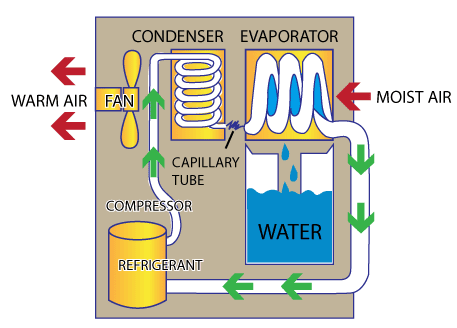
Depending on your design, your system may need two motors - one to drive the compressor and one to drive the pump. The pump is necessary to move the collected water through the filtration system unless you use gravity-based filtration. These will typically be an integral part of the equipment though and will not need to be separately purchased. In a compressor,
the motor turns the crankshaft or powers the fan of a centrifugal compressor. You can read about the different types of compressors at this
website. The University of Michigan website also has a library of images for industrial-scale chemical process equipment, including
compressors,
evaporators, and
condensers, so you can imagine what this would look like at large scales.
For the filter, what would be an appropriate configuration? Through my research I have found that most commercial companies utilize an ion exchange resin, but that may not be best for my project. I will think about using a carbon based filter (with mesh as well) and UVC for purification purposes. What else would I add to this if anything? Or do you think it would be best to simply use a commercial filter?
The wikipedia page for
AWGs has a nice image of
how a water filtration system would be integrated into the process design. You would collect the condensing water in a vessel or tank which would then pass through a filter(s) or a membrane system such as reverse osmosis.
Ion exchange water treatment systems are generally used to remove charged contaminants or undesirable minerals from the water, such as salts, calcium, magnesium, heavy metals, etc. Since an AWG is pulling water from the atmosphere rather than from a wastewater source, your water will have relatively few ionic contaminants and minerals, making ion exchange treatment unnecessary. Plus, you would just have to add back some of those minerals to make it potable drinking water.
You will want to treat the water for contaminants that could be introduced through the air, however. This would primarily be to remove biological contaminants (bacteria, viruses, yeast) that naturally exist in the air. The easiest way to do this is to pass the water through a granular filter (could be activated carbon) and then use a chemical disinfectant (such as chlorine) to kill any remaining pathogens. This is how nearly all
municipal wastewater is treated in the U.S. You could use a commercial water filter or you could even make your own.
Dr. Payne
/-/https/www.sciencebuddies.org/Files/21464/5/sb-logo.png)
/-/https/www.sciencebuddies.org/Files/21464/5/sb-logo.png)