/-/https/www.sciencebuddies.org/Files/21464/5/sb-logo.png)
/-/https/www.sciencebuddies.org/Files/21464/5/sb-logo.png)
I am doing my research for a science project. I have to prepare my reasearch for review by my teacher. I have most of my research done. She requires that I talk to an expert.
I need to know the name and job of the expert.
I need to ask some questions for my research.
Question - I need to build some different wings. What do you think is the best way? I have looked at some balsa wood models. Do you think this will work?
Question - I need a wind tunnel. Can you give me some ideas to build a small wind tunnel?
Question - I just want to show how the shape of a wing gives lift. I plan to mak some falt wings and round wings that shold not have any lift. Then I will build 1 or 2 real wings. Does this sound like enough for a good experiement?
Question - should I include angel of attack in the experiment? This seems too complicated to me.
Research for airplane wing design
-
deleted-71552
- Former Expert
- Posts: 159
- Joined: Fri Sep 30, 2005 6:31 am
- Occupation: Engineer
- Project Question: N/A
- Project Due Date: N/A
- Project Status: Not applicable
Re: Research for airplane wing design
Hi, Kevin!Kevin Kirk wrote:I am doing my research for a science project. I have to prepare my reasearch for review by my teacher. I have most of my research done. She requires that I talk to an expert.
I need to know the name and job of the expert.
I need to ask some questions for my research.
When your teacher requires that you consult with an expert, does she require an aeronautical engineer? I'm not that kind of expert, but I'd like to take a shot at helping you get answers to your questions.
First, there are wind tunnel plans available on the Internet. The biggest challenge in building a wind tunnel, in my opinion, is creating an environment in which you can *see* the wind. This requires some kind of smoke, vapor or other tiny particles be suspended in the air. If I were building one, I would consider an alternative I saw on an episode of Mythbusters on the Discovery Channel. They built a "water tunnel" using a large fish tank and a water pump to look at the aerodynamic properties of a scale model of a pickup truck. To *see* the motion of the water, they dumped oatmeal flakes into the water. They used the water pump to direct the flow of water and flakes at the front of the model. It worked very well! You might consider building a "water tunnel" with an aquarium, a small water pump, and some Quaker Oats!Kevin Kirk wrote: Question - I need a wind tunnel. Can you give me some ideas to build a small wind tunnel?
Balsa wood is a popular choice for this kind of testing. It's soft and easy to work with. Whether you use it or not depends whether you build a wind tunnel or a "water tunnel", as described above. If you use water, the balsa would probably absorb the water - unless you coated it with some waterproof spray or paint.Kevin Kirk wrote: Question - I need to build some different wings. What do you think is the best way? I have looked at some balsa wood models. Do you think this will work?
This sounds like an excellent choice of experiments. You are planning to show the contrast of how different shapes affect the wind that passes over them.Kevin Kirk wrote: Question - I just want to show how the shape of a wing gives lift. I plan to mak some falt wings and round wings that shold not have any lift. Then I will build 1 or 2 real wings. Does this sound like enough for a good experiement?
The "angle of attack" is nothing more than the angle between the upper surface of the wing and the direction of the wind. You can vary this eaily by tilting your wing. I think you have a good experiment without angle of attack, but if you show the effects of angle of attack on a true wing shape, for example, you can show how the tilt of the wing is important - at certain angles of attack you won't get lift!Kevin Kirk wrote:Question - should I include angel of attack in the experiment? This seems too complicated to me.
I hope this helps. Your project sounds like a fun one!
Brian Castelli (OneBriiguy)
Engineering Specialist
Engineering Specialist
-
deleted-71576
- Former Expert
- Posts: 238
- Joined: Thu Jan 05, 2006 6:28 pm
Kevin:
Not my area of expertise either, though I did build large scale (~10 foot wing span) radio controlled airplanes for a number of years, so I'm certainly familiar with building wings.
Balsa is an ideal material to build wings out of. But to get the shape of the wing you have to build a supporting structure underneath it. You won't have to worry about building spars, etc to handle the full load that wings have to withstand, so it should be easy to do.
Alternatively, people use foam and hot knives to cut into wing shapes, but I think that's more difficult for a beginner.
Balsa can be covered with an epoxy or fiberglass coating to make it water tolerant, if you want to take the water tunnel approach (which was pretty elegant when Mythbusters used it to test the pickup trucks.)
I would just keep the angle of attack at 0 degrees, and keep that as a constant for your experiment (one which you would mention in your poster.)
The government has a wide variety of wing shapes available to see cross sections of (I think they are called NACA airfoils.) These have been designed years ago during the heyday of aviation research.
You could cut multiple cross sections of those designs out of balsa wood, space them evenly, and then build a skin around them, either out of balsa wood, or a heat shrinkable plastic). That's all you have to do to build a wing. It's actually a lot of fun.
All of this material is available at hobby shops, or on line at Tower Hobbies.
To measure lift, you would need something like a spring scale (a very accurate one, because wings this small don't generate large amounts of lift) with the wing attached to it. Perhaps a weight dangling from the wing. As the wind speed increases, the wing will generate lift and the scale will show a decrease in weight which is equal to the force of lift it generates. Think of lift as a force that directly counteracts gravity (its vector is upward, not downward like that of gravity.)
Do google searches on Wings, NACA Airfoils, Lift, etc.. Wikipedia should also be great help.
Sounds like a fun project.
Not my area of expertise either, though I did build large scale (~10 foot wing span) radio controlled airplanes for a number of years, so I'm certainly familiar with building wings.
Balsa is an ideal material to build wings out of. But to get the shape of the wing you have to build a supporting structure underneath it. You won't have to worry about building spars, etc to handle the full load that wings have to withstand, so it should be easy to do.
Alternatively, people use foam and hot knives to cut into wing shapes, but I think that's more difficult for a beginner.
Balsa can be covered with an epoxy or fiberglass coating to make it water tolerant, if you want to take the water tunnel approach (which was pretty elegant when Mythbusters used it to test the pickup trucks.)
I would just keep the angle of attack at 0 degrees, and keep that as a constant for your experiment (one which you would mention in your poster.)
The government has a wide variety of wing shapes available to see cross sections of (I think they are called NACA airfoils.) These have been designed years ago during the heyday of aviation research.
You could cut multiple cross sections of those designs out of balsa wood, space them evenly, and then build a skin around them, either out of balsa wood, or a heat shrinkable plastic). That's all you have to do to build a wing. It's actually a lot of fun.
All of this material is available at hobby shops, or on line at Tower Hobbies.
To measure lift, you would need something like a spring scale (a very accurate one, because wings this small don't generate large amounts of lift) with the wing attached to it. Perhaps a weight dangling from the wing. As the wind speed increases, the wing will generate lift and the scale will show a decrease in weight which is equal to the force of lift it generates. Think of lift as a force that directly counteracts gravity (its vector is upward, not downward like that of gravity.)
Do google searches on Wings, NACA Airfoils, Lift, etc.. Wikipedia should also be great help.
Sounds like a fun project.
Alan Lichtenstein, MD
Anesthesiologist
Mens et manus
Veritas
He who laughs last...Thinks slowest.
Anesthesiologist
Mens et manus
Veritas
He who laughs last...Thinks slowest.
-
deleted-71552
- Former Expert
- Posts: 159
- Joined: Fri Sep 30, 2005 6:31 am
- Occupation: Engineer
- Project Question: N/A
- Project Due Date: N/A
- Project Status: Not applicable
Hey, Kevin! I think zzzzdoc's idea for measuring lift can be taken advantage of to make the wind tunnel much easier to construct. I assumed that you'd need something visible in the air so that you could take pictures, but zzzzdoc's suggested method eliminates the most difficult aspect of wind tunnel design - making air visible! In fact, using the spring scale would allow you to build a wind tunnel out of nothing more than a plywood box with a window fan in one end. You would insert various wing and non-wing designs into the box, turn on the fan, measure the lift generated by each one, and chart your results.zzzzdoc wrote: To measure lift, you would need something like a spring scale (a very accurate one, because wings this small don't generate large amounts of lift) with the wing attached to it. Perhaps a weight dangling from the wing. As the wind speed increases, the wing will generate lift and the scale will show a decrease in weight which is equal to the force of lift it generates. Think of lift as a force that directly counteracts gravity (its vector is upward, not downward like that of gravity.)
Thank you, zzzzdoc!
Brian Castelli (OneBriiguy)
Engineering Specialist
Engineering Specialist
-
deleted-71588
- Former Expert
- Posts: 1297
- Joined: Mon Oct 16, 2006 11:47 am
The first people to construct a small wind tunnel to accurately measure fluid effects on wings were the Wright brothers. http://www.wrightflyer.org/WindTunnel/testing1.html
Their first major breakthrough was the accuracy of their simple balance scale. They found that much of the published data was very inaccurate. This and their realization that a propeller was just a rotating wing combined with their intuition for solving the control problems lead to their success.
I believe the Wright brothers's wing shapes for their tests were carved out of a small solid block of wood attached to a stiff bicycle spoke that could be bent for different attack angles. It really didn't matter how much the wing weighed because their balance used a counterweight. What mattered was how accurate their small weights were and how good their fulcrum was.
Once they had an accurate balance, accurate small weights, and some shapes, and the tunnel, it wasn't hard for them to measure the effects of attach angles.
Their first major breakthrough was the accuracy of their simple balance scale. They found that much of the published data was very inaccurate. This and their realization that a propeller was just a rotating wing combined with their intuition for solving the control problems lead to their success.
I believe the Wright brothers's wing shapes for their tests were carved out of a small solid block of wood attached to a stiff bicycle spoke that could be bent for different attack angles. It really didn't matter how much the wing weighed because their balance used a counterweight. What mattered was how accurate their small weights were and how good their fulcrum was.
Once they had an accurate balance, accurate small weights, and some shapes, and the tunnel, it wasn't hard for them to measure the effects of attach angles.
-Craig
-
deleted-71588
- Former Expert
- Posts: 1297
- Joined: Mon Oct 16, 2006 11:47 am
-
deleted-71576
- Former Expert
- Posts: 238
- Joined: Thu Jan 05, 2006 6:28 pm
Yes, that's what I was alluding to in my post above. A balsa wood wing will be VERY light. It will very likely need a weight hanging down to keep it balanced. It might work better with two weights, one hanging down from near the end of each wingtip (which would maximize the wing's moment of inertia and reduce twisting.)Craig_Bridge wrote:I forgot to mention that in the case of a simple Wright brothers' style wind tunnel, a heavier wing is easier to accurately measure fluid effects with.
If the shape under test is too light, it will bounce in all directions making the balance unstable.
Craig, correct me if I'm wrong, but hanging the weights would also be preferable to just placing the weights in the wing, to reduce twisting of the wing on short axis as well as the long axis.
Alan Lichtenstein, MD
Anesthesiologist
Mens et manus
Veritas
He who laughs last...Thinks slowest.
Anesthesiologist
Mens et manus
Veritas
He who laughs last...Thinks slowest.
-
deleted-71576
- Former Expert
- Posts: 238
- Joined: Thu Jan 05, 2006 6:28 pm
I've been trying to find a diagram to show you a what a balsa wing looks like. I think it would be easier to make one similar to how real wings are made, instead of carving a wood block (which is a lot harder to do than you think). RC airplane kits have you build wings this way too.
This picture is of a real plane's wing, but a balsa wood wing can be built in the same way. You trace the cross section of the wing design you want, cut it out of balsa wood with an X-Acto knive, then make multiple copies of the same piece.
Drill a hole in those pieces for a front and back spar, shish kabob the pieces, and you have exactly the wing shape you are interested in. All you have to do is cover it with plastic (like Monokote) and your wing is done, symmetrical, and just what you are looking for.
Make a few different wing designs, measure the lift, and you have a very nice science fair project.
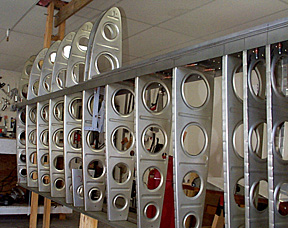
This picture is of a real plane's wing, but a balsa wood wing can be built in the same way. You trace the cross section of the wing design you want, cut it out of balsa wood with an X-Acto knive, then make multiple copies of the same piece.
Drill a hole in those pieces for a front and back spar, shish kabob the pieces, and you have exactly the wing shape you are interested in. All you have to do is cover it with plastic (like Monokote) and your wing is done, symmetrical, and just what you are looking for.
Make a few different wing designs, measure the lift, and you have a very nice science fair project.
Alan Lichtenstein, MD
Anesthesiologist
Mens et manus
Veritas
He who laughs last...Thinks slowest.
Anesthesiologist
Mens et manus
Veritas
He who laughs last...Thinks slowest.
-
deleted-71588
- Former Expert
- Posts: 1297
- Joined: Mon Oct 16, 2006 11:47 am
The problem with hanging weights is they can easily act like a pendulum and cause oscillations and make it hard to measure a balance and also affect the angle of attack.Craig, correct me if I'm wrong, but hanging the weights would also be preferable to just placing the weights in the wing, to reduce twisting of the wing on short axis as well as the long axis.
Placing the weights inside the wing (or anywhere outside of the air flow) avoids that issue.
You might consider making a "wire frame" out of some some welded steel fencing like a 6"x8". Use some wire cutters to isolate a piece that is one one frame wide by long enough to be at least twice the height of your wind tunnel. With slots in the top and bottom of your tunnel perpendicular to the wind axis, this frame would provide something to attach your test wings to. If it isn't heavy enough by itself to not vibrate too much, you could attach weight to it below the wind tunnel out of the airflow.
In order for the wind tunnel measurements to correspond to a known wing cross section, the entire length of the wing section in the wind tunnel must be the same cross section and if it warps or twists it will skew your measurements.
If you have somebody who can help you with woodworking tools that is handy with a plane (the wordworking variety) and uses poplar or ash, you can cut a wing cross section out of a 1x4x6 in 5 to 20 minutes (exluding setup and cleanup) depending on how complicated your cross section is. Counter intuitively, the thinner the cross section, the harder it is to cut. The really thin ones are easier to make by laminating balsa wood or bending sheet metal.
And yes, the Wright brothers used some sheet metal in some of their wind tunnel experiments for thin wing cross sections.
-Craig