/-/https/www.sciencebuddies.org/cdn/Files/21464/5/sb-logo.png)
/-/https/www.sciencebuddies.org/cdn/Files/21464/5/sb-logo.png)
Stopping Superbugs!
Summary
/-/https/www.sciencebuddies.org/cdn/Files/9170/5/antibiotic-superbugs-overview.jpg)
/-/https/www.sciencebuddies.org/cdn/Files/9171/5/antibiotic-superbugs-thumbnail.jpg)
Overview
If your doctor prescribes antibiotics, why do you have to take them for several days and not just once? Why do you need to finish taking them even if you feel better? If you do not follow the doctor's orders, you might contribute to the creation of antibiotic-resistant "superbugs"! In this lesson, your students will roll dice to model how bacteria respond to treatment by antibiotics, and find out what happens if treatment is stopped too early.
Learning Objectives
- Understand how natural selection leads to the predominance of certain traits in a bacterial population
- Correlate misuse of antibiotics with an increased probability of creating antibiotic-resistant bacteria
- Apply a model using probability to simulate how bacteria populations change in response to selective pressure
NGSS Alignment
This lesson helps students prepare for these Next Generation Science Standards Performance Expectations:- MS-LS4-4. Construct an explanation based on evidence that describes how genetic variations of traits in a population increase some individuals' probability of surviving and reproducing in a specific environment.
- MS-LS4-6. Use mathematical representations to support explanations of how natural selection may lead to increases and decreases of specific traits in populations over time.
|
Science & Engineering Practices
Developing and Using Models.
Develop and/or use a model to predict and/or describe phenomena.
Analyzing and Interpreting Data. Analyze and interpret data to provide evidence for phenomena. Apply concepts of statistics and probability (including mean, median, mode, and variability) to analyze and characterize data, using digital tools when feasible. Using Mathematics and Computational Thinking. Apply mathematical concepts and/or processes (e.g., ratio, rate, percent, basic operations, simple algebra) to scientific and engineering questions and problems. |
Disciplinary Core Ideas
LS4.B: Natural Selection.
Natural selection leads to the predominance of certain traits in a population, and the suppression of others.
LS4.C: Adaptation. Adaptation by natural selection acting over generations is one important process by which species change over time in response to changes in environmental conditions. Traits that support successful survival and reproduction in the new environment become more common; those that do not become less common. Thus, the distribution of traits in a population changes. |
Crosscutting Concepts
Cause and Effect.
Phenomena may have more than one cause, and some cause and effect relationships in systems can only be described using probability.
Systems and System Models. Models can be used to represent systems and their interactions—such as inputs, processes and outputs—and energy, matter, and information flows within systems. |
Materials
/-/https/www.sciencebuddies.org/cdn/Files/6689/13/dice-pot-activity-materials-edited.png)
Materials per group of 4–6 students:
- Six-sided dice (100 total), in three different colors; available at Amazon.com:
- 70 of one color (purple in the picture)
- 25 of a second color (green in the picture)
- 5 of a third color (red in the picture)
- Pot, box, or sealable plastic bag that is large and sturdy enough to hold all 100 dice. If you use a metal pot, you may also want to use a lid to cut down on the noise of rolling the dice.
- Large, flat surface for pouring 100 dice onto
- Pencil or pen
Background Information for Teachers
This section contains a quick review for teachers of the science and concepts covered in this lesson.Bacteria are microscopic, single-celled organisms that are found everywhere. They are in the environment all around us, as well as inside and outside of our bodies. Most bacteria are harmless to humans, but some can cause serious illnesses. Any microorganism that makes us sick is called a pathogen. Antibiotics are the primary treatment for fighting bacterial infections. Before the discovery of the first antibiotic, penicillin, in 1928 by Alexander Fleming, people frequently died from minor wounds and infections (things we might think of as trivial injuries, like a scraped knee). Today, penicillin is estimated to have saved between 80–200 million lives.
However, many antibiotics have lost effectiveness because bacteria has become resistant to them over time, generating bacteria that are known as superbugs. Antibiotic resistance means that the bacteria have gained the ability to resist the effects of the drug that used to kill them. According to the Centers for Disease Control and Prevention (CDC) each year at least 2 million infections and 23,000 deaths are caused by antibiotic-resistant superbugs. Carbapenem-resistant Enterobacteriaceae (CRE) and methicillin-resistant Staphylococcus aureus (MRSA) are examples of these superbugs.
/-/https/www.sciencebuddies.org/cdn/Files/9172/5/antibiotic-treatment.jpg)
Bacteria that live in the human body are killed off with antibiotics except for a few resistant cells that survive. Any cell that survives a treatment of antibiotics will stay in the body and multiply creating more bacteria that are resistant.
Figure 1. Bacteria with antibiotic resistance survive an antibiotic treatment and pass their resistance on to other bacteria.
Antibiotic-resistant bacteria can be created in several ways. One way is through mutations of their genetic material which makes them less susceptible to the drug or allows the bacteria to deal with the antibiotic before it can do any harm. Another is the misuse of antibiotics. During an antibiotic treatment, the exposure to antibiotics creates a selective pressure on the bacteria which selects for the ones that are more resistant to the drug, as shown in Figure 1. The surviving bacteria are more likely to become antibiotic resistant and replace the bacteria that have been killed.
There are many ways for antibiotic-resistant bacteria to come about, including when a person:
- takes antibiotics they do not need (e.g., the person has a viral infection, which cannot be treated with antibiotics). In this case, all the bacteria in your body—the ones that can make you sick as well as the ones that help your body to function—get unnecessarily exposed to antibiotics and can develop resistances.
- improperly disposes of antibiotics (e.g., pours them down a drain and contaminates water systems). Antibiotics in our water are a great concern as all the bacteria that come in contact with these antibiotics can become antibiotic resistant and can pass their resistance to other bacteria in the environment.
- does not take the antibiotics long enough. This might happen because the patient forgets to take the antibiotics, feels better and stops taking them early, or dislikes the side effects of the antibiotics.
- takes the antibiotics for too long. In this case, all the pathogens will already be destroyed but other bacteria in our body will still be exposed to the antibiotics and can develop resistances.
All of these situations can result in selection for bacteria that are antibiotic resistant. This selection is based on the fact that not all bacteria are genetically the same. This difference in genetic traits make some bacteria more resistant to a certain antibiotic than others. This is also explains why it is not enough to take antibiotics just once when you are sick. As some bacteria have better strategies to resist the drug, they will survive one dose of antibiotics and it will take more doses to kill them. There is little research on what the perfect treatment time for antibiotics is, especially as it is also very dependent on the bacteria that is causing the illness. However, scientists agree that either taking antibiotics for too short a time, or too long a time increases the risk of creating antibiotic resistances.
In this lesson plan, students will simulate the selection for antibiotic-resistant bacteria by rolling dice to model how bacteria respond to treatment by antibiotics during a bacterial infection. In a bacterial infection, which can contain billions of bacteria, some bacteria will have a higher likelihood of surviving the treatment than others, based on their genetic traits. Thus, students will discover that if a patient stops taking antibiotics too early, it will influence the bacteria population and help the tougher, antibiotic-resistant bacteria to grow.
Additional Background Links
- Deadly, Drug-Resistant "Superbugs" Pose Huge Threat, W.H.O. Says, The New York Times
- Get Smart: Know When Antibiotics Work in Doctor's Offices, Centers for Disease Control and Prevention
- Antibiotic/antimicrobial Resistance, Centers for Disease Control and Prevention
- Combating Antibiotic Resistance, U.S. Food & Drug Administration
- Antibiotics: An overview, Khan Academy
- Does stopping a course of antibiotics early lead to antibiotic resistance?, World Health Organization
Prep Work (15 minutes)
- For each student group, fill a pot, box, or sealable plastic bag with 100 dice (70 of one color, 25 of a second color, and 5 of a third color), as shown in Figure 2.
/-/https/www.sciencebuddies.org/cdn/Files/6690/12/dice-purple-red-green-edited.png)
Figure 2. Dice prepared for the activity (75 purple, 25 green, and 5 red).
Teacher Tool Box
Engage (20 minutes)
- Discuss with your students why we sometimes need to take antibiotics and what they do in our body. Explore how antibiotic resistances can develop, what their consequences are, and how we can prevent them. You can use the following questions to guide your students through the discussion.
 Have you ever been sick and had to take antibiotics? What are the antibiotics doing in your body?
 When you are sick, in some cases your body is infected by bacteria that cause the illness you have. Bacteria are tiny microorganisms that can be found everywhere and live inside and outside of our body. Although many bacteria are harmless or even beneficial for humans, some can make us sick. Antibiotics are drugs designed to treat bacterial infections by either killing them or slowing their growth.Doctors usually tell you to take the antibiotics for multiple days, even though you may already feel better after about three days. Can you think of a reason why it is not enough to take the antibiotics just once?When taking antibiotics, you want to take them just long enough to make sure to kill all the bacteria that make you sick. If you take them just once or stop taking them too early however, some of the bacteria might survive and become resistant to the antibiotic. Taking them too long can be just as bad since unnecessary exposure to the drug makes it more likely that bacteria will develop an antibiotic resistance. Antibiotic resistance means that the bacteria have gained the ability to resist the effects of the drug that previously used to kill them. Scientists are still debating what the best treatment duration for antibiotics is.What happens if you have antibiotic-resistant bacteria in your body?If you have an infection with antibiotic-resistant bacteria, the antibiotic will not be able to kill them, which means that the antibiotic treatment will not work. In that case, a different antibiotic or another drug that the bacteria is not resistant to might help. If more and more bacteria become resistant to antibiotics or develop resistances to multiple antibiotics, it gets more and more difficult to find a drug that works. In the worst-case scenario, the illness cannot be treated successfully with antibiotics anymore.Why would bacteria become resistant to antibiotics?Antibiotic resistance often evolves gradually during exposure to antibiotics, but can also arise spontaneously due to random genetic mutations in the bacteria's DNA. The first scenario can happen if you stop taking your antibiotics early or take them too long, as the bacteria that survived the antibiotic treatment are more likely to become resistant to the antibiotic you took. The genetic traits of a bacteria determine if they are resistant to an antibiotic. Some bacteria can even have multiple resistances to different antibiotics at the same time.How can you prevent the creation of antibiotic-resistant superbugs?The easiest way to prevent antibiotic resistance is to use fewer antibiotics and use them only when they are really necessary. Any unnecessary exposure of bacteria in our environment to antibiotics needs to be stopped. For example, common colds, which are usually caused by viruses, should not be treated with antibiotics! If you do take antibiotics for a cold, the virus will not be killed by the antibiotics because antibiotics kill only bacteria. However, the bacteria that live inside your body, such as in the gut, could still pick up antibiotic resistances from the antibiotic treatment and can pass them to other bacteria later when you have an actual bacterial infection. Also, when taking antibiotics, it is important to follow your doctor's advice on how long to take them—do not stop taking them too soon. Try to prevent bacterial infections by regularly washing your hands and following general hygiene practices.
 - Tell your students that they will use a model to demonstrate how genetic traits such as antibiotic resistance can change the bacteria population over the course of an antibiotic treatment. They will use 100 dice, which represent the bacteria in a bacterial infection (where each die roughly represents 100 million bacteria). Some of the bacteria will be more resistant to the antibiotics than others, based on their genetic differences. Rolling the dice will represent treating the infection with a dose of antibiotics. The antibiotics will create a selective pressure on the bacteria population which selects for bacteria that are more resistant to the drug.
Considering that you have 70 purple dice, 25 green dice and five red dice, which color do you think represent what kind of bacteria: non-resistant (normal bacteria), moderately resistant bacteria or super-resistant bacteria?In nature, the normal bacteria are most abundant, followed by the moderately resistant bacteria. Super-resistant bacteria are luckily still relatively rare. Therefore, the purple dice represent the normal, non-resistant bacteria; the green dice, the moderately resistant bacteria; and the red ones, the super-resistant bacteria.Which one of them is most likely to survive a dose of antibiotics?The non-resistant, or normal bacteria, are most likely to be killed by the antibiotics, whereas the moderately resistant are more likely to survive. The super-resistant bacteria are most likely to survive the antibiotic treatment.
- Explain to your students that your model will apply the concept of probability to determine the likelihood of survival for each bacteria. A probability is a number that reflects the chance or likelihood that a particular event, such as surviving the antibiotics, will occur. This is how it works: each time a patient receives an antibiotic dose, the dice are rolled (dumped out of the pot or box). The bacteria "survive" or "die" according to the rules in Table 1, which are also provided in the student worksheet:
- Normal bacteria only survive if they roll a 6
- Moderately resistant bacteria survive if they roll a 4, 5, or 6
- Super-resistant bacteria survive if they roll any number except 1
Table 1. This table shows what the different dice in the model used in this activity represent.Dice description Number of starting dice Represents Roll outcome Bacteria survive if roll Bacteria die if roll Purple dice 70 Normal bacteria 6 1, 2, 3, 4, or 5 Green dice 25 Moderately resistant bacteria 4, 5, or 6 1, 2, or 3 Red dice 5 Super-resistant bacteria 2, 3, 4, 5, or 6 1 Looking at the numbers in the table, can you tell what the different survival probabilities for each of the bacteria are?With 6 possible numbers on the die, the probability for surviving the antibiotic treatment for each bacteria is- 1 out of 6, or 16.6% for the normal bacteria (only survives when one specific number [6] shows)
- 3 out of 6, or 50% for the moderately resistant bacteria (survives when 3 different numbers [4,5,6] show)
- 5 out of 6, or 83.3% for the super-resistant bacteria (survives when 5 different numbers [2,3,4,5,6] show)
- Before you start the experiment, let your students know that they will simulate several doses of antibiotics during their experiment. It will represent a patient taking antibiotics for a prescribed, full course of 12 days. Their gathered data will allow them to model treatments for patients with antibiotic courses that are shorter than what is prescribed.
/-/https/www.sciencebuddies.org/cdn/Files/14174/23/note-question-mark-30.png)
/-/https/www.sciencebuddies.org/cdn/Files/14175/24/conversation-bubbles-30.png)
Explore (25 minutes)
- Based on previous discussions, let each student formulate his/her prediction about how many bacteria of each group will survive the whole antibiotics treatment (12 doses).
- Divide the class into groups of 4–6 students and tell them that they will be rolling the dice 12 times in total to simulate 12 doses of antibiotics for a full course.
- Walk the students through the experimental procedure described in Step 5. (A slideshow is available that you can use to guide your students through the experiments.)
- Tell your students to fill out their "Full Course of Antibiotics" data table (Table 2) every time they roll the dice. The data table is provided in the student worksheet.
| Number of Antibiotic Doses | |||||||||||||
|---|---|---|---|---|---|---|---|---|---|---|---|---|---|
| Type of Bacteria | 0 | 1 | 2 | 3 | 4 | 5 | 6 | 7 | 8 | 9 | 10 | 11 | 12 |
| Normal | |||||||||||||
| Moderately resistant | |||||||||||||
| Super-resistant | |||||||||||||
| Total number of bacteria | |||||||||||||
- To fill out the data table, have students follow these steps (as shown in Figure 3):
- Fill in the number of normal, moderately resistant, and super-resistant bacteria in the "0" antibiotic doses column. (This should be 70, 25, and 5, respectively.)
- Roll the 100 dice and carefully pour them out onto a large, flat surface.
- Separate the rolled dice into a "surviving" pile and a "died" pile based on the rules from Table 1.
- Set all the dice in the "died" pile aside. They will not be used anymore.
- Count how many dice of each color are in the "surviving" pile and record your results in your data table (Table 2).
- Place all dice from the "surviving" pile back in the pot.
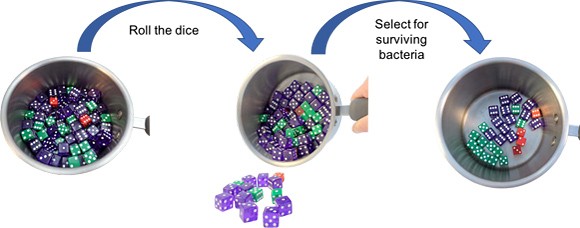
100 dice are placed in a pot and are rolled out onto a large tabletop. Any purple dice that roll a 6 are saved and placed back into the pot. Green dice that roll a 4, 5 or 6 and red dice that roll a 2, 3, 4, 5 or 6 are also placed back in the pot. These dice represent bacteria of various resistances and the probability that they will survive doses of antibiotics.
Figure 3. Rolling the dice once represents one dose of antibiotic treatment.
- Fill in the data table (in the "1" antibiotic doses column) with the results, including the total number of surviving bacteria.
- Repeat this process (Step 5) 11 more times so that 12 antibiotic doses have been modeled (or until no dice are left in the pot, if that happens sooner). Be sure students fill out the data table after each dose is modeled.
/-/https/www.sciencebuddies.org/cdn/Files/9173/6/roll-dice-antibiotic.jpg)
Reflect (20 minutes)
- Once all the students have gathered their data, let them analyze their results. Encourage the students to question and discuss their data. Possible questions for students include:
Did you manage to kill all the bacteria throughout the full course of antibiotic treatment? How many doses of antibiotics did it take to kill all the bacteria in the infection (if this happened)?Most likely all the bacteria were killed after a full course of treatment (12 doses of antibiotics). However, there is also a good chance that some bacteria survived even a full treatment.If bacteria survived your full course of treatment, which ones were they?The bacteria that survived will most likely be the super-resistant bacteria, as they are most difficult to kill.
- Let your students calculate what percentage of each bacteria type are present after each dose of antibiotics (based on the total number of bacteria that survived each dose). They should record their results in the data table provided in the student worksheet.
How did the bacteria population change over the course of the treatment? What was the reason for this change?The whole bacteria population shrank from 100 to probably 0–5 bacteria. Whereas in the beginning there were predominantly normal bacteria (70%), they should have been killed pretty fast and the moderately resistant and super-resistant bacteria should have taken over. The last surviving bacteria are the super-resistant ones. That means that the whole population shifts from predominantly normal bacteria to predominantly super-resistant bacteria. This is because their genetic traits, being super-resistant, makes them less likely to be killed by a dose of antibiotics.
- If you have time, you can combine all the groups' data into a big table on the board to reflect the entire class' data.
Did everyone see the same trend in their data? What could be the reason for different results?The trend of the results should be the same in all groups, i.e. that the normal bacteria are killed first, followed by the moderately resistant and then the super-resistant ones. However, the actual number of doses to kill each bacteria group can change from group to group, as every time the dice are rolled, the number outcome is different.
- Let your students graph the number of surviving bacteria for each treatment duration in a scatter plot (or bar graph). They should plot the number of antibiotic doses (given in Table 2) on the x-axis and the number of surviving bacteria for each group on the y-axis. A graph template is provided in the student worksheet.
How many doses did it take to completely kill each type of the bacteria?In general, it should take about 4–6 doses to kill the normal bacteria and 8–10 days to kill the moderately resistant bacteria. However, there is always the probability for outliers. The resistant bacteria are not always killed within the first 12 doses and can take up to 20 or more doses to be completely killed.What would happen if you just took one dose of antibiotics or stopped taking the antibiotics early—after 3 or 6 days, compared to 12 days?Students should see that after a full treatment (12 days) most of the bacteria have been killed. The normal bacteria are killed first, as they are not resistant to the antibiotics, but some might still survive a very short treatment time (3 days). Moderately resistant bacteria might still be present after a short course of antibiotics (6 days) but should be killed after a full treatment. Super-resistant bacteria however, can even survive a full course of antibiotics. This data should make the students aware that you need to take more than one dose of antibiotics and that if you stop taking the antibiotics too soon, bacteria can survive and potentially develop antibiotic resistances.If you were a doctor, what treatment time would you recommend to your patients, based on your results?In general, the shorter the course of the treatment, the more bacteria survive that are, or can potentially become, resistant to the antibiotic. For bacteria that are not already fully resistant to the drug, it is better to take the antibiotics long enough so they can be killed and do not develop a resistance.What other conclusions can you draw from your graph and your data?This question allows your students to reflect more on their results and come up with their own conclusions. Encourage your students to discuss their hypotheses and let them use their data to support their arguments.
Assess
You can use this quiz to assess student learning after the activity:
- Online quiz, assignable in any LMS
- Quiz (pdf) and answer key (PDF)
Make Career Connections
Discussing or reading about these careers can help students make important connections between the in-class lesson and STEM job opportunities in the real world.
/-/https/careerdiscovery.sciencebuddies.org/cdn/Files/1628/18/iStock-1203995945.jpg)

/-/https/careerdiscovery.sciencebuddies.org/cdn/Files/1365/18/iStock-1012791028.jpg)
/-/https/careerdiscovery.sciencebuddies.org/cdn/Files/1486/17/pexels-photo-4033018.jpg)
Lesson Plan Variations
- Have students repeat this activity, but start with different numbers of normal, moderately, and super-resistant bacteria. How do their results change as the number of the different types of bacteria in the initial infection changes? How many antibiotic doses are needed to get rid of an infection that is mostly super-resistant bacteria?
- Have students pick a specific antibiotic-resistant bacteria, or other microbe, and do some research on it. With an adult's help, they can try to find out how common the bacteria are, why it is resistant to antibiotics, and what treatments are used. See if students can model the treatment of an infection with this bacteria.
- Have students create a computer program to execute the model used in this activity. Doing this would allow them to easily and quickly explore many different permutations of the model. These could include adding a scenario in which bacteria can "mutate" to become more resistant to antibiotics. For example, if a certain number is rolled, the die is replaced by a more resistant bacteria (purple die replaced with a green die or green die replaced by a red die). Another variation that could be tested in a computer model is taking into account bacteria reproduction. This would mean that at certain steps throughout the procedure (or depending on the rolled number), a bacteria would double (an extra die of this color would be added).
/-/https/img.youtube.com/vi/MIS-r5K_9WE/0.jpg)
/-/https/img.youtube.com/vi/FSMbrMxCyYU/0.jpg)
/-/https/img.youtube.com/vi/6fx0PEx0g5k/0.jpg)