/-/https/www.sciencebuddies.org/Files/21464/5/sb-logo.png)
/-/https/www.sciencebuddies.org/Files/21464/5/sb-logo.png)
Summary
/-/https/www.sciencebuddies.org/Files/14750/5/ceiling-constellation.jpg)
Introduction
Can you count the stars in the night sky? People who live in rural areas can see many more stars than those who live in cities. We're all looking up at the same sky— why can some people see more stars than others? Try this activity to find out!
Materials
- Flashlight
- Black construction paper
- Scissors
- Tape
- Sharpened pencil, needle, or pin
- Room where you can control the amount of light, preferably with some variation instead of just on/off (e.g. by opening or closing the blinds or a door to another room, with a dimmer switch, or with multiple individual lights)
Prep Work
Instructions
- Cut a piece of construction paper slightly larger than the front of your flashlight.
- Poke holes in the construction paper to form a "constellation."
- Tape the piece of construction paper to the front of your flashlight.
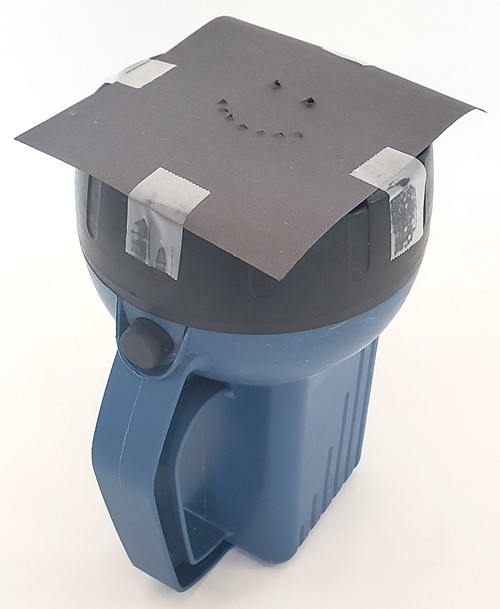
- Take your flashlight into a completely dark room. Turn off all the lights, close the doors and window blinds.
- Turn your flashlight on and aim it at the ceiling.
 What do you see?
 - If you cannot see your constellation, try the following:
- Hold your flashlight closer to the ceiling.
- Use a pencil to make the holes in your construction paper slightly bigger.
- Try a different flashlight.
- If the room has a lot of natural light, wait until nighttime to do the experiment.
- Now, try to gradually brighten the room. For example, open a single window blind partway, or turn a dimmer switch up a little bit.
- Aim your flashlight at the ceiling again.Can you still see your constellation?
- Keep increasing the amount of light in the room.At what point can you no longer see your constellation?
/-/https/www.sciencebuddies.org/Files/14751/4/flashlight-constellation.jpg)
/-/https/www.sciencebuddies.org/Files/14176/8/icon-learn-green-33x54.png)
Cleanup
What Happened?
You probably found that you could easily see your homemade constellation in a darkened room. However, as the amount of "light pollution" increased as you turned on other light sources, your constellation would gradually disappear. This is the same problem experienced by astronomers and stargazers. As human civilization as expands and we add more and more artificial lighting, we make it harder to see the stars! This makes it difficult for people to go stargazing, and harder for astronomers to take pictures of stars using telescopes.
If you tried the experiment with different size holes, you probably noticed that the smaller, fainter "stars" disappeared before the bigger, brighter ones. They get drowned out more quickly by light pollution. So stars don't just look brighter to people in rural areas—they can actually see more stars.
Digging Deeper
When you think of pollution, you might think of clouds of smog in the air or toxic waste being dumped into a river. But did you know that light can also cause pollution? The excessive use of artificial light at nighttime can drown out dimmer, natural sources of light from the stars and the Moon (note that the Moon does not generate its own light, the light is reflected from the Sun). On the ground, excessive light can disturb animals who rely on the day/night cycle to know when to eat or sleep. It can also confuse animals that use light for navigation. If you've ever had a bright light from a street lamp or neighbor's yard shine in your window at night, you also know that light pollution can make it hard for humans to sleep too!
Light pollution also causes problems for astronomers and stargazers, who look up at the night sky from Earth. When light passes through the Earth's atmosphere, some of it is scattered as it bounces off molecules in the air. Some of this scattered light bounces back towards our eyes, making it harder to see the stars. This problem is worse in urban and heavily-populated areas that have more artificial light sources at night. In this activity you experimented with making your own "constellation" to see how external light levels affected its visibility.

Ask an Expert
For Further Exploration
- Try making different size holes in your construction paper, representing stars of different brightness. Try the experiment again. Do certain "stars" disappear before others?
/-/https/www.sciencebuddies.org/Files/6076/19/icecap-polarbear.png)

/-/https/www.sciencebuddies.org/Files/12511/6/pupil-example-thumbnail.jpg)
/-/https/careerdiscovery.sciencebuddies.org/Files/902/18/iStock-1174945987.jpg)
/-/https/careerdiscovery.sciencebuddies.org/Files/1288/18/Career-Map-Environmental-Scientist.jpg)
/-/https/img.youtube.com/vi/ZWJfIdZOpP4/0.jpg)
/-/https/img.youtube.com/vi/wkbIZ9NgC3o/0.jpg)
/-/https/img.youtube.com/vi/WGlJMt5etr8/0.jpg)