/-/https/www.sciencebuddies.org/cdn/Files/21464/5/sb-logo.png)
/-/https/www.sciencebuddies.org/cdn/Files/21464/5/sb-logo.png)
Summary
/-/https/i.ytimg.com/vi/jzdC6PnuFKU/maxresdefault.jpg)
/-/https/www.sciencebuddies.org/cdn/Files/20511/4/google-classroom.png)
/-/https/www.sciencebuddies.org/cdn/Files/20512/4/ms-teams.png)
/-/https/www.sciencebuddies.org/cdn/Files/20469/4/Canvas_Bug_Color_RGB.png)
/-/https/www.sciencebuddies.org/cdn/Files/20470/5/Schoology-Logo.png)
/-/https/www.sciencebuddies.org/cdn/Files/20471/4/lms.png)
/-/https/www.sciencebuddies.org/cdn/Files/20469/4/Canvas_Bug_Color_RGB.png)
/-/https/www.sciencebuddies.org/cdn/Files/20470/5/Schoology-Logo.png)
/-/https/www.sciencebuddies.org/cdn/Files/20471/4/lms.png)
Overview
In this lesson, students will model how traits are passed on from parents to their offspring by creating baby aliens based on their parents' traits. As students compare the physical features of their alien families, they will be able to make the connection between an organism's genotype and phenotype. Students will also learn the difference between dominant and recessive traits.
Learning Objectives
- Simulate genetic transmission from parents to their offspring using a model.
- Describe how genetic variation is caused by sexual reproduction.
- Explain the connection between an organism's genotype and phenotype.
NGSS Alignment
This lesson helps students prepare for these Next Generation Science Standards Performance Expectations:- MS-LS3-2. Develop and use a model to describe why asexual reproduction results in offspring with identical genetic information and sexual reproduction results in offspring with genetic variation.
|
Science & Engineering Practices
Developing and Using Models.
Develop and use a model to describe phenomena.
Constructing Explanations and Designing Solutions. Apply scientific ideas, principles, and/or evidence to construct, revise and/or use an explanation for real-world phenomena, examples, or events. Analyzing and Interpreting Data. Analyze and interpret data to provide evidence for phenomena. |
Disciplinary Core Ideas
LS1.B: Growth and Development of Organisms.
Organisms reproduce, either sexually or asexually, and transfer their genetic information to their offspring.
LS3.A: Inheritance of Traits. Variations of inherited traits between parents and offspring arise from genetic differences that result from the subset of chromosomes (and therefore genes) inherited. LS3.B: Variation of Traits. In sexually reproducing organisms, each parent contributes half of the genes acquired (at random) by the offspring. Individuals have two of each chromosome and hence two alleles of each gene, one acquired from each parent. These versions may be identical or may differ from each other. |
Crosscutting Concepts
Cause and Effect.
Cause-and-effect relationships may be used to predict phenomena in natural systems.
|
Materials
/-/https/www.sciencebuddies.org/cdn/Files/15509/5/alien-genetics-materials.jpg)
For teacher:
- Printout of Physical Traits Images
- Printout of Sibling Images
For each student:
- Printout of the Alien Genotype Table and Alien Phenotype Table
- Construction paper, different colors (orange and green must be included)
- Scissors
- Tape
- Glue
- Markers, crayons, or coloring pens
- Pencils
- Two coins
You can also let students draw their alien babies instead of building them from construction paper. In this case, the construction paper, scissors, tape, and glue are not necessary.
Background Information for Teachers
This section contains a quick review for teachers of the science and concepts covered in this lesson.It was Gregor Mendel, a monk and scientist, who first discovered in the 1860's that some traits are passed down from generation to generation in very clear and predictable patterns. Today, we know that offspring inherit half of their DNA from each parent. Thus, our genome contains two copies of every gene (one copy from the mother and one copy from the father). Many genes come in several different versions, called alleles. Alleles, or gene variants, arise when the DNA sequence of a gene is changed due to mutations. This means that no two people have the exact same set of genes (identical twins come the closest, but even they have differences). Siblings, who originate from the same genetic material (their parents' DNA), share some traits, but others are different. This is because each parent has two copies of every gene and either copy can be passed on to their offspring. Which gene a given offspring will get is random, and thus can vary from sibling to sibling. As a result, each of the siblings will only share part of their genes, and thus traits, with the other siblings.
When you have inherited two identical alleles (or gene variants), you are said to be homozygous for that gene. People with two different alleles are heterozygous for that gene. The set of alleles a person has is called their genotype. A genotype determines the phenotype, the observable characteristics (or traits) that the genotype codes for. Some traits, called Mendelian traits, are due to a single gene. Two examples of Mendelian traits are a cleft chin or face freckles. In genetics, scientists often abbreviate such traits with letters. These letters are often chosen so they relate to the trait, like the letter F to represent face freckles. Sometimes a gene only has two alleles, one of which is dominant and the other recessive. If you have just one copy of a dominant allele, you will display that trait. Scientists denote a dominant allele by a capital letter (F versus f). You need two copies of a recessive allele to display that trait. Recessive alleles are usually denoted by a lowercase letter (f versus F).
Because alleles are randomly assigned during sex cell production, offspring can end up with different combinations of alleles relative to one another. If you know the alleles of the parents, you can predict the probability of an offspring having a particular set of alleles. For Mendelian traits, scientists use a Punnett square diagram to visualize the alleles of parents and their offspring (Figure 1).
/-/https/www.sciencebuddies.org/cdn/Files/15510/5/punnett-square1.png)
A square with four boxes. Uppercase F and lowercase f are on the left side of the square. Uppercase F and lowercase f are the top of the square. In the square: Uppercase F and uppercase F in the first box on the top. Uppercase F and lowercase f in the second box on the top. Lowercase f and uppercase F in the first box on the bottom. Lowercase f and lowercase f in the second box on the bottom.
Figure 1. A Punnett square visualizes the possible combinations (green) of maternal alleles (red) with paternal alleles (blue). In this example, F is the dominant allele for face freckles, whereas f represents the recessive allele for no face freckles.
Figure 1 shows that parents with a dominant phenotype can have offspring with either the dominant or the recessive phenotype. Scientists can use these rules of inheritance to examine generations within a biological family and discover the mode of inheritance for a specific human trait. To do this, scientists create family trees, called pedigrees, showing as many generations of a biological family as they can and marking who has which phenotype. Human pedigrees are also a powerful screening tool for certain diseases. Exactly like physical traits, genetic disorders of human beings that originate from a gene defect can be dominant or recessive. By examining a pedigree for where genetic diseases arise, scientists can deduce how the condition is inherited.
In this lesson, students will model how traits are passed on from parents to their offspring by creating baby aliens based on their parents' traits. As students compare the physical features of their alien families, they will be able to make the connection between an organism's genotype and phenotype. Students will also learn the difference between dominant and recessive traits.
Additional Background Links
- Mendelian Genetics: Patterns of Inheritance and Single-Gene Disorders, from Nature Education
- Identical Twins' Genes Are Not Identical, from Scientific American
- Probability of Inheritance, from Palomar College
- Rare Genetic Disorders: Learning About Genetic Disease Through Gene Mapping, SNPs, and Microarray Data, from Nature Education
Prep Work (15 minutes)
- Print out the Alien Genotype Table and Alien Phenotype Table for each student.
- Print out the Physical Traits Images and the Sibling Images.
- Prepare all necessary materials for each student group.
Teacher Tool Box
Engage (25 minutes)
Notes:
- If students have already learned about dominant and recessive genes, have them summarize the concept of dominant versus recessive gene variants and then jump straight into the Explore section.
- Note: There might be students in your class who do not know or do not live with both or either of their biological parents. Be sensitive to these students and also be mindful of traits that include race, body weight, etc.
- While engaging your students in the topic, make sure to write every new vocabulary term that comes up on the board and define it with or for your students.
- Show students the two sibling images. Then ask them:
 Do you think these two girls, or these two boys are siblings?Why do you think they are siblings? Why do you think they are not siblings?
 Collect students' replies. Emphasize replies that point out how the two girls look very similar and the boys do not.
 - Tell students that today they will learn about traits. Define traits as a person's distinguishing characteristics or physical traits.
Can you name some traits that differentiate one person from another?Have students list some traits. They might mention physical traits such as eye color, hair color, height, etc. Be mindful of traits like race, body weight, etc.
- Show students the images of physical traits in humans. Tell them that these are some examples of characteristic traits in humans. As you show the images, ask students about each specific trait, so they can compare traits with each other as you ask the following questions.
Who writes with their right (left) hand?Who has (does not have) face freckles?Who has curly, straight, or wavy hair?Who has brown, black, red, or blond hair?Who has blue, brown, or green eyes?Have students raise their hands to signal that they have that specific trait. Keep track of how many students have each trait on the board. You can make a histogram of the data to show the class's diversity of traits.Did you notice that many of you have a different set of traits? Why do you think this is the case?Have students share their ideas. Use their responses to point out that every person has two copies of the same gene, which they inherit from their biological parents (one gene from the mother and one gene from the father). Those genes encode different traits like the ones they just talked about. Many human traits are controlled by genes. There are different versions of each gene. Each variant of a gene is called an allele. And the alleles (or variants) you inherit from your biological parents determine the traits you exhibit.
- Present some example scenarios with a specific trait to your students. To make these examples more concrete for your students, you can show images of famous couples that match the scenario. For example, for scenario A, you could show a picture of Prince Harry and Meghan Markle.
- Let's say a mother with face freckles and a father with face freckles have a baby.
Do you think the baby will also have face freckles?Let students show by raising their hands if they think the baby will have face freckles or not.
- Another mother and father, neither with face freckles, have a baby.
Do you think the baby will have face freckles?Again, let students show by raising their hands if they think the baby will have face freckles or not.
- What about a mother who has face freckles and a father who has no face freckles?
Do you think their baby will have face freckles?Again, let students show by raising their hands if they think the baby will have face freckles or not.
- Let's say a mother with face freckles and a father with face freckles have a baby.
- Tell students that today they will do an activity that helps them answer all these questions. Explain that it is not always obvious what trait a baby will have, even if you know the traits of the parents. This is because some traits are dominant, and some traits are recessive. Define what these terms mean. A dominant trait or allele overrides the effect of the other gene variant. This means that if a person has two different variants of the same gene, the person will exhibit the trait of the dominant allele. On the other hand, if an allele is recessive, it is masked by the dominant gene. A recessive trait only becomes visible if a person has two copies of the recessive gene variant.
- Again, demonstrate this concept. Use the face freckle example as before. Introduce students to the fact that traits are often abbreviated with a letter (for example F/f for face freckles). The dominant allele or gene variant is written with an uppercase letter (F), whereas the recessive allele is written with a lowercase letter (f). Tell students that face freckles are a dominant trait.
What gene combinations could a person with freckles have?Two dominant freckle genes (FF) or a dominant and recessive gene combination (Ff). In this case, the dominant allele overrides the recessive allele. Point out that a person with two different gene variants is called a heterozygote for that gene.What gene combination could a person with no freckles have?Two recessive freckle genes (ff). Point out that a person with two identical gene variants is called a homozygote for that gene.So, does that mean that parents who both have face freckles will always have a baby with face freckles as well?Listen to students' responses. Guide them to conclude that it depends on the set of freckle genes the parents have if the baby will have face freckles or not. Introduce the terms genotype and phenotype. A genotype generally refers to the entire set of DNA instructions for an organism, but it is sometimes used to refer to a set of genes or alleles that is responsible for a particular trait. The phenotype is an organism's observable characteristics or traits. This means that a person's genotype determines a person's phenotype.
- Tell students that they will now do an activity to model how traits are passed on from parents to their offspring and how an individual's phenotype is determined by its genotype.
/-/https/www.sciencebuddies.org/cdn/Files/14174/23/note-question-mark-30.png)
/-/https/www.sciencebuddies.org/cdn/Files/14175/24/conversation-bubbles-30.png)
Explore (45 minutes)
- Divide students into pairs and provide each group with all the materials they need.
- Explain to students that in the following activity, they will create a baby alien based on its parents' genotypes for 10 different traits. Point students to the Alien Genotype Table and the Alien Phenotype Table. Together with your students, go through each of the listed traits. Make sure students understand the table. You can do this by asking questions such as:
Based on your table, is green skin color a dominant or recessive trait?It is a dominant trait (uppercase letter).How many toes would an alien that has a dominant toe gene variant have?Two toes, as this is the dominant allele.Looking at the alien mom's finger genotype, how many fingers does she have?She has three fingers, as she has the dominant finger gene variant (allele).
- Once you are sure that students understand the information provided in the tables, have them look at the genotypes of both parents.
What do you notice when looking at the genotypes of both parents for all traits?Let each student pair briefly discuss the question and then share with the class. Students should notice that both parents have the exact same genotypes for all traits. Also, they have both a dominant and a recessive allele or gene variant for each trait. This means they are heterozygotes for all traits.
- Ask the student-pairs to fill out the phenotype table for both of the alien parents. Based on their genotypes, what do the alien mom and alien dad look like?
- Have the student-pairs draw the alien mother and the alien father based on their phenotypes, as shown in Figure 2.
/-/https/www.sciencebuddies.org/cdn/Files/15511/5/alien-parents.jpg)
Figure 2. Example drawings of the alien mother and alien father.
- Then tell students that they will now create an alien baby from these two parents.
How can we determine which gene variant or allele is passed on to the baby from each of the parents?Collect students' ideas. Remind them that the baby will receive one gene variant from each parent. It is random which gene variant is passed on. There is a 50/50 chance of each gene being passed on to the child. Explain that they will do a coin toss to decide which gene is passed on from which parent.
- Provide each student-pair with two coins. One coin represents the alien dad, the other coin represents the alien mom. Students will toss the coin for each trait to find out which of the two alleles is passed on. Heads means the dominant allele is passed on, tails means the recessive allele is passed on.
- Instruct student-pairs to toss the two coins for each of the traits listed in the Alien Genotype Table. After each coin toss, they should fill in the resulting genotype for the alien baby, as shown in Figure 3.
/-/https/www.sciencebuddies.org/cdn/Files/15512/5/genotype-table.jpg)
Figure 3. Example of a filled-out genotype table.
- Once students have created their alien baby by determining its genotype for all listed traits, have them fill out the baby's phenotype in the Alien Phenotype Table, based on the baby's genotype (Figure 4).
/-/https/www.sciencebuddies.org/cdn/Files/15513/5/phenotype-table.jpg)
Figure 4. Example of a filled-out phenotype table.
- Now it is time for students to actually create their baby alien (Figure 5). Ask student-pairs to either draw or construct their alien baby from the materials they have been given. The phenotype of the baby alien should tell them how the baby alien looks. Tell students that they can choose traits that are not listed on the table, such as length of arms or legs, the eye color, etc. themselves. Note: if you are short on time, it might be preferable to let the students draw the baby aliens instead of creating them from construction paper.
/-/https/www.sciencebuddies.org/cdn/Files/15514/6/alien-baby.jpg)
Figure 5. Built alien baby, based on the phenotype table in Figure 3.
Reflect (20 minutes)
- Ask three student-pairs to bring their baby aliens, as well as one drawing of the parent aliens, to the front. Hold all three baby aliens, as well as the drawing of the alien parents, up for everyone to see. Point out that all three baby aliens came from the same parents. This means that the three aliens are siblings (Figure 6). Start a discussion based on the following questions.
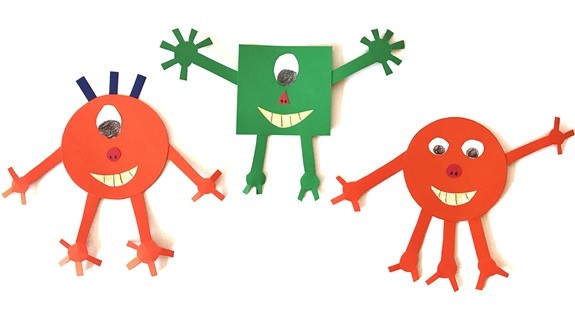
Figure 6. Example of three alien siblings.When you look at the three baby alien siblings and their parents, what do you notice first?How different do the three alien siblings look from each other?How similar or different do the alien babies look compared to their parents?Do any of them have traits that the parents don't have?Have students share their observations. Students will probably notice that although all three baby aliens come from the same genetic material, the siblings don't look the same. They share traits, but they also have different traits from each other. The same is true when comparing the babies to their parents. Most likely the alien babies show some traits that the parents have and some that they don't have. Have students identify which these traits are. They can color the matching and non-matching trait in their tables respectively (see Figures 3 and 4).Why is it possible that the baby aliens show traits that are different from their parents?Listen to students' reasoning. Guide them to conclude that each alien baby inherited one gene variant from each of their parents. As both parents are heterozygotes for each trait, there are many different possibilities of what gene combinations the baby can inherit. A baby alien shows a different trait only if it inherits both recessive gene variants for a specific trait from each of its parents. If there is time you can introduce the Punnett square (Figure 1) at this point, which visualizes the possible combinations of maternal with paternal alleles. - Make students aware that in reality, genetics is not as simple as was demonstrated in the alien example. Usually parents don't have the exact same genotype, as both of the alien parents had in this activity.
How would the appearance of the alien babies change if the genotype of the parents were different; for example, if both parents were homozygous for the recessive skin color (orange)?Students will probably point out correctly that in this case all the alien babies would be orange as well. You can make a Punnett square again to demonstrate that.Do you think that every trait is a Mendelian trait (linked to only one single gene) as we assumed for the aliens?Point out that this was also simplified in their activity. Most traits are dependent on many different genes. For many traits it is not even clear if they have a genetic link or what these links are. In addition, there are also other forms of dominance, such as incomplete dominance, in which a gene variant has a partial effect, and co-dominance, in which different variants on each chromosome both show their associated traits.
- Come back to the pictures of the two girls and the two boys that you showed in the beginning. Ask students:
Based on what you have learned, why do you think some siblings look more alike than others?Let students share their thoughts. Guide them to conclude that how similar their phenotype is depends on their genotype. Identical twins, for example, share the same genotype, which is the reason why they also share all their traits. Other siblings can have different mixtures of alleles from their parents, which means that they don't share all the traits with each other. The random mixing of parent genes results in gene variation, which is visible in their offspring.
- Close the lesson by telling students that genetics is very complex, but that you can learn a lot by studying it. For example, studying the genotypes of patients can provide a lot of information about genetic diseases. Such diseases can be caused by certain gene variants. Examples of such genetic diseases are cystic fibrosis or sickle cell anemia. Both of these diseases are linked to one specific gene variant. Whether a gene defect is dominant or recessive determines if a person will actually have the disease. There are many other traits or diseases that are controlled by multiple genes and figuring out what those genes are and the traits or diseases they lead to help us make medicines to address the disease symptoms.
/-/https/www.sciencebuddies.org/cdn/Files/15508/5/lp-alien-siblings.jpg)
Make Career Connections
Discussing or reading about these careers can help students make important connections between the in-class lesson and STEM job opportunities in the real world.
/-/https/careerdiscovery.sciencebuddies.org/cdn/Files/1338/23/pexels-photo-3958380.jpg)

/-/https/careerdiscovery.sciencebuddies.org/cdn/Files/1171/18/pexels-photo-4033151.jpg)
Lesson Plan Variations
- Ask your students to create another generation of aliens from one of the babies they made and another alien with a random genotype. Then have them make a pedigree of their alien family and trace individual traits through the different generations.
- Introduce the concept of gene mutations and create a random gene mutation in a baby alien, which would result in a new trait that hasn't been there before (e.g. blue color, three eyes, etc.). Then create more generations of aliens and find out how the mutation gets passed on.
- Change the genotypes of the parent aliens. What happens if one parent has only recessive or only dominant gene variants for all traits?
/-/https/img.youtube.com/vi/9Fv0-501msc/0.jpg)
/-/https/img.youtube.com/vi/nhgNh3BdMsc/0.jpg)
/-/https/img.youtube.com/vi/mn_-XdmyMuA/0.jpg)