/-/https/www.sciencebuddies.org/cdn/Files/21464/5/sb-logo.png)
/-/https/www.sciencebuddies.org/cdn/Files/21464/5/sb-logo.png)
How Gene Mutations Change Your Ability to Taste
Summary
/-/https/www.sciencebuddies.org/cdn/Files/11780/9/PTC-test-main-thumbnail.jpg)
/-/https/www.sciencebuddies.org/cdn/Files/11779/10/PTC-test-main.jpg)
Overview
Explore genetic variation through the world of taste in this problem-solving lesson plan. Working both individually and collaboratively, students figure out what kind of tasters they are, what this means about their own genetics, and how genetic mutations can lead to functional differences. This activity provides a hands-on, personalized opportunity to learn about how genotypes and phenotypes align.Learning Objectives
- Understand the relationship between genotype and phenotype
- Describe how single nucleotide mutations sometimes lead to protein changes
- Explain how traits are inherited
- Understand causes of genetic variation
NGSS Alignment
This lesson helps students prepare for these Next Generation Science Standards Performance Expectations:- MS-LS3-1. Develop and use a model to describe why structural changes to genes (mutations) located on chromosomes may affect proteins and may result in harmful, beneficial, or neutral effects to the structure and function of the organism.
- MS-LS3-2. Develop and use a model to describe why asexual reproduction results in offspring with identical genetic information and sexual reproduction results in offspring with genetic variation.
|
Science & Engineering Practices
Asking Questions and Defining Problems.
Ask questions that arise from careful observation of phenomena, models, or unexpected results, to clarify and/or seek additional information.
Analyzing and Interpreting Data. Analyze and interpret data to provide evidence for phenomena. Constructing Explanations and Designing Solutions. Apply scientific reasoning to show why the data or evidence is adequate for the explanation or conclusion. Engaging in Argument from Evidence. Construct, use, and/or present an oral and written argument supported by empirical evidence and scientific reasoning to support or refute an explanation or a model for a phenomenon or a solution to a problem. |
Disciplinary Core Ideas
LS3.A: Inheritance of Traits
Genes are located in the chromosomes of cells, with each chromosome pair containing two variants of each of many distinct genes. Each distinct gene chiefly controls the production of specific proteins, which in turn affects the traits of the individual. Changes (mutations) to genes can result in changes to proteins, which can affect the structures and functions of the organism and thereby change traits.
Variations of inherited traits between parent and offspring arise from genetic differences that result from the subset of chromosomes (and therefore genes) inherited. LS3.B: Variation of Traits In addition to variations that arise from sexual reproduction, genetic information can be altered because of mutations. Though rare, mutations may result in changes to the structure and function of proteins. Some changes are beneficial, others harmful, and some neutral to the organism. |
Crosscutting Concepts
Structure and Function.
Complex and microscopic structures and systems can be visualized, modeled, and used to describe how their function depends on the shapes, composition, and relationships among its parts, therefore complex natural structures/systems can be analyzed to determine how they function.
Cause and Effect: Mechanism and Prediction. Cause and effect relationships may be used to predict phenomena in natural or designed systems. |
Materials
/-/https/www.sciencebuddies.org/cdn/Files/11781/13/PTC-test-materials.jpg)
Materials for each student:
- Paper test strip, control (1); available from Carolina Biologial.
- Paper test strip, PTC (1); available from Carolina Biological.
- Handouts with "taster" or "non-taster" gene sequence (2 sequences per student). Each student gets two sequences dependent on his/her observed phenotype ("taster," "non-taster," or "in-between").
- Stickers or colored armbands, etc., that you can use to color-code students according to their phenotype.
Background Information for Teachers
This section contains a quick review for teachers of the science and concepts covered in this lesson.The genetic material within our cells, our genome, plays a large role in determining our traits, such as how we look and how we function. Every person—with the exception of identical twins, triplets, etc.—has a unique set of genes inherited from their parents. These genes consist of DNA (deoxyribonucleid acid). DNA is a genetic code that is made up of four different nucleotides that each include a different base molecule: adenine (A), thymine (T), guanine (G), and cytosine (C). The nucleotides are organized in a double helix structure, made up of two complimentary DNA strands: the sense, or coding, strand, and the antisense strand. The antisense DNA strand is turned into RNA (ribonucleic acid) in our bodies in a process called transcription.
The resulting RNA has the same sequence as the sense strand of the DNA; the only difference is that in RNA, a nucleotide called uracil (U) substitutes for each thymine molecule. The RNA then goes through a process called translation to turn into amino acids (Figure 1). During translation, every three RNA nucleotides encodes a single amino acid. This set of three nucleotides is called a codon, and different codons may code for the same amino acid, as shown in Figure 2. In the end, a sequence of DNA is turned into a sequence of amino acids joined together in a long chain, which is called a protein. Proteins are responsible for most our cell function.
/-/https/www.sciencebuddies.org/cdn/Files/11782/9/DNA-to-protein.png)
Figure 1. A DNA sequence is first transcribed into RNA, and then translated into a protein.
/-/https/www.sciencebuddies.org/cdn/Files/11783/11/dna-152136_1280.jpg)
Figure 2. In the genetic code, every nucleotide triplet (codon) encodes for one amino acid. Some codons are "stop" codons, which signal the end of a protein.
Many things can happen during this process that can result in an altered structure of the protein or prevent a gene from turning into a functional protein. For example, if a single DNA nucleotide is mutated in a gene from an adenine (A) to a guanine (G), this may cause the wrong amino acid to be made. This is called a missense mutation. If the wrong amino acid is made and assembled into a long chain of amino acids, the resulting protein might have different properties than intended, or might not work at all. This is because different amino acids have different characteristics, which affects how they interact with each other as well as the molecules that surround them. Other single DNA nucleotide mutations might not lead to a change in the amino acid sequence, in which case they are called silent mutations and do not have any effects on the protein function.
Gene mutations may result in the same gene occurring in slightly different versions. These variants are called alleles. For example, a gene that encodes for a flower's color can have a purple-flower allele or a white-flower allele. The set of alleles that a person inherits make up the individual's genotype. As each person inherits two alleles—one from each parent —these two alleles can be the same, in which case the person is called a homozygote, or different, which is called a heterozygote. The traits, or observable characteristics such as color, shape, behavior, or other properties of an organism that result from the expression of its genotype, is called the phenotype. In the flower color example, this would mean that depending on what alleles are present in the plant, its phenotype (flower color) would be purple or white. This is simple if a plant has two purple alleles or two white alleles, but what if it has one white and one purple allele? In this case, it depends on which allele is dominant and which is recessive. The dominant allele always determines the phenotype, which explains why different genotypes can produce the same phenotype.
Over time, numerous mutations have created a great variety of alleles in the human genome, which is the reason for the genetic variety we see. In this lesson plan, students will explore how mutations in a taste receptor gene have resulted in two phenotypes, a "taster" and a "non-taster," with respect to a certain chemical called phenylthiocarbamide, or PTC. Depending on alleles present in their genome, students will either be able to taste bitterness in the PTC sample, or will not detect a taste in the PTC at all. Researchers have found that this difference is based on three single nucleotide mutations in the PTC receptor gene. Students will find out if they are a PTC "taster" or "non-taster" and will explore the reason for the two different phenotypes.
Additional Background Links
- Help Me Understand Genetics, NIH U.S. National Library of Medicine
- How Genes Work, NIH U.S. National Library of Medicine
- Using a Single-Nucleotide Polymorphism to Predict Bitter-Tasting Ability, DNA Learning Center
- Patterns of Inheritance, Genetics Generation
Prep Work (10 minutes)
- Prepare one control paper test strip and one PTC paper strip for each student.
- Print out enough copies of the with "taster" and "non-taster" handouts to provide every student with two copies of each.
- Note: Make sure your students are familiar with the terms on the vocabulary sheet before you start this activity. If you need to refresh their knowledge, you can assign or show them these videos in advance:
/-/https/i.ytimg.com/vi/gG7uCskUOrA/maxresdefault.jpg)
/-/https/www.sciencebuddies.org/cdn/Files/20511/4/google-classroom.png)
/-/https/www.sciencebuddies.org/cdn/Files/20512/4/ms-teams.png)
/-/https/www.sciencebuddies.org/cdn/Files/20469/4/Canvas_Bug_Color_RGB.png)
/-/https/www.sciencebuddies.org/cdn/Files/20470/5/Schoology-Logo.png)
/-/https/www.sciencebuddies.org/cdn/Files/20471/4/lms.png)
/-/https/www.sciencebuddies.org/cdn/Files/20469/4/Canvas_Bug_Color_RGB.png)
/-/https/www.sciencebuddies.org/cdn/Files/20470/5/Schoology-Logo.png)
/-/https/www.sciencebuddies.org/cdn/Files/20471/4/lms.png)
/-/https/i.ytimg.com/vi/a4XhoB3YjnU/maxresdefault.jpg)
/-/https/i.ytimg.com/vi/zNEtVaNQ0s8/maxresdefault.jpg)
/-/https/i.ytimg.com/vi/MOtRqBs0jxE/maxresdefault.jpg)
Teacher Tool Box
Engage (20 minutes)
- Inform your students that you will perform a taste test with them. Tell them that the taste test is based on an observation that a scientist (Arthur Fox) made in the early 1930s when he synthesized a harmless chemical called phenylthiocarbamide (PTC). When he filled a bottle with the powder, some escaped into the air and his colleague complained that it tasted really bitter. However, Arthur Fox himself could not taste anything at all. This made him curious, and they performed a test to see how many people were PTC "tasters" or "non-tasters." Let your students know that they will get two taste strips: one control strip without PTC, and the other one with PTC.
- Hand one control strip to each student, but do not tell them it is the control. Let your students know that everybody got the same taste strips.
- Ask your students to taste the strip by holding it at one end and laying the other end on their tongue. Ask them to write in their worksheets what the strip tastes like. Students should remove the paper strip from their tongue once they are done.
 Can you describe the taste of the paper strip?
 Students should not notice any obvious taste and will probably say that it tastes like paper.
 - Next, hand out the PTC taste strips. Again, do not tell them that this one is the one with PTC. Have the students put the PTC taste strip on their tongue and ask them to write down what it tastes like to them.
Can you describe the taste of the paper strip?Student reactions will vary. They will respond differently to the taste of PTC. Some might find it to taste extremely bitter, and others will not taste it at all. You can ask students that have a strong reaction to the strip what they tasted, then ask the other students if they had a different reaction to the strip.
- Point out that some students clearly had a reaction to the PTC taste strips, whereas others did not. Ask your class to form "taster" and "non-taster" groups. Everybody who thought the PTC taste strip tasted bitter is in the "taster" group, and students who did not taste a significant difference from the control are in the "non-taster" group. If there are students who cannot decide, they can form an "in between" group.
Why do you think some of you reacted differently to the second taste strip? Why do you think some of you tasted bitterness and others did not?Let students come up with their own answers. You can guide the discussion by asking follow-up questions such as "How do we taste?," "Why can we taste different tastes such as salty, sweet, or bitter?," or "Which part of our body is responsible for our taste?"
- Tell your students that the second taste strip contained the chemical phenylthiocarbamide, or "PTC." Our tongues have special cells called taste receptors that can taste salty, sweet, or bitter. Whether we have a receptor that can taste PTC is determined by our genes, or more specifically, the PTC receptor gene that we have in our genome, just like how we have genes that determine the color of our hair or eyes.
- Explain to your students that they will do an activity in which they explore this specific receptor gene to find out why some people can taste PTC but others cannot.
/-/https/www.sciencebuddies.org/cdn/Files/14174/23/note-question-mark-30.png)
/-/https/www.sciencebuddies.org/cdn/Files/14175/24/conversation-bubbles-30.png)
Explore (40 minutes)
Optional: If you have classroom resources that include biotechnology equipment such as PCR machines and a gel electrophoresis apparatus, you can add a biotechnology laboratory experiment to this investigation using the Carolina Biological kit and following the instructions in the user manual. Your students should be familiar with the concepts of DNA extraction, PCR, restriction digest, and gel electrophoresis. Otherwise, proceed with step 1.
- Color code every student of each group ("taster," "non-taster," and "in between") so their phenotype is visible to everyone. You could use different colored stickers or armbands to do that.
- Tell your students that depending on their phenotype ("taster," "non-taster," or "in between"), each of them will receive two sheets of paper that includes the full DNA sequence of the PTC receptor gene. The gene sequences represent the genotype that they inherited from their parents (one sheet represents the allele from their father, the other from their mother).
- Hand out the gene sequences to the students.
- Give every student in the "non-taster" group two sheets of the non-taster handout, so their genotype becomes "tt."
- Give half of the students in the "taster" group two taster handouts ("TT"), and the other half one taster handout and one non-taster handout ("Tt").
- If there is a third group, they can get a random set of either two "non-taster" sheets ("tt") or one "taster" and one "non-taster" sheet ("Tt").
- Once every student is color-coded and has their two gene sequences, ask them to walk around and talk to other students to compare their phenotypes ("taster," "non-taster," or "in between"), genotypes ("TT," "Tt," or "tt"), and the two gene sequences. The color coding helps students to identify those who have either the same or a different phenotype than themselves. Encourage them to ask questions and discuss their different phenotypes/genotypes and the differences between the taster and non-taster gene sequence and what consequences the discovered gene mutations might have. Also, hand out the vocabulary sheet and remind your students that they can look up terms if they have trouble remembering them. These questions might help students to initiate discussions with each other.
Are both of your gene sequences the same, or do you have two different PTC taster alleles? If they are different, how are they different?Do all phenotypes ("taster"/"non-taster") have the same genotype (meaning that both gene sequences for one phenotype are always the same)? If not, why do you think there is a difference and what does the difference mean?Is there a difference between the taster and non-taster sequence? If yes, which codons (triplet base pairs) have mutated? Note: If a student has two of the same gene sequences, he/she has to find another student with the other gene sequences to find the differences.
- After 20 minutes, ask the students to write down their findings into the tables provided in their worksheet, then ask them to share their findings with the class. Write the same tables on the blackboard to summarize their observations about the different genotypes (Table 1) and the different gene sequences (Table 2).
Swipe left to see more
Table 1. For each phenotype, enter all the observed genotypes (Tt, tt, or TT).Phenotype All observed genotypes Taster Non-taster In between
Swipe left to see more
Table 2. Write down each codon (nucleotide triplet) that shows mutations between the taster and non-taster gene.Codon number Taster gene sequence Non-taster gene sequence Students should find that all the non-tasters have the "tt" genotype whereas tasters can have the "TT" or "Tt" genotype. The in between group can have "Tt" or "tt."Several codons differ between the taster and non-taster genes. There are three single nucleotide changes that have been scientifically linked to the tasting and non-tasting phenotype respectively: codon 49 (GCA to CCA), codon 262 (GTT to GCT) and codon 296 (ATC to GTC). The other mutations (codon 83 [AAG to AAA], codon 117 [TAC to TAT], codon 164 [AGC to AGT], and codon 214 [GGG to GGC]) are not based on scientific findings, but have been introduced in this lesson plan for educational purposes.Now that we know that there are several nucleotide differences between the taster and non-taster gene sequences, do you think these mutations cause any change in the resulting protein? How could we find out?If students are familiar with the genetic code, they will most likely suggest translating the nucleotide sequence into an amino acid sequence using the genetic code chart. This way, they can compare if the nucleotide mutations result in a change of the amino acid sequence of the receptor protein. - Let your students translate the mutated codons into the respective amino acid of the PTC receptor protein using the genetic code chart in their worksheet. They should enter their results in the table provided in the student worksheet.
Did any of the mutations change the amino acid sequence of the receptor protein? If yes, what are the changes?Are there any mutations that did not lead to an amino acid change? If yes, what is the difference between these mutations versus the mutations that changed the amino acid sequence?There should be three codons that resulted in an amino acid change:
- Codon 49: change from GCA (Alanine - A) to CCA (Proline - P)
- Codon 262: change from GTT (Valine - V) to GCT (Alanine - A)
- Codon 296: change from ATC (Isoleucine - I) to GTC (Valine - V)
The other mutations (codons 83, 117, 164, and 214) should not have resulted in a change of the amino acid sequence of the receptor protein. There are silent mutations that do not change the phenotype, and mutations that do change the phenotype. Examples are missense mutations that result in an amino acid change or nonsense mutation that change an amino acid into a stop codon which cuts off the protein early. Silent mutations often involve the third base of a codon, which usually does not change the encoded amino acid.
- Once all the students have finished translating the mutated codons, collect their results in a table on the blackboard.
Swipe left to see more
Table 3. Enter all the mutated codons and their respective encoded amino acids to see if the mutations result in an amino acid change.Codon number Taster Gene Codon Encoded Amino Acid Non-taster Gene Codon Encoded Amino Acid Change of Amino Acid
(yes/no)
Reflect (30 minutes)
- Start a discussion with the class about their results. The following questions might help analyze their findings and reflect on their results:
Based on your findings, why do you think the mutations in the DNA sequence caused a different phenotype, meaning that a person can either taste or not taste the PTC?Because some of the nucleotide mutations resulted in a different amino acid in the receptor protein, and different receptor proteins have different properties. In the case of the PTC receptor, the mutations in the non-taster receptor gene result in a different protein structure that cannot bind the PTC molecule as well, which reduces the ability to taste the PTC on your tongue.Do all mutations in our DNA have an effect on our phenotype—an effect that we can see?As students saw, DNA mutations can happen in an area of the sequence that does not result in an amino acid change. Therefore, these mutations would not have an effect on the protein. These mutations are called silent mutations as they do not affect the phenotype.Look at the different genotypes within the "taster" and "non-taster" groups (Table 1). Based on the number of students who are "tasters" versus "non-tasters," do you think the genetic ability to taste PTC is a dominant or recessive trait?As all "non-tasters" have the "tt" genotype and "tasters" have either the "Tt" or "TT" genotype, the ability to taste PTC is a dominant trait. This means that even if you only have one taster allele, you will be able to taste PTC although the other allele is the non-taster allele. About 2/3 of the class should be "tasters", while 1/4 to 1/3 should not be.Looking at your individual genotype, or the two DNA sequences that you got from your teacher, are you a homozygote, meaning that both of your inherited gene sequences are the same, or a heterozygote with two different gene sequences?The answer depends on the actual gene sequences that the students received. Every non-taster ("tt") should be a homozygote, whereas the "tasters" and "in between" students could be a heterozygote ("Tt") or homozygote ("TT" or "tt").Considering that you inherited one allele, or one gene sequence, from each of your parents, what genotype could your parents have? Use the Punnett square to try out the different possibilities.Several variations are possible dependent on their genotype. Possible Punnett squares are shown below.
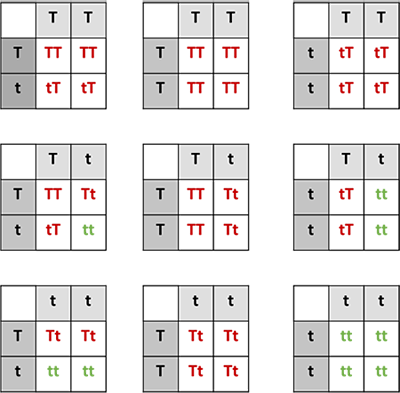
Figure 3. Possible Punnett squares for a variety of phenotypes. Cells shaded in light grey represent the paternal genotype, and the dark grey shaded cells represent the maternal genotype. Resulting genotypes in the offspring are marked red for "tasters" and green for "non-tasters".Why is there an "in between" group and not only "tasters" and non-tasters"?The "in between" group of students might have a different set of mutations in the PTC receptor gene that is not shown in the sequences given to the students. They could, for example, only have one or two of the single nucleotide changes that alter the amino acid sequence of the protein instead of all three. In addition, in some cases there might be mutations in other genes that could contribute to an altered sense of taste.Why do you think these single nucleotide changes in the PTC receptor gene occurred, and why do they not repair themselves but stay in the population?Mutations in the genome happen very frequently, but most of the time the DNA repair mechanisms in our bodies correct them in time. Occasionally, mutations are not corrected and stay in the genome. This means that the mutation is also passed on to the next generation. Mutations that are very harmful will not survive, but other mutations can actually turn out to be beneficial and therefore stay. For the PTC taster gene, the ability to taste the PTC and its bitterness was probably an advantage in the past, as most poisonous plants have a similar bitterness. Individuals that could taste the bitterness were warned not to eat the plant. Although the non-taster allele does not provide this advantage, it is hypothesized that it might have other advantages, such as providing the ability to taste other substances better. This is not fully understood yet and the question of why certain mutations are sustained in our genome is a field of active research.We have seen that one single nucleotide mutation in our DNA can have significant effects on our taste. Do you know of other genetic changes or mutations that result in harmful, beneficial, or neutral effects to our bodies? For example, do you think one single nucleotide could result in a specific disease or disorder?Many phenotypes or diseases have been associated with single nucleotide changes in our DNA such as sickle-cell anemia or cystic fibrosis. Single nucleotide changes have also been linked to hair color or to an increased risk of Alzheimer's disease, alcoholism, or Parkinson's disease, for example.Based on all our findings today, what would you say are some major factors that contribute to the genetic variation we see around us?Students should understand that 1) mutations in our genome can contribute to genetic variation and 2) sexual reproduction, i.e. the random combination of two alleles from parents in their offspring, result in the genetic variation that we observe.
/-/https/www.sciencebuddies.org/cdn/Files/11784/10/punnett-squares-combinations.png)
Assess
You can use this quiz to assess student learning after the activity:
- Online quiz, assignable in any LMS
- Quiz (pdf) and answer key (PDF)
Make Career Connections
Discussing or reading about these careers can help students make important connections between the in-class lesson and STEM job opportunities in the real world.
/-/https/careerdiscovery.sciencebuddies.org/cdn/Files/947/17/pexels-photo-3825412.jpg)

/-/https/careerdiscovery.sciencebuddies.org/cdn/Files/956/18/unsplash-mVV0s8ZvEm4.jpg)
/-/https/careerdiscovery.sciencebuddies.org/cdn/Files/1338/23/pexels-photo-3958380.jpg)
/-/https/img.youtube.com/vi/subFttvmGng/0.jpg)
/-/https/img.youtube.com/vi/BE-b2Tp_B3E/0.jpg)
/-/https/img.youtube.com/vi/jr3BOE_EpOk/0.jpg)