/-/https/www.sciencebuddies.org/cdn/Files/21464/5/sb-logo.png)
/-/https/www.sciencebuddies.org/cdn/Files/21464/5/sb-logo.png)
Immunotherapy: How Antibodies Can Be Used to Treat Diseases
Summary
/-/https/www.sciencebuddies.org/cdn/Files/19273/6/immunotherapy-antibody-infusion.png)
Left: A diagram of an antibody structure. Twelve rectangular shapes connect to make a double-width Y. Middle: A schematic drawing of an infusion bag containing liquid with y-shaped antibodies inside. Right: A tube leads from the infusion bag into a person's arm.
Overview
In this lesson, students will do a series of activities to explore the role of antibodies in our immune system. They will also investigate how doctors use monoclonal antibodies as part of immunotherapy to treat diseases like cancer.
Learning Objectives
- Understand the structure and function of antibodies
- Explain how immunotherapy with monoclonal antibodies works
- Identify the different phases of the drug development process
- Discuss the potential and limitations of therapeutic antibodies
- Optional: Describe the difference between monoclonal and bispecific antibodies
Materials
/-/https/www.sciencebuddies.org/cdn/Files/19284/5/antibody-immunotherapy-materials.jpg)
- Printed student worksheet for each student
- Antibody structure slide
- Antibody 3D model (either (online or 3D-printed)
- One set of printed antigen cards for each student group (in color)
- One set of printed antibody cards for each student group (in color)
- Scissors
- Resealable plastic bag (quart size) for each student group
- Pathogen slide set
- Printed monoclonal antibody handout for each student group
- Printed monoclonal antibody notes
- Optional: Bispecific antibody structure slide
- Optional: Printed bispecific antibody handout for each student group
- Optional: Printed student study guide for each student
Background Information for Teachers
This section contains a quick review for teachers of the science and concepts covered in this lesson.Antibodies are our immune system's highly specialized and ultimate defense weapon against pathogens. When our body comes in contact with foreign substances (antigens), special immune cells called B-cells get triggered to produce antibodies in a process called the adaptive immune response. Antibodies are large y-shaped proteins that identify and neutralize foreign objects, like bacteria or viruses, in our bodies. Each antibody consists of a conserved or constant region and a variable region, as shown in Figure 1. The tips of both y-arms contain variable antigen-binding sites. These are tailored to the specific antigen the immune system is fighting. Once an antibody encounters a matching antigen, it binds to it and flags it for destruction. This process of antibodies fighting a specific pathogen is called the humoral immune response. B-cells continue to produce antibodies until the body is cleared of pathogens and the infection is over.
/-/https/www.sciencebuddies.org/cdn/Files/19179/5/antibody-structure.jpg)
On the left, 12 rectangular shapes arranged into a y-shape show the basic structure of an antibody. The rectangles at the tips of the y have indentations representing antigen-binding sites. On the right, squiggly lines arranged into a y-shape respresent a more realistic visualization of the y-shaped protein structure of antibodies.
Figure 1. Schematic drawing (left) and protein structure (right) of an antibody. Image credit: OpenStax College, CC BY 3.0, via Wikimedia Commons
The high binding selectivity of antibodies to a specific target makes them a powerful tool in biotechnology and medicine. They can, for example, be used as probes for diagnostic purposes to identify specific markers, genes, or other materials in laboratory samples. Many home test kits, such as ovulation and pregnancy test kits, use antibodies to selectively bind to and detect specific hormones produced during pregnancy or ovulation.
Antibodies have also become increasingly important in diagnosing and treating diseases such as cancer and Alzheimer's. In recent decades, researchers have found ways to bioengineer antibodies with specific antigen-binding sites. These antigen-binding sites can be designed, for example, to target specific proteins or other disease-causing antigens.
Bioengineered antibodies derived from a single B-cell clone in the laboratory are called monoclonal antibodies (MAbs). Monoclonal antibodies have become powerful medicines for disease prevention and today play a significant role in immunotherapy. Immunotherapy is a medical term that describes any treatment that uses a person's own immune system to fight diseases. This includes the use of monoclonal antibody drugs. It often takes many years of research to develop a new antibody drug. It is a rigorous process with many steps. The most important ones are listed below.
- Target discovery: This is usually the first step of the drug development process and includes the identification of potential drug targets in the human body. Potential targets can be any gene, protein, or molecule linked to a particular disease.
- Antibody development and testing (preclinical research): Once a potential target has been identified and validated, the next step is developing target-specific antibodies. These antibodies must be tested and optimized.
- Clinical trials: The most promising and effective antibody candidates are tested in humans. These trials follow a three-phase process, increasing in scale with every phase.
- Drug approval and manufacturing: If the clinical trials are successful, the drug is assessed by the regulatory authorities for its safety and efficacy. Once approval is granted, the large-scale production and distribution of the newly developed antibody drug can begin.
Today there are more than 100 monoclonal antibody drugs on the market. Many of them are used to treat cancer. There are several ways monoclonal antibodies can be used to fight cancer. Some of them are listed below:
- First, monoclonal antibodies can help the immune system locate cancer cells. By binding to the surface of cancer cells, monoclonal antibodies flag them so they are more easily detected by immune cells and destroyed.
- Some monoclonal antibodies are used for a more direct attack on cancer cells. Once bound to a cancer cell, these antibodies trigger a series of events inside the cell that cause it to self-destruct.
- Other antibody drugs prevent cancer cells from growing by binding to and blocking proteins, hormones, or signal molecules necessary for cancer growth and cancer blood vessel formation.
- Some monoclonal antibody drugs, called antibody-drug conjugates (ADC), deliver cell-killing substances to cancer cells. These substances may include toxins, chemotherapy drugs, or radiation. When these antibodies bind to their target on the surface of the cancer cells, the cell-killing substances linked to the antibody cause the cancer cells to die. The antibody specificity ensures that any cell that does not have the target will not be attacked or harmed.
- Antibodies can also interact with immune cells directly—for example, by blocking immune system inhibitors, which allows for a more radical immune response against cancer cells.
The following video provides a good overview of the different cancer treatment mechanisms of monoclonal antibodies.
/-/https/i.ytimg.com/vi/dxnjAc-rqz8/maxresdefault.jpg)
/-/https/www.sciencebuddies.org/cdn/Files/20511/4/google-classroom.png)
/-/https/www.sciencebuddies.org/cdn/Files/20512/4/ms-teams.png)
/-/https/www.sciencebuddies.org/cdn/Files/20469/4/Canvas_Bug_Color_RGB.png)
/-/https/www.sciencebuddies.org/cdn/Files/20470/5/Schoology-Logo.png)
/-/https/www.sciencebuddies.org/cdn/Files/20471/4/lms.png)
/-/https/www.sciencebuddies.org/cdn/Files/20469/4/Canvas_Bug_Color_RGB.png)
/-/https/www.sciencebuddies.org/cdn/Files/20470/5/Schoology-Logo.png)
/-/https/www.sciencebuddies.org/cdn/Files/20471/4/lms.png)
Whereas the specificity of monoclonal antibodies poses a huge opportunity to target specific disease-causing antigens, it also creates limitations for monoclonal antibody drugs. Often, diseases are complex, and targeting just one disease-causing antigen is not enough. More recently, researchers have developed a new type of antibody drug called bispecific antibodies (BsAbs). A bispecific antibody is designed to recognize two different antigens simultaneously. Each antigen-binding site of the two y-arms can bind to a different molecular target. This allows the antibody, for example, to block two different cancer growth factors at the same time. Bispecific antibodies can also be designed to recruit special immune cells and bring them closer to cancer cells. One arm of the antibody binds to a cancer cell, while the other arm binds to a special immune cell called a T-cell, as shown in Figure 2. The proximity to the cancer cell triggers the T-cell to kill the cancer cell.
/-/https/www.sciencebuddies.org/cdn/Files/19274/6/bispecific-antibody-cancer.png)
Figure 2. Bispecific antibodies have two different antigen-binding sites and thus can bind to two different antigens simultaneously. Image credit: Anypodetos, Public domain, via Wikimedia Commons
The first bispecific antibody drug was approved in 2015. Currently, seven bispecific antibody drugs are approved by the regulatory authorities (FDA and EMA), and many more are still in the research pipeline or waiting to be approved. The future of antibody drugs is promising, and developing novel antibody-drug treatments and therapies is part of today's cutting-edge research. Researchers in many biotechnology companies are working hard to develop new technologies to discover new and better antibody immunotherapies.
In this lesson, students will do a series of activities to explore the role of antibodies in our immune system. They will also investigate how doctors use monoclonal antibodies as part of immunotherapy to treat diseases like cancer.
Additional Background Links
- Antibodies, Regeneron
- Overview of therapeutic monoclonal antibodies, UpToDate
- Antibody therapeutics approved or in regulatory review in the EU or US, Antibody Society
- Immunotherapy: Targeted Antibodies, Cancer Research Institute
Prep Work (10 minutes)
- Open the 3D antibody animation on your computer and have it ready to show to your class. Alternatively, you can print a 3D antibody model using this antibody file from Thingiverse (File credit: Immuniglobulin by Anthromod on Thingiverse, published under the CC BY 4.0 license). Download the file and either print it yourself or upload it to an online 3D printing service (like Shapeways) and order a print.
- Print one student worksheet for each student.
- Print one set of antigen cards and one set of antibody cards for each student group (in color). Cut along the lines to separate each antigen and antibody, and place all the cut-out antigens and antibodies in a resealable plastic bag.
- Print one set of monoclonal antibody handouts for each student group.
- Print out the monoclonal antibody notes for students and cut out each note.
- Have the Pathogen slide set and Antibody structure slide ready to show to your class.
- If you decide to include Part 3 in your lesson, have the bispecific antibody structure slide ready to show to your class.
- If you decide to include Part 3 in your lesson, print out one bispecific antibody handout for each student group.
- Optional: If you don't have your own reading materials for this lesson content, you can print out a student study guide for each student. It contains all the key points of the lesson in condensed form. You may want to distribute the study guide to students after class so they can review the lesson content before taking the quiz.
Teacher Tool Box
- 3D antibody model (online or 3D-printed)
- Student worksheet (PDF)
- Worksheet answer key (PDF)
- Student study guide (PDF)
- Antigen cards
- Antibody cards
- Monoclonal antibody handout
- Monoclonal antibody student notes
- Bispecific antibody handout
- Bispecific antibody handout key
- Pathogen slide set
- Antibody structure slide
- Quiz (PDF)
- Answer sheet (PDF)
- Quiz (assignable in any LMS)
Engage (15 minutes)
- Tell students that in today's lesson you will explore new types of medicines. Pass around the 3D antibody model and have your students take a close look at the object. If you don't have a 3D antibody model, open this Sketchfab 3D antibody animation
or this Wikimedia animation
and show it to students. Let students guess what the object is or what the animation shows.
 What do you think this object represents?
 Listen to students' guesses. They might not know right away what the object represents. That is ok! If nobody has an idea, give them some clues, but don't tell them the solution yet. Possible clues are listed below.
- This is a model of something and not to scale. The real thing is much, much smaller and invisible to the eyes.
- The shape is very characteristic of this type of thing.
- This is present in each of our bodies. It travels through the bloodstream.
- This becomes especially important to us when we get sick.
- This is our immune system's ultimate weapon against bacteria or viruses that infect our bodies.
Write all the answers students come up with on the board. Then tell students that to find out what the object really is you will watch a short video.
- Show students the following video, which introduces antibodies.
- Present the 3D antibody model to your students one more time. Ask them if they can now identify or confirm the identity of the 3D antibody model. At this point, students should realize or confirm that the model represents an antibody. If they don't, tell them. Briefly discuss the video with your students. You might want to address the following questions:
What was the video about?What did you learn about antibodies in this video?Why are antibodies important?Where do antibodies come from?What did you learn about how antibodies work?Together with your students, summarize the most important points of the video.
- Our immune system helps keep us healthy in case of an attack by a germ (also called a pathogen).
- Germs (pathogens) have different markers on them called antigens.
- Antigens are recognized by the immune system, which responds by custom-making an antibodies that attach to the antigen.
- Antibodies bound to a pathogen tell other parts of the immune system to destroy the pathogen.
- Antibodies stay in our bodies in case we have to fight the same pathogen again.
- Antibodies are also made when people get vaccines.
- Building up lots of antibodies allows the body to fight many different germs.
At this point, students don't need to know any details about how antibodies work. They should, however, realize that antibodies are an important part of our immune system. Point out that our immune system is made up of different cells and organs that work together to defend us against diseases. Mention that our immune system gets triggered whenever a foreign substance invades our bodies. Such foreign substances are also called antigens. They can be entire pathogens (like bacteria or viruses), specific parts of a pathogen, allergens, toxins, or specific molecules. Have students write on their worksheets what an antigen is. Emphasize that what makes antibodies so powerful is their ability to bind to invading antigens to neutralize or destroy them.
- Tell students that in this lesson they will explore in more detail why antibodies are so powerful in fighting diseases. They will do several activities to investigate how antibodies work.
/-/https/www.sciencebuddies.org/cdn/Files/14174/23/note-question-mark-30.png)
/-/https/www.sciencebuddies.org/cdn/Files/14175/24/conversation-bubbles-30.png)
/-/https/i.ytimg.com/vi/cixCF5_mF-4/maxresdefault.jpg)
Explore (60 minutes: Three 20-minute activities)
For the activities, divide the class into groups of 2–3 students.
Part 1: Explore the structure and function of antibodies (20 min)
- Tell students that they will now do an activity to find out why antibodies are such a powerful weapon against pathogens. Distribute one set of printed antigen and antibody cards (in color) to each student group. Explain that one set of cards shows a variety of antibodies, and the other set of cards shows a variety of pathogens with antigens on their cell surfaces. Remind students that antigens are any foreign substances that trigger an immune response. Antigens can, for example, be special surface features or molecular structures on the pathogen's cell surface that our immune system can recognize as foreign. Ask students to look at both the antigen and antibody cards carefully. Give students five minutes to examine the cards. Then discuss what they observed.
What observations did you make when looking at the antibody and antigen cards? What did you notice about the shape of the antibodies? How are the antibodies and antigens similar or different?Listen to students' replies. Use their replies to point out the antibody structure. Show students Figure 1, which shows what an antibody looks like, and explain to students that antibodies are y-shaped proteins that our immune system's B cells produce in order to fight pathogens. Each antibody contains a conserved (constant) region and a variable region. The variable region is at both tips of the Y and contains the antigen-binding site.
Students should have noticed that the antigen-binding sites of each antibody are different and match only one of the pathogens on the antigen cards. (The matching antibody and antigen have the same color.) Tell students that each antibody is designed to bind only to one specific antigen. Antibodies and antigens work like a lock and key mechanism. Point out that this antibody specificity is what makes antibodies so powerful—specificity is the antibody's superpower! Using highly specialized antibodies allows the immune system to specifically target one type of pathogen. Once the antibodies have found and bound to their target antigen, the pathogen is flagged for destruction.
- Continue with the matching game. Tell students that you will simulate a pathogen invading their body and that they must produce the matching antibody against it as fast as possible. Explain that you will show them a picture of the pathogen that enters their body. Use the pathogen slide set for this purpose. They must find the right antibody from their antibody cards to match the antigen on the pathogen shown (see example in Figure 3). Once they have found the matching antibody, ask them to hold it in the air for everybody to see. The student group that finds the matching antibody card first gets one point. Play the game until you have shown 10 pathogen cards in total. If you like, you can give a prize to the winning student team.
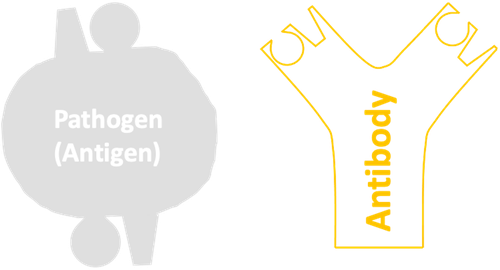
The left image shows a roundish shape representing a pathogen. On its surface are a circular shape and a truncated cone shape representing the pathogen's antigens. The right image shows a y-shaped form representing an antibody. At both tips of the Y-shape, inverted circular and truncated cone shapes represent the matching antigen-binding sites of the antibody.
Figure 3. Example of a matching antigen-antibody pair. - Conclude Part 1 by asking students to summarize the key points of what they have learned about antibodies. Encourage them to make notes on their worksheet. These key points should include the following:
- Antibodies are y-shaped proteins with a constant region and a variable region. Antigen-binding sites exist at the tips of the variable region.
- Antibodies are specific and only match one antigen. Antibodies and antigens work like a lock and key mechanism.
- Antibodies bind to their matching antigen and flag it for destruction.
- Continue with Part 2 of the lesson.
/-/https/www.sciencebuddies.org/cdn/Files/19181/6/example-matching-antigen-antibody.png)
Part 2: Investigate how monoclonal antibody medicines can be used to fight diseases (20 min)
- Point out to students that they now know the basics of how antibodies work. The key is in the structure of the antibodies, specifically their two antigen-binding sites. Our body makes antibodies with the right antigen-binding sites to match the invading antigen. This way, our immune system attacks the targeted intruder only and keeps the rest of the body safe. Mention that because antibodies are so powerful in fighting diseases, researchers have been exploring how they can be turned into drugs to treat diseases such as cancer.
How do you think antibodies could be used to treat diseases like cancer?Have students share their ideas. Use their replies to explain that if we can identify targets/antigens in our body linked to the onset, progression, or prevention of diseases like cancer, we can design antibodies with antigen-binding sites that bind to these targets. This is exactly what researchers have figured out how to do. For example, they have found ways to bioengineer antibodies in the laboratory so they can bind to targets the researchers have identified as promising to stop cancer growth. The antibodies researchers make in the laboratory are called monoclonal antibodies. Tell students that medical treatments like monoclonal antibodies that use a person's own immune system to fight diseases are also called immunotherapies. Immunotherapy today plays a significant role in the treatment of diseases.
- Mention that the first monoclonal antibody drug was approved in 1986 and that currently there are more than 100 approved monoclonal antibody drugs on the market. Many of them treat cancer. Tell students that antibody drugs can be used in many different ways to treat cancer. Show students the following video from the National Cancer Institute, which provides examples of how different antibody drugs can treat cancer. Then have them write down on their worksheet what monoclonal antibody drugs are.
- Tell students that in the following activity, they will have to design their own monoclonal antibody drug to treat cancer. The antibody drug they are developing must bind to the cancer cell directly and flag it for destruction. Point out that drug development is a rigorous process that involves many steps and can take up to 20 years. The first step of developing a new monoclonal antibody drug is usually target discovery and validation. This is exactly what they are going to do in their activity. Their task is to identify an effective target antigen and design an antibody that specifically targets it.
- Distribute one monoclonal antibody handout to each student group. Then give each student group a note that tells them which cell number will represent their target cancer cell. Each group should design a monoclonal antibody for a different cancer cell. Explain to students that on their handout, they will find many different cells presenting different antigens on their surface. The note they received tells them which of the cells represents the cancer cell they need to develop a monoclonal antibody drug for. The other cells represent healthy body cells.
- Tell students that the first step of their antibody medicine development is to identify an appropriate target antigen for their antibody drug based on these cards. Ask them to review all cells in their handout carefully and remind them that antibody medicines need to be specific and should only target the cells that need to be destroyed. If the antibody drug binds to cells other than the cancer cells, this could have serious side effects.
- Give students 5-10 minutes to complete their tasks. Ask them to draw their selected target antigen on their worksheet.
- Once the 5-10 minutes are over, ask the students to stop. Then ask every group about their results. You might want to ask them the following questions.
Tell us which cell number you are developing an antibody for. Which antigen did you select as the target for your antibody medicine? Can you explain why you chose this antigen?What did you find easy or difficult about choosing the specific antigen as your target?Either have students explain what their target antigen looks like or have them draw the antigen on the whiteboard. Students should have recognized that each single antigen symbol is not unique; it is present on several cells. Thus, an antigen that is selective for their cancer cell has to be a combination of at least two different antigen symbols.
Some student groups might have found it challenging to determine which antigen symbol combination is unique to their cancer cell. For some cells, there exist more than one possible unique antigen. An example is shown in Figure 4.
If students don't mention it themselves, emphasize again that their target antigens should be unique for their cancer cells and not target healthy body cells simultaneously. This is crucial; otherwise, the monoclonal antibodies would also target healthy body cells and harm them.
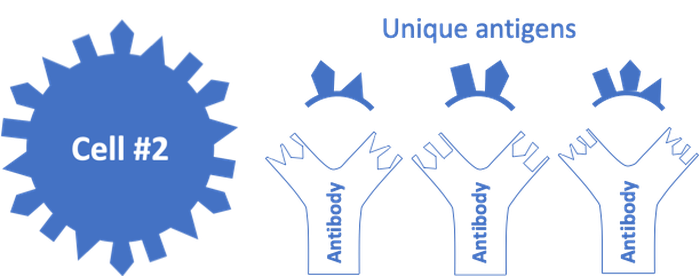
On the left is a schematic drawing of a cell. It is a circle surrounded by a repeating pattern of rectangles, pentagons, and triangles. On the right are three unique antigens copied from around the cell: the first has a pentagon and a triangle, the second has a rectangle and a pentagon, and the third has a rectangle, a pentagon, and a triangle. For each of these unique antigens, there is a y-shaped antibody. At the tips of the y-arms are cutouts the same shape as the antigen - like the locks that fit the antigens' specific keys.
Figure 4. Possible unique antigens for cell #2 and their corresponding antibodies. - Tell students that now that they have identified their target antigen, they need to develop the respective monoclonal antibody drug. This is usually the next step of the drug development process. Ask them to design their monoclonal antibody and draw it on their worksheet. An example is shown in Figure 4. Prompt them to check again whether their antibody drug is specific to their cancer cell and doesn't target any other cells.
- Briefly review the monoclonal antibody drugs for each group. Have students explain why they designed their antibodies that way. Use their reasoning to point out once more that the antibody has to be designed so that its two antigen-binding sites match the desired target antigens only. If students have designed an antibody drug that doesn't match their target antigens, make them aware of it and together come up with an antibody design that works for their cancer cells.
- Congratulate everyone for doing a great job designing their monoclonal antibody drug. The monoclonal antibodies they have designed should be able to bind to their cancer cells and flag them for destruction by immune cells. This means they have successfully created a monoclonal antibody drug candidate that has the potential to treat cancer. The next step in drug development would be to produce the antibodies in the laboratory and test their effectiveness and side effects. This testing would involve doing preclinical research with the antibody-drug candidate in animal models and then continuing with human trials. Once the efficacy and safety of the antibody drug have been demonstrated, and the regulatory authorities approve the drug, the large-scale manufacturing of the monoclonal antibody drug can be developed to ensure a reliable, safe, and consistent production of the antibody medicine.
- Conclude Part 2 by asking students to summarize the key points they learned about monoclonal antibodies. Encourage them to make notes on their worksheet. These key points should include the following:
- Monoclonal antibodies look and behave like natural antibodies but are made in the laboratory.
- Monoclonal antibodies have identical antigen-binding sites that are designed to bind to disease-associated targets, such as antigens on the surface of cancer cells.
- Monoclonal antibodies are a type of immunotherapy and can be used to treat cancer. They can act on the cancer cells in different ways: they can block molecules that cancer cells need to grow, flag cancer cells for destruction by the body's immune system, or deliver harmful substances to cancer cells.
- The first monoclonal antibody drug was approved in 1986, and currently there are over 100 monoclonal antibody drugs on the market. Additional ones continue to be approved by the FDA.
- If time allows, continue with Part 3; otherwise, skip to the Reflect section.
/-/https/www.sciencebuddies.org/cdn/Files/19182/5/example-vaccine-factory.png)
Part 3 [if time allows]: Discuss the emergence of bispecific antibodies and their benefits (20 min)
- Make students aware that monoclonal antibody drugs are not only used to treat cancer. They can also treat many other diseases or conditions, such as rheumatoid arthritis, multiple sclerosis, cardiovascular diseases, allergies, and more.
What do you think makes monoclonal antibodies so versatile and powerful?Listen to students' replies. They should mention that antibodies are so versatile and powerful because, in theory, you can design antibodies to bind to any target you like, as long as you know what your target antigen is. This way, antibodies can be designed to bind to any antigen that is linked to the onset, progression, or prevention of any disease. As monoclonal antibodies are so specific, they don't harm anything other than their target.
- Tell students that this is true, but at the same time, this high binding specificity creates limitations for antibody drugs. Many complex diseases have multiple disease-causing antigens and thus require targeting several antigens simultaneously. This is not possible with monoclonal antibodies, as they can only bind to one single target antigen. A solution to this challenge is a novel type of antibody therapy called bispecific monoclonal antibodies. Show students the bispecific antibody structure slide, which depicts a monoclonal antibody next to a bispecific monoclonal antibody. Have students discuss the differences between them.
This slide shows a monoclonal antibody and a bispecific monoclonal antibody. What differences and similarities do you observe between them? Based on their structure, what benefits do you think bispecific monoclonal antibodies have over monoclonal antibodies?Let students share their observations. They should realize that bispecific antibodies look like monoclonal antibodies. However, they are designed to have two different antigen-binding sides. This creates more versatility for disease treatment, as bispecific antibodies can simultaneously bind to two different disease-causing antigens. Ask students to write down on their worksheet what bispecific antibodies are.
- Point out that the first bispecific antibody drug was approved in 2009 and that currently, there are more than five bispecific antibody drugs approved by the regulatory authorities (FDA and EMA). Most of them are used to treat cancer. Show students the following video, which explains how bispecific antibodies work to treat cancer. Before showing the video, explain that in the video, the structure of the bispecific antibodies is truncated (the lower part of the Y is missing), which is why they don't look like a Y.
- Tell students that in their next activity, they have to design a bispecific antibody drug that can treat cancer by binding to a cancer cell and an immune cell at the same time and thus bringing the immune cell close to the cancer cell so it can be destroyed, just like they have seen in the video. Have them review their monoclonal antibody handout again. In this scenario, cell #1 of their monoclonal antibody card set represents the cancer cell, and cell #2 represents the immune cell that needs to be recruited. All the other cells are healthy body cells. Provide each student group with a bispecific antibody handout. The handout shows an antibody template with gray boxes at its y-tips and several possible antigen-binding site boxes. Explain to students that their goal is to find the right antigen-binding sites for their bispecific antibody drug from the selection on the handout. Remind them that their bispecific antibody needs to target cell #1, the cancer cell, and cell #2, the immune cell. All other cells are healthy body cells and should not be harmed.
- Give students 5-10 minutes to complete their task. Ask them to follow the instructions on their worksheet and write the numbers of their chosen antigen-binding sites in the two gray fields of the bispecific antibody template on their handout once they have made their selections.
- Once the 5-10 minutes are over, ask the students to stop. Then ask every group about their results.
Can you tell us which antigen-binding sites you chose for your bispecific antibody? Please explain your selection criteria.Have students present their bispecific antibodies and their reasoning for selecting their two antigen-binding sites. To complete this task, students should have selected two different antigen-binding sites for their bispecific antibody. The selection criteria for their antigen-binding sites are listed below:
- Both antigen-binding sites need to be different, as it is a bispecific antibody drug.
- One antigen-binding site needs to be specific and unique for cell #1, the cancer cell.
- The other antigen-binding site needs to be specific and unique for cell #2, the immune cell.
- None of the selected antibody-binding sites can bind to a healthy body cell.
The possible and unique antigen-binding sites for cell #1 and cell #2 are shown in Figure 6. If students have difficulties making their antigen-binding site choices, together list the antigen-binding site selection criteria and help them make the right selections.
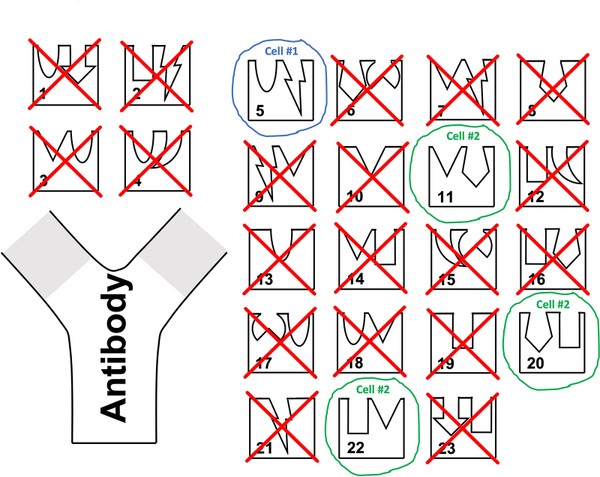
Figure 5. Possible unique antigen-binding sites for cell #1, the cancer cell (circled in blue), and for cell #2, the immune cell (circled in green). - Tell students that if they selected antigen-binding site #5 for one y-arm and antigen-binding sites #11, #20, or #22 for their second arm, they have successfully designed a bispecific antibody drug candidate that can bind cancer cell #1 and immune cell #2 simultaneously. Mention to students that Blinatumomab is an approved bispecific antibody drug used to treat leukemia that works exactly this way. One arm of the antibody binds to the CD19 site of the cancer cell, and the other binds to the CD3 site of T-cells, which are immune cells that can destroy cancer cells. By bringing the immune cell close to the cancer cell, the cancer cell can more easily be identified and destroyed.
- Conclude Part 3 by asking students to summarize the key points they learned about bispecific antibodies. Encourage them to make notes on their worksheet. These key points should include the following:
- Bispecific antibody drugs are new types of antibody medicines and have two different antigen-binding sites. This means they can bind to two different target antigens simultaneously.
- Bispecific antibodies are more effective in treating complex diseases that require targeting multiple disease-causing antigens.
- The first bispecific antibody drug was approved in 2009, and currently there are more than five bispecific antibody drugs approved by the regulatory authorities. Additional ones continue to be approved by the FDA.
/-/https/i.ytimg.com/vi/LUTEYahkauQ/sddefault.jpg)
/-/https/www.sciencebuddies.org/cdn/Files/19275/6/bispecific-antibody-handout-key.jpg)
Reflect (15 minutes)
- Wrap up the lesson by discussing the future of antibody medicines. Tell students that therapeutic antibodies, such as the monoclonal and bispecific antibodies you have explored today, are often praised as the medicines of the future.
Based on all our activities today, can you tell why therapeutic antibodies are so useful and promising for future drug development?Have students share their thoughts. If they have difficulties answering the question, refer them to the key learning points of each activity. The main point students should be making is that one of the great benefits of antibody medicines is their exquisite target specificity. By targeting known disease-causing antigens, a wide range of diseases can be treated with therapeutic antibodies. You might also want to point out that antibodies usually have low toxicity, as they mimic the natural antibodies made by our immune system.What are some challenges or limitations of antibody medicines that you can think of?Listen to students' responses. Some limitations that have been associated with current therapeutic antibodies are their high production cost and time. These treatments may also have a limited ability to penetrate cells or solid tissues, meaning most antibodies are limited to antigen targets that are on the surface of the cell membrane. Another challenge in developing effective antibody therapies is finding attractive targets that have the potential to prevent or cure a disease.
- Conclude the lesson by telling students that researchers in many biotechnology companies are working hard to solve these challenges. Developing novel antibody drug treatments and therapies is a huge part of today's cutting-edge research in medical biotechnology. Your students might be interested in the fact that the global antibody market has been valued at over $150 billion (U.S.) and is estimated to grow even more in the future. Emphasize that this means therapeutic antibodies will most likely become more and more important in disease management and treatment.
Assess
You can use this quiz to assess student learning after the activity:
- Online quiz, assignable in any LMS
- Quiz (pdf) and answer key (pdf)
In addition, the student worksheet can be used to evaluate students' understanding of the activities and basic concepts.
Make Career Connections
Discussing or reading about these careers can help students make important connections between the in-class lesson and STEM job opportunities in the real world.
/-/https/careerdiscovery.sciencebuddies.org/cdn/Files/947/17/pexels-photo-3825412.jpg)

/-/https/careerdiscovery.sciencebuddies.org/cdn/Files/1463/18/iStock-1156456853.jpg)
/-/https/careerdiscovery.sciencebuddies.org/cdn/Files/1628/18/iStock-1203995945.jpg)
Lesson Plan Variations
- The ability of our immune system to produce highly specific antibodies can be harnessed for purposes beyond the development of effective antibody therapies. Vaccines are another application that makes use of our immune system's power. With your students, explore how vaccines work and what role antibodies play in preventing infectious diseases.
- Encourage students to research what antibody drugs are currently on the market. Have them investigate what types of antibody drugs they are (monoclonal, bispecific, etc.), what diseases they treat, and what targets they bind to.
/-/https/img.youtube.com/vi/h1Vs6_3PXY4/0.jpg)
/-/https/img.youtube.com/vi/E6Kw1YL03zk/0.jpg)
/-/https/img.youtube.com/vi/8ptiSuskdtU/0.jpg)
