/-/https/www.sciencebuddies.org/cdn/Files/21464/5/sb-logo.png)
/-/https/www.sciencebuddies.org/cdn/Files/21464/5/sb-logo.png)
Measuring Heart Rate with Your Own Stethoscope
Summary
/-/https/www.sciencebuddies.org/cdn/Files/8946/6/heart-rate-stethoscope.jpg)
Overview
In this fun, hands-on lesson, students explore their heartbeats and learn about blood circulation. They will make their own stethoscopes, use them to measure their heart rates and investigate how heart rate is affected by exercise.Learning Objectives
- Understand the function of the heart and blood.
- Relate heart rate to blood flow and pulse.
- Measure and interpret how heart rates are affected by exercising.
NGSS Alignment
This lesson helps students prepare for these Next Generation Science Standards Performance Expectations:- 4-LS1-1. Construct an argument that plants and animals have internal and external structures that function to support survival, growth, behavior, and reproduction.
|
Science & Engineering Practices
Engaging in Argument from Evidence. Construct and/or support an argument with evidence, data, and/or a model.
Analyzing and Interpreting Data. Represent data in tables and/or various graphical displays to reveal patterns that indicate relationships. |
Disciplinary Core Ideas
LS1.A: Structure and Function. Plants and animals have both internal and external structures that serve various functions in growth, survival, behavior, and reproduction.
|
Crosscutting Concepts
Cause and Effect. Cause and effect relationships are routinely identified, tested, and used to explain change.
Systems and System Models. A system is a group of related parts that make up a whole and can carry out functions its individual parts cannot. |
Materials
/-/https/www.sciencebuddies.org/cdn/Files/8947/7/materials_stethoscope.jpg)
For each group of two students:
- Plastic funnel
- A cardboard tube from a paper towel roll
- A strip of duct tape or other strong tape
- Scissors
- Stopwatch or clock that counts seconds
Background Information for Teachers
This section contains a quick review for teachers of the science and concepts covered in this lesson.A stethoscope (steth- ə-sk ōp), such as the one shown in Figure 1, is a medical instrument used to listen to sounds produced inside the body, especially the sounds produced by the heart and lungs or of blood flowing in blood vessels. The small disc placed on the body picks up small sounds and amplifies them. They are then guided to the listener's ear(s) by an air-filled tube.
/-/https/www.sciencebuddies.org/cdn/Files/8950/7/stethoscope.jpg)
Figure 1. A stethoscope.
The heart, which is a muscle about the size of your fist, is part of the circulatory or cardiovascular system, your body's transportation system for nutrients and oxygen. Each time it contracts, it pushes blood to all parts of the body. Blood is a carrier. It transports oxygen from the air you breathe and nutrients from the food you eat. It also transports waste away and helps keep body temperature steady. An average adult has about 4.7 liters (one and a quarter gallons) of blood. An 80-pound child has about half as much blood.
You can hear a heartbeat using a stethoscope. What you hear as a heartbeat is the sound of the valves in the heart closing. These valves keep blood from flowing the wrong way, as shown in Figure 2. When you feel or listen to your pulse, you feel or hear the throbbing of blood flushing through the arteries. It is best felt in the wrists or neck. As it is the heart that pushes blood through the arteries, each heartbeat is accompanied by a pulse.
/-/https/www.sciencebuddies.org/cdn/Files/8951/6/heart-valves-chambers.jpg)
A human heart has two main chambers: a left and right atrium on top of the heart, and a left and right ventricle on the bottom of the heart. Other parts of the heart include the pulmonary valve, tricuspid valve, aortic valve, and mitral valve.
Figure 2. A picture of the heart with its two chambers and four valves (image from www.imgarcade.com)
A heart rate or pulse is usually expressed in terms of the number of beats per minute (BPM). To measure a heart rate or pulse, it is easier to count the number of beats or pulses for 15 seconds and multiply that value by four (to get the number of beats in one minute). You can calculate how many times your heart beats in a year by multiplying your BPM by 60 minutes per hour, 24 hours per day, and 365 days per year. A BPM of 70 beats per minute yields over 36 million beats a year!
In this science activity, students make their own stethoscopes using a cardboard tube, a funnel, and tape, and use these to measure other students' heart rates. They will measure pulses as well. By comparing the pulse to the heart rate, they will discover that the heart rate and the pulse are identical, an argument in support of the hypothesis that the heart beats to push blood through the body.
Students will also compare pulses at rest and immediately after exercise. They will discover that heart rates increase while exercising. This happens because the body needs more oxygen while exercising, and consequently, the heart beats faster to deliver more oxygen-rich blood, which increases the heart rate.
Additional Background Links
- Your Heart and Circulatory System, KidsHealth
- Heartbeat Sound Video, justsoundfx
Prep Work (5 minutes)
Cut a strip of tape for each group and stick one end to their desk. The strip should be long enough to go around the cardboard tube twice.
Teacher Tool Box
Engage (10 minutes)
/-/https/www.sciencebuddies.org/cdn/Files/14174/23/note-question-mark-30.png) | An organ is a part of the body that performs a specific function. What organs of the body do you know? |
/-/https/www.sciencebuddies.org/cdn/Files/14175/24/conversation-bubbles-30.png) | The brain, the heart, blood, the kidneys, the stomach, the liver, the lungs, the intestines, the skin, etc. are organs. |
| Today, we will learn about the heart. Do you know what function the heart has in our body? |
| The function of the heart is to make blood flow throughout the body. |
| Have you ever felt your heart beat when you felt nervous or anxious? Why could you feel your heart beat then while normally, you cannot? |
| Our hearts beat faster when we react to stress or a perceived threat. Our body prepares to fight or flee. |
| Why would the heart beat faster when we perceive a threat? |
| Your body needs more energy when it is on alert than it needs when it is in a relaxed state. Your body needs the blood to flow faster to make extra energy, and the heart is the organ that makes blood flow. By beating faster, more blood can be delivered. |
| Could that give us a clue to why we need blood to flow throughout the body? |
| Our bodies need oxygen to make energy. Blood is the carrier of oxygen. Blood also carries nutrients, which are needed for repair and growth. In addition, blood carries away waste products and helps regulate body temperature. |
| Does anyone know how you can measure your heart rate? [Possible prompts for students include questions like "what instrument do doctors or nurses us to listen to the heart and measure how fast it beats?"] |
| Nurses and doctors use a stethoscope. This is an instrument to listen to the noises made inside a body. It has a small disc that is placed on the body to pick up sounds, and a long air-filled tube that guides these sounds to the listener's ear(s). |
| In this lesson, we will build our own stethoscope. We will use it to listen to the heart. What does the heart do that could make a noise, and how could we use it to measure how fast the heart beats? |
| The heart squeezes and relaxes to pump blood through the blood vessels. The beats you hear are the heart valves closing with every beat (squeeze) of the heart. The number of beats (squeezes) in a specific time interval is a measure of how fast the heart beats. |
Explore (20 minutes)
Have your students follow these steps:
- To build the stethoscope, insert the narrow end of the funnel into the cardboard tube and tape the funnel and cardboard tube securely together using the duct tape. Cutting the tape in small pieces or making incisions as shown in Figure 3 can help tape the funnel neatly to the tube.
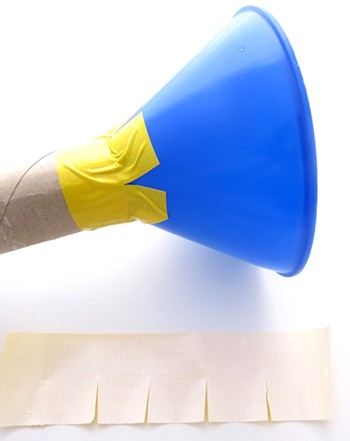
Figure 3. Funnel taped to cardboard tube.
- Practice listening to the heartbeat of another student using the homemade stethoscopes. The student listening should place the funnel flat on the chest of another student, on the left side roughly where the heart is, and place the hole at the end of the cardboard tube against their ear as shown in Figure 4.
If there are other noises in the room, it can be difficult to hear, so try to have the students be quiet. Also, thick clothing may make it difficult to hear the heartbeat.
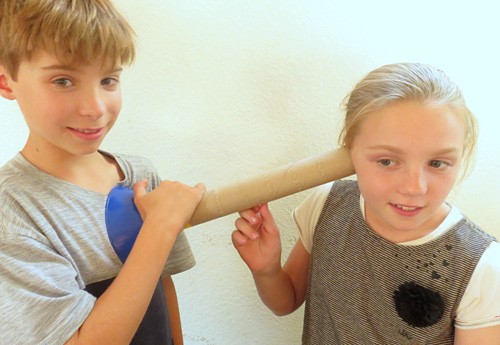
Figure 4. How to use the stethoscope.
- Once students have practiced listening to each other's heartbeats, ask for their attention to discuss what sounds they hear with the stethoscope.
 What sounds do you hear with the stethoscope? Does it sound like a heartbeat? Can you hear a pattern?
 You hear a regular pattern created by the beating heart. Each double beat (two short beats rapidly following each other) counts as one heartbeat. This heartbeat sound video is a good example.
 - Let them sit down if they are not already sitting and explain they will now start an experiment. They will measure heart rates and pulses. The heart rate expresses how fast the heart beats, or how many beats it makes in one minute.
How can the stethoscope help us measure the heart rate, or how fast the heart beats?With the stethoscope, we can listen to the heart and hear it beat. By counting how many beats it makes during a specific time period, like one minute or 15 seconds, you get a measure of the heart rate.Does anyone know what a pulse is, and how it can be measured?A pulse is the rhythmical throbbing of the arteries as blood flushes through them. You can feel this throbbing at specific places on the body like your wrist and neck. You can measure the pulse by counting pulses during a specific time period.
Explain how they will first measure the resting heart rate and pulse, which is the heart rate and pulse of a person when that person is at rest. Afterwards, they will measure the pulse instantly after exercising. (Because the class can get noisy after students exercise, we only measure the pulse, and not the heart rate, after exercising.)
- To measure the resting heart rate, the students being measured need to be sitting calmly for at least five minutes before their heart rates are measured. Using the stopwatch, let the students count the number of beats in 15 seconds. Let the students write that number down in the data table on their worksheet.
- Switch roles and repeat the measurements.
- Let all students sit and explain how they can measure their own pulses. To measure the pulse, use the first two fingers of one hand to feel the pulse in the wrist of your other hand, as shown in Figure 5. Use the artery located on the "thumb side" of the wrist, just below the base of the hand. Advise the students not to use the thumb to feel the pulse, because it has its own pulse. Let the students practice finding their pulse.
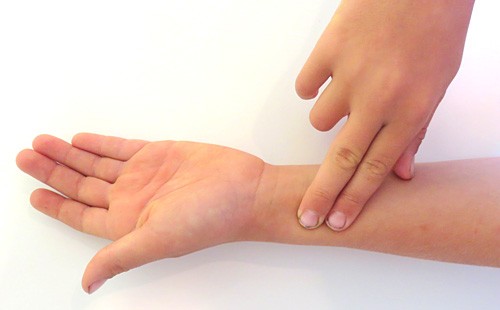
Figure 5. How to feel your pulse.
- To measure the resting pulse, the students need to be sitting calmly for at least five minutes. Let the students count the number of pulses felt in 15 seconds. Use a stopwatch to direct the students when they should start and stop counting. Let the students write that measurement and that of their partner down in the data table on their worksheet.
- In the next section, students will study the impact of physical exercise on the heart rate. Let them reflect on how and why vigorous exercise could impact the heart rate. If students did not fill in question 1 of their worksheet yet, they can do so now.
- Have the students measure their heart rates immediately after vigorous exercise such as running in place with high knees or doing jumping jacks for 30 seconds. Note it is important to measure the heart rate instantly after the exercise time. Use the timer to guide the students to do the exercise (30 s.) and the counting of their pulse (15 s.). Let the students write the counted number of pulses of themselves and their partner down in the data table on their worksheet.
/-/https/www.sciencebuddies.org/cdn/Files/8952/6/make-stethoscope.jpg)
/-/https/www.sciencebuddies.org/cdn/Files/8953/6/stethoscope-in-use.jpg)
/-/https/www.sciencebuddies.org/cdn/Files/8954/6/measure-pulse.jpg)
Reflect (10 minutes)
Have your students follow these steps:
- Analyze their gathered data following the directions given in their worksheet. First, they convert the number of beats and pulses counted in 15 seconds to beats per minute (BPM) by multiplying the counts by four, as shown in Equation 1. Students calculate the heart rate and pulse in BPM and write the results down in the data table on the worksheet.
Equation 1.
- Create bar graphs of the measured heart rates or pulses at rest and after exercises. Template graphs are provided on the worksheet.
- Start a discussion where students reflect on their data and draw conclusions.
When at rest, is the number of pulses similar to the number of heart beats counted in 15 seconds? Why or why not?Both numbers should be similar as both measure how many times the heart beats in 15 seconds when a person is at rest. The heart beats measured with a stethoscope uses the sounds made by each heartbeat to count beats. It is a direct way of measuring heart beats. The pulse measures the heartbeat indirectly by feeling the pressure changes caused by blood being pushed through the arteries with each heartbeat. Note it is normal that both numbers are not exactly the same; on top of measurement fluctuations, other factors might have changed (e.g. the student might be more relaxed or more nervous, might be talking, etc.).Does anyone know if our measured values agree with what is expected for a heart rate of a human?A resting heart rate is usually between 60 and 100 BPM. This could drop to 40 BPM for well-trained athletes. Your heart rate during exercise can easily be double the resting heart rate. Most probably, the measurements will fall into this range.Did the heart rate stay the same, increase, or decrease with physical activity? Was your hypothesis confirmed? Why do you think that happens?The heart rate increases during physical activity. This is because the muscles need more oxygen to generate energy during physical activity. Blood delivers oxygen, so more blood needs to flow. The heart is responsible for pumping blood, and a faster-beating heart can pump more blood to the muscles.Regular physical activity makes the heart stronger. Why would this be the case? How and why would our heart change with regular physical activity?Just like any other muscle, the heart muscle will grow stronger with regular vigorous exercise. For the heart, this means it will be able to pump more blood with every squeeze, or it will be able to provide more oxygen and nutrients to the body parts with every squeeze. Our bodies adjust to their environment to make themselves better-suited for the jobs they are required to do.How would the resting heart rate of an athlete be different compared to the resting heart rate of an inactive person? Why would they be different?You would expect the resting heart rate of an athlete to be slower. This is because the heart of the athlete is trained to squeeze hard and push more blood through the body with every squeeze. It does not need to squeeze as frequently to get the same amount of blood through the body.
Assess
You can use this quiz to assess student learning after the activity:
- Online quiz, assignable in any LMS
- Quiz (pdf) and answer key (PDF)
Make Career Connections
Discussing or reading about these careers can help students make important connections between the in-class lesson and STEM job opportunities in the real world.
/-/https/careerdiscovery.sciencebuddies.org/cdn/Files/1628/18/iStock-1203995945.jpg)

/-/https/careerdiscovery.sciencebuddies.org/cdn/Files/1365/18/iStock-1012791028.jpg)
Lesson Plan Variations
- Modeling Blood Flow is a nice continuation of this lesson. In that lesson, students build a simple model to explore the effects of plaque buildup in arteries and demonstrate what happens to blood flow when heart disease narrows a person's arteries.
- Calculate the average heart rate for the entire class and look at the variation of heart rate within the class.
- A person should use at least 50% of their maximum heart rate when they are exercising for the activity to qualify as exercise. You can have students read about maximum and target heart rates, and then use that information to determine what physical activities they do that qualify as exercise.
/-/https/img.youtube.com/vi/SLiibpsV5AQ/0.jpg)
/-/https/img.youtube.com/vi/jBpS6W-2otk/0.jpg)
/-/https/img.youtube.com/vi/pvHyTATszZU/0.jpg)