/-/https/www.sciencebuddies.org/Files/21464/5/sb-logo.png)
/-/https/www.sciencebuddies.org/Files/21464/5/sb-logo.png)
Modeling Biologic Manufacturing
Summary
/-/https/www.sciencebuddies.org/Files/21119/9/search-image-biologic-manufacturing-lo-phd.jpg)
Overview
In this lesson plan, students will model the complex biologic manufacturing process. First, they will model the cellular expansion process that occurs in a bioreactor. Then, students will lyse the cells to isolate the proteins from the dyed cell debris. Lastly, they will model the advanced filtration process to purify proteins so they can be used as medicines.
Learning Objectives
- Students will be able to describe the steps of the biologic manufacturing process.
- Students will be able to identify key characteristics of safe biologic medicines and how to model this process effectively.
- Students will be able to understand how cells expand and create proteins, explain how cells are vectors for protein production, and recognize the importance of filtration for protein purification.
- Students will understand the importance of cells in creating biologic medicines.
NGSS Alignment
This lesson helps students prepare for these Next Generation Science Standards Performance Expectations:- MS-LS1-2. Develop and use a model to describe the function of a cell as a whole and ways the parts of cells contribute to the function.
|
Science & Engineering Practices
Developing and Using Models
|
Disciplinary Core Ideas
LS1.A: Structure and Function
|
Crosscutting Concepts
Scale, Proportion, and Quantity
|
Materials
/-/https/www.sciencebuddies.org/Files/21120/5/Figure2_Materials-Modeling-Biologic-Manufacturing_LO-PhD.jpg)
Materials List (per student group):
- 4 clear cups or containers (heat-resistant)
- 1 funnel
- 1 coffee filter or syringe with an attachable filter
- 1/4 cup warm water (105-110 °F)
- 2 packets of active yeast
- 1 Tablespoon sugar
- 1 Tablespoon hydrogen peroxide (standard 3%)
- Food dye
- Ruler
- Paper towel or tissues (optional)
Background Information for Teachers
This section contains a quick review for teachers of the science and concepts covered in this lesson.Biologic manufacturing is a multi-step process that creates a biological product. These products help reduce symptoms or treat diseases. Below is an image of an overview of the manufacturing process students will be modeling.
/-/https/www.sciencebuddies.org/Files/21118/8/Figure1-Biologic-Development-Overview-LO-PhD.jpg)
Additional Background Links
Prep Work (5-10 minutes)
- Based on the materials listed above, set up the laboratory with materials for each student group or station for each group or for your classroom.
- Print out written instructions and lesson plan sheets for the students to follow along for the experiment.
- Right before class, have the drug development overview presentation containing Figure 1 projected for you to introduce the lesson plan overview. Use the figures and images for discussion throughout the experiment.
- Right before class, pre-warm water in a water bath or with a temperature-controlled kettle to 105-110°F.
Teacher Tool Box
- Student worksheet (PDF)
- Quiz (PDF)
- Answer Sheet (PDF)
- Quiz (Google Classroom or other LMS)
- PowerPoint presentation
- Introductory video
Engage (2 minutes)
/-/https/www.sciencebuddies.org/Files/14174/23/note-question-mark-30.png) | Have you ever wondered how biological medicines are made in large vats called bioreactors? |
/-/https/www.sciencebuddies.org/Files/14175/24/conversation-bubbles-30.png) | Biological medicines are complex biological molecules, like proteins, created using single cells of a single origin called a cell line. These cells are added to a bioreactor that contains all of the nutrients they need to create biological molecules, for example proteins, in the cells that will then be extracted out of them and purified to create a biological medicine for a patient. This process differs from drug development, which is typically is used to create less complex small-molecule drugs or non-biological medicines. |
| Insulin is a protein that is made by the human body. How can we manufacture it for use as a medicine, when someone can’t create their own? |
| You can make it through biologic manufacturing. We will model this process in today’s lesson plan. |
Explore (28-35 minutes)
Introduction (3-5 minutes)
- Introduce the lesson plan by discussing how pharmaceutical companies develop life-transforming medicines for people with serious diseases. Tell the students they will explore and model how life-changing biological medicines are made in today's lesson.
Discuss the three major steps that will be modeled in today's lesson plan by showing students Figure 1 from the Regeneron-Lesson-Plan-Presentation file, which illustrates the overview of the basic steps of the biopharmaceutical development process that this lesson plan models. Ask the students,
 What is a cell, and what do you see happening to them in the first step of the process?
 Have students describe the cell expansion process and properties of a cell. Point out answers about how the number of cells and proteins is increasing, too.
Then ask the group,
What is happening to the cell and its contents in the second step of the process?Have students describe the lysis of cells. Amplify those answers that talk about the cell breaking open and its contents coming out, resulting in the protein being expelled from inside the cell so it can be isolated or collected.Finally ask,
What is happening in the third step of the process that we will model today? When have you seen someone use a filter in your life?Encourage students to talk about filtration. Provide examples of everyday life that separate solids from liquids. For example, when they see adults in their lives make a cup of coffee or tea. When the water goes over the coffee grounds or tea, the filter stops the solids and distills a new solution of extracted coffee or tea beneath the filter.- After you've captured the student's interest and attention, reiterate the process with a full overview of the lesson plan. In this lesson plan, students will model the manufacturing process of biologic medicines or medicines created from biological organisms. First, they will model how a few cells can rapidly replicate, which is called the cellular expansion process. This first step takes place in a bioreactor, and the purpose is to create a lot of proteins within the cells for therapeutic use. After the cells containing the proteins expand, they will lyse or break the cells open. This will allow for proteins inside the cell to be exposed so that they can be separated from the dyed cell debris, which is a waste product of this process. Lastly, students will model the advanced filtration process to purify proteins from the dyed cell debris. After additional quality assurance checks to ensure the isolated protein is safe for use, they will be used as biological medicines, also known as biologics.
Ask the students this question to challenge them to form a hypothesis regarding the biologic development process:
How much of the cell's content becomes a biological product for therapy? (or) How much volume of protein products do you think we will create in our model?Listen to students' hypotheses. Then, inform them that they will test their hypothesis through the lesson plan to investigate the answer to this question.- Divide the classroom into groups of 3-4 students each.
- Distribute materials to each group or set them up before starting the lesson plan.
Part I: Modeling Cellular Expansion (10-15 minutes)
First, students will model the cellular expansion process to create many proteins inside the cells.
- Instruct students to label their 2 cups as follows:
- Cup 1: Cells without sugar
- Cup 2: Cells with sugar
- Pour 1/4 cup of warm water (105-110℉) into each cup. Each cup represents a bioreactor.
- Add 2 teaspoons of active yeast to each up.
- Add 1 teaspoon of sugar to the cells with sugar cup.
- Mix the contents in the cup containing cells without sugar and the cup containing cells with sugar.
- Wait 2-3 minutes and then mix again. Have students answer the following 2 questions in their group during the first 5 minutes of the incubation.
What color was the yeast, water, and the resulting solution?Does either cup have a smell? What does it smell like? Have them add their answer to Table 1.
- Instruct the students to measure the height of the foam after 5 and 10 minutes. They will measure the height of the foam from the bottom of the bottle (touching the table) up to the top of the foam from the outside of each cup, so they don't interrupt the biological reaction. Ask them to record their results in Table 1, and use their results to answer the following questions.
Does the solution expand more or less as time goes on?Is sugar required for the cell expansion or "growth" process? Ask the students to use their results to inform their answer.
Swipe left to see moreTable 1: Modeling cellular expansion and cell lysis to harvest proteins. Bioreactor Model, Cup Number
Does either cup have a change in color or smell? Expansion: Height of foam at 5 minutes (cm) Expansion: Height of foam at 10 minutes (cm) Cup 1
(without sugar)Cup 2
(with sugar) - During observation and measurements, ask students to share their observations and measurements with the rest of their group. Point out to students that the yeast with sugar creates foam and smells of a biologically active reaction (yeast rising). The yeast cup with sugar models what happens when cells have the nutrients they need for replication, illustrating what happens in a bioreactor in the cellular expansion phase. Therefore, this step teaches students that when these cellular requirements are met, the cells can successfully expand and create the protein inside of them that is needed to create biological therapy.
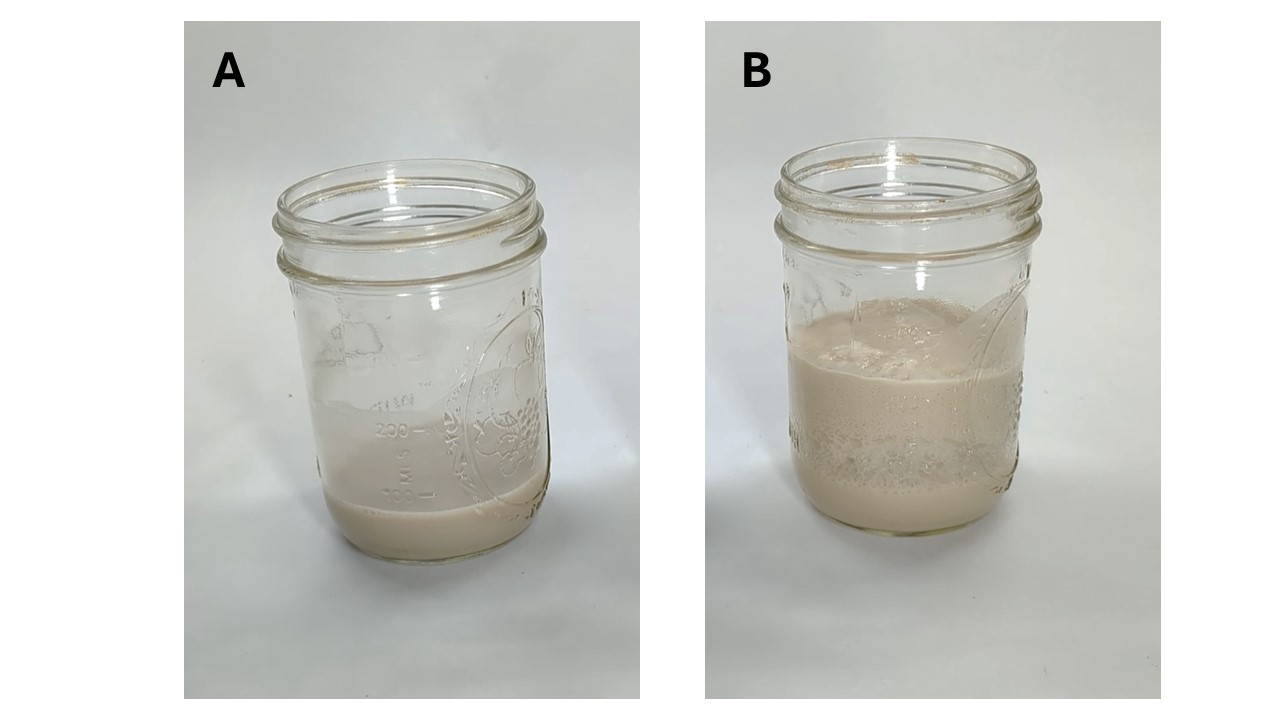
Figure 2. Expected results for yeast with and without sugar after 10 minutes. (A) Yeast without sugar. (B) Yeast with sugar.
- After 10 minutes, the yeast will be fully activated and expand in the cells with sugar cup, but not the cells with no sugar cup.
/-/https/www.sciencebuddies.org/Files/21146/4/Figure2_Yeast-Expansion_LO-PhD.jpg)
Part II: Modelling Cellular Lysis (10 minutes)
Next, inform the students that they will lyse the cells open to expose and isolate the proteins from inside the many cells.
- Transfer 1 tablespoon of yeast with sugar to both cup 3 and cup 4.
- Lyse or break open the yeast with sugar cup by adding 1 tablespoon of hydrogen peroxide containing one drop of dye per cup. This will simulate the lysis and dying of cell debris with the colored dye.
- Ask students to stir their solution with the tablespoon every 2-3 minutes for up to 10 minutes. This will simulate cell harvesting and lysis of the cells to isolate the protein product from the dyed "cell debris."
- Tell the students to measure the height of the foam after 1, 5, and 10 minutes. Ask them to add the results to Table 2.
What happens when they add hydrogen peroxide to the expanded yeast? Does it foam more or less? At what times does this occur in the 5-10 minute incubation?Ask students to share their answers. Reiterate and amplify answers that discuss how the process was dynamic and required multiple changes or steps until the lysis process was complete, just like the biologic development process.
Swipe left to see moreTable 2: Modeling the role of cell lysis in the protein extraction process. Bioreactor Model, Cup Number
Lysis: Height of foam at 1 minute (cm) Lysis: Height of foam at 5 minutes (cm) Lysis: Height of foam at 10 minutes (cm) Cup 1
(without sugar)Cup 2
(with sugar)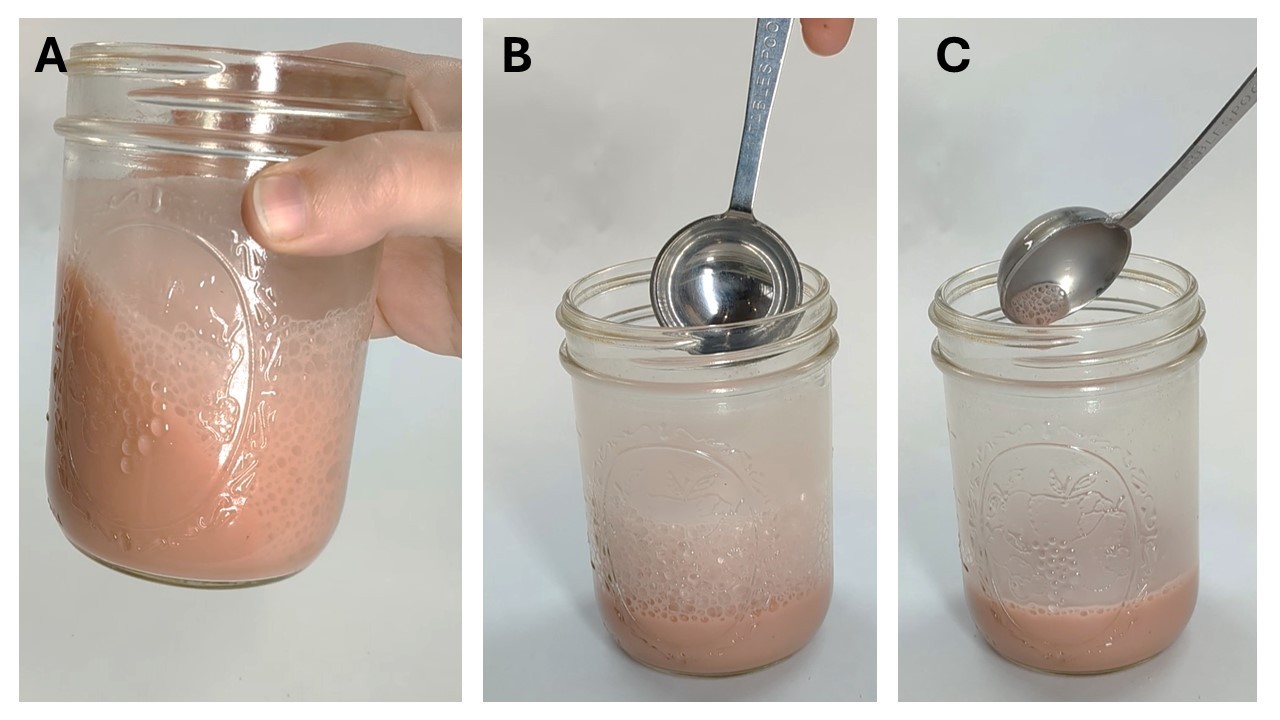
Figure 3. Expected results for the lysis of the cells. (A) Immediately after adding hydrogen peroxide, the foam continues to expand (B). With mixing, foam reduces after approximately 5 minutes. (C) Foam fully dissipates with mixing by 10 minutes.
/-/https/www.sciencebuddies.org/Files/21199/6/Figure3.jpg)
Part III: Modeling Filtration for Purification (5 minutes)
Lastly, students will filter the dyed “cell debris” from the protein product to isolate it.
- Instruct students to place a funnel and a coffee filter each over a new empty cup.
What color was the solution before filtration? Have them record their answer in Table 3.
- Ask students to measure and pour 1 tablespoon of the activated yeast solution with sugar into the funnel over cup 3. This will simulate a no-filtering condition (negative control).
- Measure and pour 1 tablespoon of the activated yeast with sugar and pour it over the filter over cup 4 to simulate the filtering condition (experimental). This will simulate the complex filtering process of protein isolation. Inform the students about the size-exclusion filters and the amounts of them used in the biopharmaceutical production of a single biologic product.
What color was the solution after filtration? Remind them to record their answer in Table 3.
- Wait for gravity filtration of the protein product for about 3-5 minutes. During this incubation, discuss the importance of filtration in purifying proteins from the cell debris created during the cell lysis process, which is required to isolate the proteins of interest.
How much of the solution remains after filtration compared to the unfiltered product? Was the dyed “cell debris” caught by the funnel or filter? Check the funnel and filter to find out.Why is filtration needed for the purification of proteins? Remind students to use their results to inform their answer.Allow students to share their ideas with the group or as a class. Encourage answers about the small amount of protein isolated after filtration due to a large volume of cell debris.Swipe left to see more
Table 3. Modeling the role of filtration in the protein purification process. Filtration Container Color of the lysis byproduct before filtering Color of the filtered protein product after filtering Time to filter (min: sec) Volume of filtered product (tsp) Cup 3
(no filter,
negative control)Cup 4
(with filter)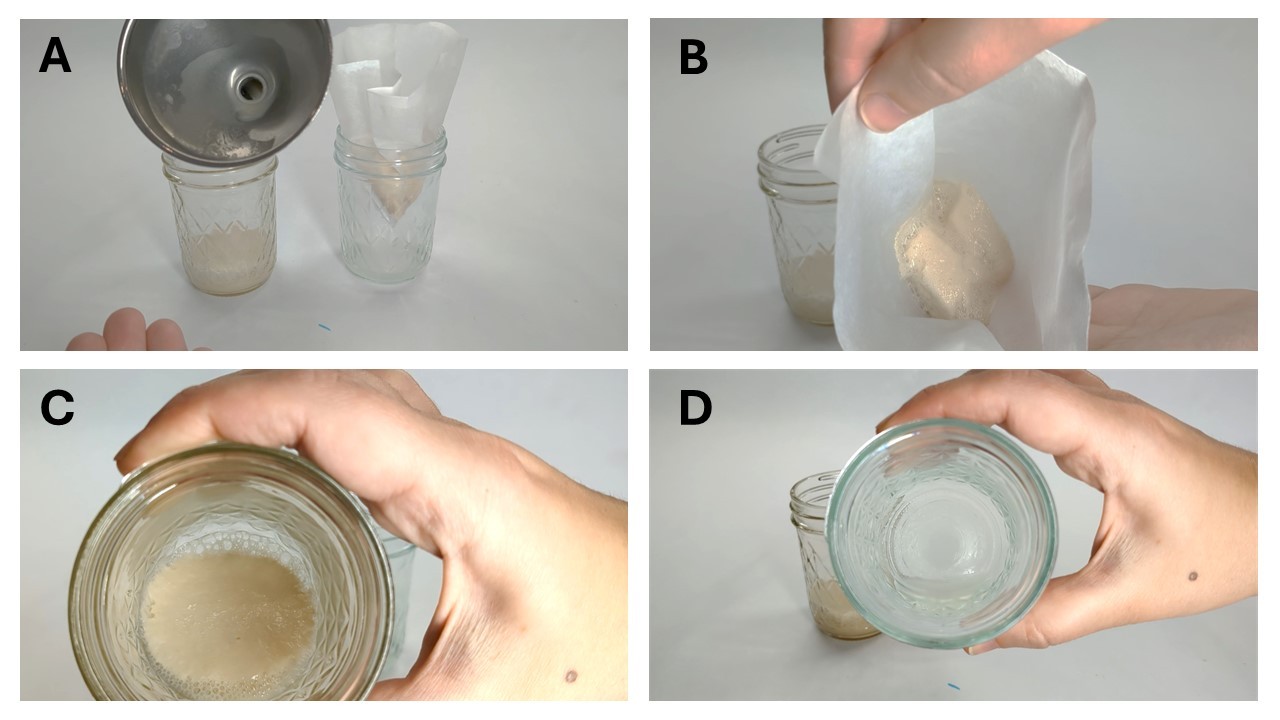
Figure 4. Expected results for the filtration of protein from cells. (A) The funnel is clear of cell debris. (B) The filter is full of yeast cell debris (pictured here undyed). (C) The unfiltered solution remains the same as the previous solution. (D) Filtered solution results in clear "purified protein."
/-/https/www.sciencebuddies.org/Files/21200/5/Figure4.jpg)
Reflect (5-10 minutes)
- Debrief the students on the main concepts of the lesson plan to help them remember and contextualize what happened in the experiment. Students saw how yeast activates in the presence of sugar, simulating the expansion of cells in a bioreactor. They then saw how the cells' expansion had to be halted with hydrogen peroxide while the dye simulated the “cell debris” extracted from the cells. Students then modeled the filtration process to purify their protein product from the “cell debris." This lesson plan demonstrates the scale needed for large bioreactors to create a small amount of protein products for therapeutic. It also illustrates to students the need for tons of cells to make a new therapeutic with these small but very effective biological medicines.
- With your students, reflect on the impact that the development of biologics had in the field of medicine. Biologics are revolutionary medicines that come from living organisms such as cells and microorganisms like yeast or bacteria. These medicines are hard to create outside of living organisms due to the complexity of the structure of biological molecules such as proteins. One example of a commonly sold biologic is insulin. Insulin is a hormone that regulates the amount of blood glucose in our bloodstream by facilitating the movement of glucose into our cells. Patients with diabetes often struggle to create this important hormone. Therefore, providing their bodies with insulin (when they cannot create or use their own insulin) will prevent them from becoming ill and can save their life. Companies that create biological medicines have also contributed to creating lifesaving and life-improving biologic medicines that treat skin diseases (dermatitis), breathing diseases (asthma), eye diseases (macular degeneration), and inflammatory diseases.
- Encourage students to ask more questions about biologic development, career options in this field, the research pharmaceutical and biotech companies do, or the drugs they develop. This is a great opportunity to highlight the many career opportunities students can get involved in the STEM field. If relevant, offer students advice on what steps they could take if they are interested in pursuing a career in the biopharmaceutical and biotech industry using our career connections and careers page.
- To conclude the lesson, inform students about what they learned today. They learned about the biomedical importance of and impact of the biopharmaceutical industry. They also learned how to model parts of the manufacturing process to create biological products for therapies, including the importance of using cells in this process to make medicines to treat diseases. Please encourage students to take the handouts home to tell their families and friends what they learned today.
Assess
You can use this quiz to assess student learning after the lesson plan:
- Quiz (pdf) and Answer Sheet (pdf)
Make Career Connections
Discussing or reading about these careers can help students make important connections between the in-class lesson and STEM job opportunities in the real world.
/-/https/careerdiscovery.sciencebuddies.org/Files/967/17/unsplash-d4KQc-ZqBrc.jpg)

/-/https/careerdiscovery.sciencebuddies.org/Files/956/18/unsplash-mVV0s8ZvEm4.jpg)
Lesson Plan Variations
- Have the students experiment with the amount of sugar, yeast, or hydrogen peroxide. How does it impact the experiment, and what does this model mimic in the biologic manufacturing process? Can you find the ideal combination of reactants to maximize the amount of protein product created?
- Test different filtration methods to determine the most effective way to isolate the proteins from the cells, using yeast as a cellular model.
/-/https/img.youtube.com/vi/w2meaXDflFQ/0.jpg)
/-/https/img.youtube.com/vi/M63ew2hxEKk/0.jpg)
/-/https/img.youtube.com/vi/xXqoGwIPiK8/0.jpg)