/-/https/www.sciencebuddies.org/Files/21464/5/sb-logo.png)
/-/https/www.sciencebuddies.org/Files/21464/5/sb-logo.png)
Abstract
LED lighting can add a cool ambient effect to a room, a device, or even the inside of a car. You may know that LED lights are more efficient than incandescent bulbs, but do you know how to design and build your own LED circuit? How would you minimize power consumption and maximize efficiency? In this project you will learn how to design and build your own LED circuits so you can add LED lighting effects wherever you want. Check out this page for more LED science projects.
Summary
Familiarity with Ohm's Law and circuit diagrams will be helpful when doing this project
Circuit parts required. See the Materials section for details.
Eye protection required
Objective
Design an LED lighting circuit for maximum efficiency.
Introduction
Light-emitting diodes, or LEDs for short, are electronic components that emit light when electrical current flows through them. LEDs come in many shapes and sizes (Figure 1) and are used in many different applications. Many electronic devices (TVs, computers, Wi-Fi routers, etc.) have status LEDs indicating when they are powered on or connected to the Internet. LEDs are replacing older incandescent and fluorescent bulbs in residential and automotive lighting applications and in handheld devices like flashlights. If you look around the room you are in right now, you can probably see one or more LEDs.
/-/https/www.sciencebuddies.org/Files/20030/9/LED-circuit.jpg)
/-/https/www.sciencebuddies.org/Files/20031/9/assorted-LEDs.jpg)
Figure 1. An assortment of LEDs.
Incandescent bulbs are made from traditional conductors. They rely on resistive heating to generate visible light. The filament inside an incandescent light bulb literally gets so hot that it glows, but this means that it also gives off a lot of infrared light, which is not visible to the human eye. Incandescent bulbs are therefore not very efficient for generating light, since much of the input electrical power is converted into heat. LEDs, on the other hand, are semiconductor devices, meaning they are made from materials that only conduct electricity some of the time. They are more efficient than incandescent bulbs, meaning they convert more of the input electrical power into visible light.
You can read more about the many uses of LEDs and the physics behind how they work using the resources in the Bibliography.
The rest of this introduction will focus on the math and physics you will need for practical LED circuit design if you want to make your own LED lighting circuit for a science or engineering project. This is where it will be helpful if you have taken a physics course that included a basic introduction to circuits and you are familiar with terms like voltage, current, and resistance. If you have not, do not worry—we will walk you through the equations you need to do this project, but you might need to do a little more background reading on these concepts. The references in the Bibliography can help.
Ready to get started? Then let's talk about circuit design!
The circuit design for a semiconductor-based LED is slightly more complicated than that for a resistive load like an incandescent bulb. A resistive load follows Ohm's Law:
Equation 1:
where
- V is the voltage across the resistive load, measured in volts (V)
- I is the current through the load, measured in amperes (A), called amps for short
- R is the resistance of the load, measured in ohms (Ω)
You can rearrange Ohm's Law to solve for current, showing that the current through a resistive load is determined by its resistance and the voltage across it:
Equation 2:
If you make a graph of current vs. voltage (called an I-V diagram) for a resistive load, it will be a straight line with a slope of 1/R (Figure 2). In other words, the relationship between current and voltage for a resistive load is linear. All of this means that if you directly connect a resistive load (like an incandescent light bulb) to a voltage source without any additional electronics, a small increase in the voltage will result in a small, proportional increase in the current.
/-/https/www.sciencebuddies.org/Files/20032/9/resistor-I-V-diagram.png)
Figure 2. A graph showing the linear relationship between current and voltage for a resistive load.
LEDs, however, have a nonlinear relationship between voltage and current (Figure 3), meaning they do not follow Ohm's Law. Remember that LEDs are semiconductor devices, meaning that sometimes they conduct and sometimes they do not. The current through an LED is almost zero until the applied voltage exceeds the threshold voltage, also called the forward voltage or voltage drop. The current then increases very rapidly. This can be a problem because a very small change in voltage can result in a very large change in current—and possibly too much current, which can then burn out the LED.
/-/https/www.sciencebuddies.org/Files/20033/9/LED-I-V-diagram.png)
Figure 3. A graph showing the nonlinear relationship between current and voltage for an LED.
We get around this problem by including a current-limiting resistor in series (as opposed to in parallel) with the LED, as shown in the circuit diagram in Figure 4. This resistor helps limit the current through the LED to safe levels.
This is also a good time to mention that LEDs have polarity, meaning current only flows through them in one direction (indicated by the way the arrow points in the circuit diagram). On the physical LED, the positive side, or anode, is the longer leg, and the negative side, or cathode, is the shorter leg.
/-/https/www.sciencebuddies.org/Files/20034/9/LED-circuit-diagram.png)
Figure 4. Circuit diagram for a circuit with a single battery, an LED, and a current-limiting resistor.
How do we know what resistor value to use in an LED circuit? First, we can analyze the circuit in Figure 4 by applying Ohm's Law to the resistor. (Remember, Ohm's Law does not apply to LEDs!) The voltage drop across the resistor is equal to the battery voltage minus the LED voltage. So writing Ohm's Law for the resistor gives:
Equation 3:
Since the resistor and LED are in series, the current through them must be the same. If the battery voltage, LED voltage, and desired LED current are known, we can solve for the resistor value by rearranging the equation to get Equation 4:
Equation 4:
You can look up the threshold voltage and rated current of your LED in its datasheet. You can usually find the datasheet online from wherever you bought your LEDs. If you cannot find the datasheet, many common LEDs are rated for 20 milliamps (mA) of current, so that is a good place to start. (Make sure you convert this value from milliamps to amps when using Equation 4.) The threshold voltage will depend on the LED's color. It is typically in the range of 2 V for red LEDs up to nearly 4 V for blue LEDs. You can easily find tables of LED color and voltage by searching online.
You can choose a value for the voltage supply based on what you have available or what you plan to purchase for a project. Common AA batteries provide about 1.5 V, so you can combine them in series to make power supplies of 3 V, 4.5 V, 6 V, etc. You could also use a 9 V battery or a wall adapter DC power supply, which is available at different voltages.
Once you know the battery voltage, LED voltage, and desired current, you can plug them all into Equation 4 to solve for a resistor value. However, you might not be able to find a resistor with the exact resistance value you need. Resistors are only commonly available in certain values.. Instead, you have a couple of options. One option is to choose the next biggest resistance. For example, if your calculations show that you need a 95 Ω resistor, you could use a 100 Ω resistor instead. This will ensure that the current through your LED is lower than the rated value. (If you choose a smaller resistor, then the current through the LED will go up, and you will risk burning it out sooner.) Another option is to combine multiple resistors in series and/or parallel to create an equivalent resistance with a value closer to your target value. We will discuss this option more in the procedure.
Even after you have chosen a resistor, you are not done yet! We do not want to burn out our LED, but we also need to avoid burning out the resistor. Unlike incandescent light bulb filaments, current-limiting resistors are not intended to give off any visible light. All of their electrical power is dissipated as heat. (If your resistor is glowing, you have a problem.) The electrical power P in watts (W) dissipated by the resistor is equal to
Equation 5:
If you substitute Ohm's Law into Equation 5, you can convert to this equivalent form, which lets you calculate the power dissipated by the resistor based on its resistance and the current through it. (Remember that this current is the same as the current through the LED, since they are in series.)
Equation 6:
All resistors have a maximum power rating. Many common resistors are rated at 1/4 W (250 mW). So, when designing an LED circuit, not only do you need to choose an appropriate current-limiting resistor, but you also need to make sure the resistor has an appropriate power rating so it does not burn out. If the power dissipated by your resistor is too high, you may need to redesign your circuit.
All of that effort just for one LED? What if you want a circuit with multiple LEDs? How do you design the circuit so power levels remain within safe limits for all the parts? How do you maximize efficiency and minimize waste heat dissipated by the resistors? The procedure of this project will walk you through the process!
Terms and Concepts
- Light-emitting diode (LED)
- Incandescent
- Fluorescent
- Conductor
- Resistive heating
- Visible light
- Infrared light
- Efficient
- Electrical power
- Semiconductor
- Voltage
- Current
- Resistance
- Resistive
- Ohm's Law
- Volt
- Ampere
- Ohm
- I-V diagram
- Linear
- Nonlinear
- Threshold voltage
- Current-limiting resistor
- Series
- Parallel
- Polarity
- Anode
- Cathode
- Datasheet
Questions
- Why are LEDs more efficient than incandescent bulbs?
- What are some uses for LED lighting?
- What are some important things you have to consider when designing an LED lighting circuit?
Bibliography
You can read more about LEDs, their uses, and the physics of semiconductors on Wikipedia:
- Wikipedia Contributors. (November 7, 2023). Light-emitting diode. Wikipedia. Retrieved November 14, 2023.
- Wikipedia Contributors. (November 6, 2023). Semiconductor. Wikipedia. Retrieved November 14, 2023.
If you have not taken a physics class about circuits yet, the following resources from SparkFun Electronics will be useful:
- Taylor, C. (n.d.). Voltage, current, resistance, and Ohm's law. SparkFun Electronics. Retrieved November 14, 2023.
- Dokter, P. (n.d.). Series and parallel circuits. SparkFun Electronics. Retrieved November 14, 2023.
- Lindblom, J. (n.d.). Resistors. SparkFun Electronics. Retrieved November 14, 2023.
- Lindblom, J. (n.d.). How to read a schematic. SparkFun Electronics. Retrieved November 14, 2023.
If you do not know how to use a breadboard or a multimeter, check out these Science Buddies resources:
- Finio, B. (n.d.). How to use a breadboard for electronics and circuits. Science Buddies. Retrieved November 14, 2023.
- Finio, B. (n.d.). How to use a multimeter. Science Buddies. Retrieved November 14, 2023.
Use these Science Buddies resources to learn more about the engineering design process and its differences from the scientific method:
- Science Buddies Staff. (n.d.). Engineering design process. Science Buddies. Retrieved November 14, 2023.
- Science Buddies Staff. (n.d.). Comparing the engineering design process and the scientific method. Science Buddies. Retrieved November 14, 2023.
Materials and Equipment
Note: This is an engineering design project. The exact parts you need will depend on your design. You should read the project procedure and do some math to design your circuit before you purchase parts.
- LEDs: size, color, and number of your choice. 5 mm LEDs are a common size.
- Solderless breadboard
- 22 AWG jumper wire kit. (You will also need wire strippers if you purchase spools of wire instead of pre-cut wires.)
- Resistor kit with assorted values. Resistors are available with different power ratings, but 1/4 W carbon film resistors are probably the most common.
- Power supply, such as batteries and a battery holder. Alternatively, you can use a DC wall adapter, but you will need an adapter to connect a barrel plug to wires for your breadboard. Choosing the power supply voltage is part of the circuit design for your project.
- Lab notebook
Disclaimer: Science Buddies participates in affiliate programs with Home Science Tools®, Amazon.com, Carolina Biological, and Jameco Electronics. Proceeds from the affiliate programs help support Science Buddies, a 501(c)(3) public charity, and keep our resources free for everyone. Our top priority is student learning. If you have any comments (positive or negative) related to purchases you've made for science projects from recommendations on our site, please let us know. Write to us at [email protected].
Experimental Procedure
/-/https/www.sciencebuddies.org/Files/20484/5/icon-gear.png)
Planning Your Circuit
- Think about how you want to use LED lighting. Do you want to have ambient LED lighting in your room? Do you want to build a portable device that you can bring to a party? A flashlight? Lighting for the inside of a car?
- Decide how many and what color LEDs you want for your circuit. This procedure will walk you through an example circuit design. You can then apply the same process to your own circuit.
- This is an engineering design project, so think about the design constraints and criteria for your circuit.
- At minimum, you need to make sure you do not burn out any of the resistors or LEDs in your circuit by passing too much current through them.
- Consider the total power consumption and efficiency of your circuit. How much power is drawn from the power supply? How much of that power is "wasted" in the resistors instead of being delivered from the LEDs?
- You may need to work within a certain budget, or you may only have certain options available for a power supply. Depending on where and how you want to use the device, will a wall outlet or car charger/adapter be available? Will it need to be battery powered?
- Watch the following three videos to make sure you are familiar with the basic calculations needed for this project.
/-/https/i.ytimg.com/vi/JkFkUTxMkCk/maxresdefault.jpg)
/-/https/i.ytimg.com/vi/OgRzJmu03VY/maxresdefault.jpg)
/-/https/i.ytimg.com/vi/xx5ou6n0GEU/maxresdefault.jpg)
Parallel Circuit
- Let us start with an example circuit that has one red, one green, and one blue LED. The parameters for each LED are shown in Table 1 (note that these are not the same values as the example shown in the video).
Table 1. LED parameters.LED Color Forward Voltage Current Red 1.8 V 30 mA Green 2.2 V 20 mA Blue 3.8 V 20 mA - For now, assume we have a 9 V battery available and decide to use that for our power supply. One simple circuit design is just to give each LED its own current-limiting resistor, and then put the three branches of the circuit in parallel as shown in Figure 5.
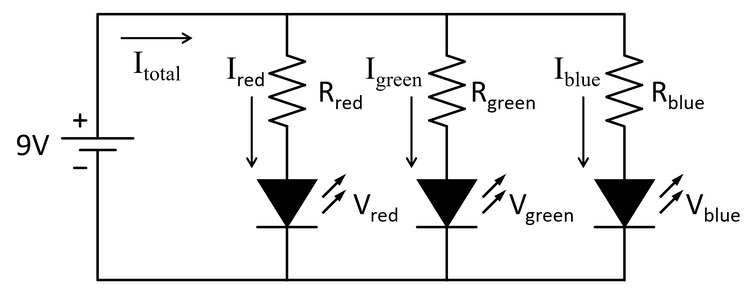
Figure 5. Circuit diagram for the red, green, and blue LEDs, each with its own current-limiting resistor, connected in parallel to the 9 V battery.
/-/https/www.sciencebuddies.org/Files/20035/9/LED-circuit-parallel.png)
/-/https/i.ytimg.com/vi/9ZQz2IUEtO8/maxresdefault.jpg)
- For this configuration, since the three branches of the circuit are in parallel, the voltage drop over each branch is equal to the battery voltage. We can apply Equation 4 from the introduction to calculate the current-limiting resistor value for each LED individually:
Equation 7 (red LED):
Equation 8 (green LED):
Equation 9 (blue LED):
- Our resistor kit does not have these exact values available, so we choose the next largest resistance value for each LED. That gives 270 Ω resistors for the red and blue LEDs and a 470 Ω resistor for the green LED.
- Changing the resistor value will change the current through the circuit. So, before we calculate the power dissipated by each resistor, we need to calculate the actual current through each branch of the circuit. We do that by rearranging Equation 4 to solve for current:
Equation 10:
Using this equation, we can find the current through each LED and its corresponding resistor:
Equation 11 (red LED):
Equation 12 (green LED):
Equation 13 (blue LED):
- Now, using Equation 6, we calculate the power dissipated by each resistor and make sure it is less than 250 mW. (Our resistors are rated for 1/4 W.)
Equation 14 (red LED's resistor):
Equation 15 (green LED's resistor):
Equation 16 (blue LED's resistor):
- So far, it looks like we are OK! Each LED is below its rated current and each resistor is below its rated power level. So this circuit meets the requirement for not burning out any of the LEDs or resistors. However, what about the power consumption and efficiency of the circuit?
First, we can calculate the total power dissipated in all three resistors by adding them together:
Equation 17:
We can also calculate the total power delivered to the circuit by the battery. We do this by multiplying the battery's voltage by the total current drawn from the battery. Since the three circuit branches are in parallel, their currents add. The total current drawn from the battery is:
Equation 18:
The total power drawn from the battery is:
Equation 19:
The amount of power delivered to the LEDs is equal to the total power from the battery minus the power dissipated by the resistors:
Equation 20:
However, the LEDs themselves are not 100% efficient. They do not convert 100% of the input electrical power to visible light—some of it is also lost as heat. LED datasheets will not always include an efficiency value, but you can use 50% as a rough estimate. That means that the total efficiency (η) of the circuit—the percentage of electrical power from the battery that is converted to visible light—is:
Equation 21:
So our circuit draws just over half a watt of power from the battery and is only 12.3% efficient. Just over three-quarters of the power drawn from the battery is wasted as heat dissipated in the resistors:
Equation 22:
Can we do anything to decrease overall power consumption or improve the efficiency of our circuit? Let us find out!
Series Circuit
- You may have noticed that a lot of voltage from the 9 V battery is "dropped" over the resistors in the circuit in Figure 5. The voltage drop over the individual LEDs is only about 2–4 V, depending on the color. That means that 5–7 V is dropped over the resistors, resulting in a lot of wasted power.
There are several ways we could improve this. One would be to choose a lower-voltage power supply (that is still high enough in voltage to power our LEDs). For example, you could use a 4xAA battery pack to put four 1.5 V AA batteries in series, giving a total voltage of 6 V. Then you could redo the calculations, starting back at step 5, to solve for new resistor values. However, let us assume for now that we only have a 9 V battery available to work with. Another option is to put the LEDs in series, as shown in Figure 6. In this configuration the circuit only requires one resistor. Since the LEDs are in series, their voltage drops add up, and less voltage is dropped over the resistor.
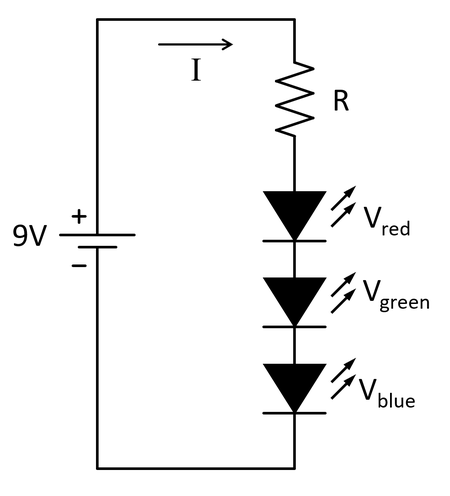
Figure 6. Circuit diagram for the red, green, and blue LEDs connected in series with a single current-limiting resistor
/-/https/www.sciencebuddies.org/Files/20036/9/LED-circuit-series.png)
/-/https/i.ytimg.com/vi/qZSP5-jYW34/maxresdefault.jpg)
- We can still calculate a resistor value using Equation 4, but this time we need to subtract the voltage drops over all three LEDs. We also need to choose a single value for the current, since the LEDs are in series and will all have the same current. To avoid burning out the blue and green LEDs, we will choose 20 mA, since that is the lowest value. That gives a resistor value of:
Equation 23:
- Again, our resistor kit does not have a resistor with a value of exactly 60 Ω, so we go up to the next biggest value, which is 68 Ω. We then calculate the actual current through the resistor:
Equation 24:
- Now we can calculate the power dissipated by the resistor, the power delivered by the battery, the total power delivered to the LEDs, the efficiency of the circuit, and the percentage of power dissipated in the resistors, just like we did before:
Equation 25:
Equation 26:
Equation 27:
Equation 28:
Equation 29:
You can see that we have dramatically reduced the power consumption of our circuit and improved its efficiency! Just by rearranging the parts, we have reduced the total power consumption of the circuit from 514.8 mW to 158.4 mW, a savings of nearly 70%. The overall efficiency of the circuit improved from only 12.3% to 43.3%, increasing by a factor of 3.5!
Combination Series-Parallel Circuit Design
- You might now think, "OK, great, so to design an LED circuit, you just put all the LEDs in series with a single resistor, right?" But it is not that simple. Here are a few things to consider:
- What if you want a circuit with dozens or even hundreds of LEDs? Putting them all in series would require a very high-voltage supply, out of range of most common battery packs and wall adapters. So it is not practical to just put all of the LEDs in series.
- What about properly tuning the brightness of the LEDs? We did not talk about this when we designed our series circuit and our parallel circuit. The brightness of an LED depends on how much current flows through it. In our series circuit, the green LED only had about 14 mA through it, since we had to choose a larger resistor. In the parallel circuit, the red LED only had about 20 mA, even though it was rated for 30 mA. In either case, the LED with less current might appear dimmer than the other LEDs.
- How, then, do you design a circuit with more than a few LEDs? You can build a combination series-parallel circuit, as shown in Figure 7. This circuit has multiple branches in parallel. Each individual branch consists of one or more LEDs and a resistor. You can analyze each branch individually and choose the resistor size based on the corresponding LED voltage drops using Equation 24.
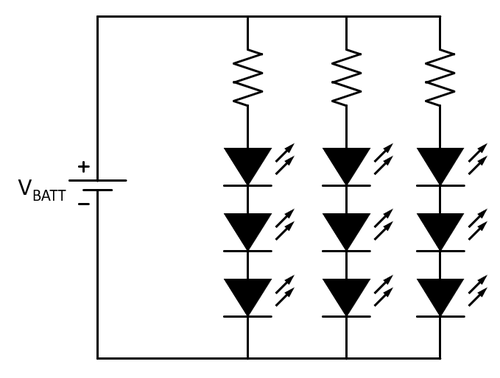
Figure 7. A combination series-parallel circuit with nine LEDs and three resistors. - Now that you have seen some examples, it is time for the open-ended engineering design part of this project. You will need to design a circuit based on the number and color of LEDs you want. For example, say that you want to build the circuit shown in Figure 7, with three each of red, green, and blue LEDs. Should each branch contain LEDs of all one color, or should each branch have one of each color LED? Should you choose a lower-voltage power supply and only put one or two LEDs in each branch instead of three? Which configuration will maximize efficiency and minimize overall power consumption from the battery? We will not do the math for you this time—it is up to you to figure out the best design for your circuit!
- Another tip: So far, we have only chosen single resistors. This can limit your choices, since common resistors are only available with certain values. You can combine resistors in series and/or parallel to create an equivalent resistor value according to Equations 30 (for series) and 31 (for parallel). For example, you can combine two 100 Ω resistors in series for an equivalent resistance of 200 Ω, and you can combine two 100 Ω resistors in parallel for an equivalent resistance of 50 Ω. Combining resistors to create different resistance values can allow you to more precisely tune the amount of current through your LEDs. However, adding more parts also increases the cost and complexity of a circuit, so there is a design trade-off. Remember that there is no right or wrong answer, since this is an engineering design project.
Equation 30:
Equation 31:
- Something else we have not addressed yet: In all of our circuits so far, the resistors go before the LEDs. What happens if you put the resistor after the LED? Does it matter? Does it affect the circuit design or analysis at all? You can do the math yourself to find out, but we also cover it in this video:
- There are many other things you can consider when designing your circuit. See the Variations section for more ideas.
/-/https/www.sciencebuddies.org/Files/20037/9/LED-series-parallel-circuit.png)
/-/https/i.ytimg.com/vi/NUKD9qESO58/maxresdefault.jpg)

Ask an Expert
Global Goals
The United Nations Sustainable Development Goals (UNSDGs) are a blueprint to achieve a better and more sustainable future for all.
/-/https/www.sciencebuddies.org/Files/19755/5/E-WEB-Goal-12.png)
Variations
- What about the cost of your circuit? What if you wanted to mass produce it? Can you figure out a circuit design that minimizes cost? Is it the same design that maximizes efficiency? If not, is there a trade-off? What if you factor in the cost of electricity to run the circuit (either the electricity from a wall outlet or the cost of replacing batteries periodically)? What do you consider the best overall circuit design?
- Use a multimeter to measure the actual current and voltage values in your circuit and compare them to your calculated values. How do they differ? Can you redesign the circuit so your actual measured values are closer to your target values, such as 20 mA current through an LED?
- The procedures we have used so far assume ideal battery behavior, meaning that the battery can provide a constant voltage with no internal resistance of its own. In reality, the voltage of a battery will decrease over time, and it will have a non-zero internal resistance that increases as the battery drains. Can you use a multimeter to measure the actual voltage of your battery? You can do an experiment to measure your battery's internal resistance or look up the internal resistance value in its datasheet. Can you account for real-world battery behavior in your circuit design? Does it significantly change your resistor values?
- This project showed you how to build a static LED circuit with fixed colors and brightness. You can use a microcontroller, like an Arduino, to control the brightness of LEDs and generate different colors with RGB LEDs. Check out our Arduino tutorial series to learn how.
- Can you solder a permanent version of your circuit instead of using a solderless breadboard? Check out our How to Solder Electronic Components page for help.
Careers
If you like this project, you might enjoy exploring these related careers:
/-/https/careerdiscovery.sciencebuddies.org/Files/1223/17/iStock-971549326.jpg)

/-/https/careerdiscovery.sciencebuddies.org/Files/1233/17/unsplash-b28ac533a45f.jpg)
/-/https/careerdiscovery.sciencebuddies.org/Files/20162/5/SemiconductorProcessorHeroImage.jpg)

/-/https/img.youtube.com/vi/shrrwhTZ-kA/0.jpg)
/-/https/img.youtube.com/vi/9ITx0WJKU0I/0.jpg)
/-/https/img.youtube.com/vi/7xkbXPzBTHE/0.jpg)