/-/https/www.sciencebuddies.org/cdn/Files/21464/5/sb-logo.png)
/-/https/www.sciencebuddies.org/cdn/Files/21464/5/sb-logo.png)
Can Biodegradable Materials Replace Plastic as Protective Food Packaging?
Abstract
Many foods, such as fresh fruits, vegetables, or eggs, are packaged in plastic to protect them from damage during handling and transport. But is plastic the best choice? What if a more sustainable and biodegradable material could replace it? Researchers have begun exploring hydrogels—squishy materials that can hold a lot of water—as alternative packaging materials. In this science project, you will make your own hydrogels from gelatin and cornstarch and investigate what ratio of ingredients makes the best packaging material. Can your hydrogels protect fruits or eggs from getting squashed?Summary
This project idea is based on the following paper:
How a Gel Can Protect an Egg: A Flexible Hydrogel with Embedded Starch Particles Shields Fragile Objects Against ImpactSairam Ganesh, Sai Nikhil Subraveti, and Srinivasa R. Raghavan
ACS Applied Materials & Interfaces 2022 14 (17), 20014-20022
DOI: 10.1021/acsami.2c01261
/-/https/www.sciencebuddies.org/cdn/Files/19515/5/wrapped-eggs-thumbnail.jpg)
Objective
Investigate the optimal gelatin-to-starch ratio in a hydrogel designed for protective food packaging.
Introduction
/-/https/www.sciencebuddies.org/cdn/Files/19515/5/wrapped-eggs-thumbnail.jpg)
Have you ever looked around a grocery store and noticed how much food is packaged in plastic? This is especially true for fragile foods, such as fresh produce (Figure 1) and eggs. Plastic packaging is often used to protect delicate foods from damage. During handling or transport, fruits and vegetables can be bruised or crushed. This damaged produce cannot be sold, so it goes to waste. Plastic packaging creates a protective layer around the fruit or vegetable. This layer can absorb part of the impact from bumps and drops. Some packaging is even specifically designed with cushioning materials, such as foam or air pockets, to provide additional protection from impact.
/-/https/www.sciencebuddies.org/cdn/Files/19516/5/fruit-plastic-packaging.jpg)
Figure 1. Plastic packaging for fresh produce is often designed to be used once, then discarded.
Plastic packaging can also extend the shelf life of fruits and vegetables. Plastic wrap and bags prevent air, water, and harmful bacteria from coming into contact with the food. As a result, the food stays fresh longer.
Although packaging fruits and vegetables in plastic can be effective, there is an increasing concern about all the plastic waste it creates. Plastic pollution has significant impacts on the environment. Much of the packaging used for food is single-use plastic—designed to be used once, then immediately discarded. Only a small percentage of plastic waste is recycled, and most plastic waste ends up in landfills or in the environment. Plastics are usually not biodegradable, which means they do not decompose naturally, so they stay in the environment for a long time. In the environment, plastic can cause a lot of harm to wildlife and entire ecosystems. Microplastic—tiny particles of plastic—has even been detected in human bodies and is a concern for human health. In addition, most single-use plastic products are made out of chemicals from fossil fuels and thus contribute significantly to greenhouse gas emissions. You can read more about the impacts of plastic in the sources listed in the Bibliography section.
Because of plastic's environmental impacts, researchers are exploring the use of more sustainable and eco-friendly alternatives for food packaging. One way to work toward creating sustainable alternatives is to use green chemistry. Green chemistry requires thinking about the starting materials, waste, and byproducts of your manufacturing process from the very beginning so that your design choices are as eco-friendly as possible. There are 12 principles that guide the green chemistry movement. These include reducing waste, reducing the use and creation of harmful chemicals, and being more efficient with energy and natural resources. You can hear Paul Anastas, one of the founders of the green chemistry movement, explain the concept of green chemistry in the video below.
/-/https/i.ytimg.com/vi/WIMHTWNYAoo/maxresdefault.jpg)
One green chemistry solution for plastic packaging currently being researched is hydrogel. Hydrogels are squishy materials made up of long chains of special molecules that link together like a net. They can soak up a lot of water without falling apart or dissolving. You might be familiar with hydrogels in the form of water gel beads (shown in Figure 2), which grow significantly in size when put in water.
/-/https/www.sciencebuddies.org/cdn/Files/19493/9/hydrogel-water-beads.jpg)
Figure 2. Water gel beads that grow when put in water are examples of a hydrogel.
Hydrogels have been investigated as packaging materials because they can absorb water and thus help avoid moisture-related problems with packaged goods. Since hydrogels are usually squishy, they can also be used as a protective layer to prevent damage to fragile goods, such as fresh produce or eggs. Hydrogels, like plastic, can be designed to have different material properties, such as mechanical strength or flexibility. They can also be designed to be biodegradable.
Researchers from the University of Maryland have recently designed a hydrogel made from gelatin and starch, which are both biodegradable materials. They did several tests to investigate their hydrogel's suitability as a food packaging material. One of the properties they tested was the material's coefficient of restitution. The coefficient of restitution (COR) measures how much a material can absorb the impact of a collision. This is important for a packaging material that needs to protect products from damage during handling and transport. The researchers' paper describes how the test works: A marble is dropped onto the material from a specific height (H), and then the height (h) to which the marble bounces is measured. The coefficient of restitution is calculated as , and it measures how elastic the collision between the marble and the material's surface is. The lower the coefficient of restitution, the more the material is able to absorb the impact of the marble.
In this science project, you will make a gelatin/starch hydrogel similar to the one described in the paper, except you will use cornstarch instead of specialty starch granules. Next, you will investigate whether your resulting product can protect certain foods from collision damage. Your task will be to explore how the gelatin-to-cornstarch ratio changes the properties of the hydrogel. Can you find the perfect recipe for a gelatin/starch hydrogel packaging material?
Terms and Concepts
- Pollution
- Biodegradable
- Greenhouse gas emissions
- Green chemistry
- Hydrogel
- Molecule
- Material property
- Gelatin
- Coefficient of restitution (COR)
Questions
- Why are many fruits, vegetables, eggs, and other fragile foods packaged in plastic?
- What are the environmental impacts of plastic?
- What are the 12 principles of green chemistry?
- What are hydrogels?
- Are hydrogels sustainable alternatives to plastic food packaging?
Bibliography
- Naik, M. (2017, November 10). What You Need to Know About Plastic Food Packaging. Food Safety Magazine. Retrieved April 3, 2023.
- Vijayakumar, A., Sunooj K.V. (2022, June 1). Hydrogel-Based Food Packaging: An Overview. Food Infotech. Retrieved April 3, 2023.
- Igini, M. (2022, May 15). We Need Sustainable Food Packaging Now. Here's Why. Earth.org. Retrieved April 3, 2023.
- UN Environment Programme. Our planet is choking on plastic. Retrieved April 3, 2023.
- Ganesh, S., Subraveti, S.N., Raghavan, S.R. (2022). How a Gel Can Protect an Egg: A Flexible Hydrogel with Embedded Starch Particles Shields Fragile Objects Against Impact. ACS Applied Materials & Interfaces, 14(17), 20014-20022. Retrieved April 4, 2023.
Materials and Equipment
- Pots with lids (3). Note: The pots don't need to be the same size. You can also use one pot and prepare the different gels one after the other, washing your pot in between.
- Masking tape
- Marker
- Stove
- Measuring cup
- Distilled water
- Digital scale, 0.1 g precision. Available from Amazon.
- Small bowls (5)
- Gelatin powder
- Cornstarch, about 150 g
- Fork
- Whisk
- Heat-resistant trays or containers (3), at least 17 cm long and 6 cm wide. Note: You can also use one container and prepare the different gels one after the other, washing the container in between.
- Refrigerator
- Sharp knife
- Cling wrap
- Glass marble, about 1–2 cm diameter
- Meter stick or ruler at least 40 cm long
- Camera or smartphone that can take slow-motion video
- Raw eggs (9)
- Tape
- Scientific calculator
- Pen or pencil
- Lab notebook
Disclaimer: Science Buddies participates in affiliate programs with Home Science Tools®, Amazon.com, Carolina Biological, and Jameco Electronics. Proceeds from the affiliate programs help support Science Buddies, a 501(c)(3) public charity, and keep our resources free for everyone. Our top priority is student learning. If you have any comments (positive or negative) related to purchases you've made for science projects from recommendations on our site, please let us know. Write to us at [email protected].
Experimental Procedure
/-/https/www.sciencebuddies.org/cdn/Files/20483/6/icon-flask.png)
Making the Hydrogels
- You will prepare hydrogels with three different gelatin-to-starch ratios. The ingredients for each recipe and their amounts are provided in Table 1. The amounts are calculated for a glass container with a length of 9 inches (about 23 cm) and a width of 7 inches (about 18 cm). If you use a different container, you will have to adjust your amounts. You want to make a hydrogel that is approximately 5 mm thick.
Swipe left to see more
Table 1. Hydrogel recipes.Ingredients Recipe 1: 0% starch Recipe 2: 10% starch Recipe 3: 20% starch Distilled water 150 mL 150 mL 150 mL Gelatin powder 15 g 15 g 15 g Cornstarch 0 g 15 g 30 g - Use tape and a marker to label the three pots and the three heat-resistant containers. Label one pot and one container "0% starch." Repeat with "10% starch" and "20% starch."
- Prepare your hydrogels. You can prepare them all at the same time or one after the other. For each hydrogel, follow these steps:
- Measure 150 mL of distilled water.
- Weigh 15 g of gelatin powder into a small bowl.
- Weigh the amount of cornstarch you need for your hydrogel (given in Table 1) into another small bowl.
- Pour a small amount of the measured distilled water into the bowl with the cornstarch. Use a fork to mix the cornstarch with the water, making sure all the cornstarch is dissolved. This will prevent the cornstarch from forming clumps in the hydrogel later.
- Pour the remaining water into the appropriately labeled pot. Place the lid on the pot and bring the water to a boil.
- Once the water is boiling, add the 15 g gelatin and the dissolved cornstarch to the water. Use a whisk to mix until everything is dissolved.
- Carefully pour the hot mixture into the appropriately labeled heat-resistant container. Note: If there are lots of air bubbles on the surface of the gel, take a spoon or fork and skim them to the sides of the container.
- Put all three containers into the refrigerator to let the hydrogels solidify. Make sure to put the containers on a flat surface. It takes at least one hour for the hydrogel to solidify. You can check whether the hydrogel has solidified by carefully poking the gel with your finger.
- Once the hydrogels are solid, take them out of the refrigerator. With a sharp knife, cut around the edges of the glass containers to separate the gels from the containers. Then carefully peel the gel out of each container.
- Wrap each hydrogel in a piece of cling wrap and label it with the appropriate starch percentage. Note: The gels should not be stored longer than 3 days in the cling wrap.
- Repeat steps 2–6 two more times. When you are done, you will have three hydrogel sheets for each starch percentage. You will do each of your tests with all three sheets. Repeating an experiment multiple times is good practice in science and helps to ensure that you can trust your results.
Testing the Hydrogels
- Qualitative description. Before you start cutting your hydrogels, look at each of them closely and make notes about how they look, feel, etc. Record your observations in a data table like Table 2.
Swipe left to see more
Table 2. Data table to record the qualitative features of the different hydrogels.Hydrogel Qualitative description of the hydrogel Recipe 1: 0% cornstarch Recipe 2: 10% cornstarch Recipe 3: 20% cornstarch - Coefficient of restitution (COR). In this test, you will investigate how well your hydrogel can absorb the impact of a collision, which is an important property for protective packaging materials. To measure the COR, make a data table like Table 3 in your lab notebook and follow steps a–h to test all of your hydrogels.
- From each of your three gels with 0% cornstarch, cut a 6 cm x 6 cm piece with a sharp knife. Make sure your gel piece is free of defects such as tears, large bubbles, or ridges.
- Measure the thickness of your gel pieces with a ruler. Record your measurements in millimeters in your data table. All gels should have the same thickness.
- Lay one of the gel pieces flat on a table or a plate. Next to it, place a ruler upright, with the zero mark at the bottom, as shown in Figure 3. You can set the ruler against an object to make it stand up, but the ruler should be straight and not lean in any direction.
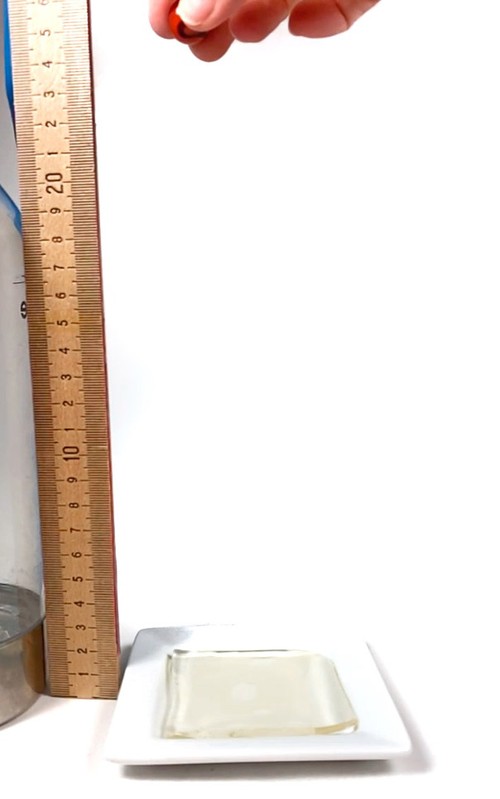
Figure 3. Experimental setup for the COR measurements. - Set up a camera facing the ruler. Put the camera in slow-motion video mode. In your camera frame, you should be able to see the gel at the bottom and the 25 cm mark on the ruler at the top, as shown in Figure 3.
- Start the slow-motion video. Then take the glass marble and hold it at the 25 cm (or 10 inch) mark of the ruler , as shown in Figure 3. Line up the bottom of the marble with the 25 cm mark. (You will do this for every trial.) Let the marble drop directly onto the gel piece.
- Stop the camera and view the video. Your drop height (H) is 25 cm (or 10 inches). In the video, find the highest point that the bottom of the marble reaches on its first bounce, after it touches the gel for the first time. Read the ruler at that point and record the bounce height (h) in centimeters in your data table.
- Repeat steps e and f with the remaining two gel pieces with the same cornstarch percentage.
- Repeat steps a–g with the 10% cornstarch and 20% cornstarch hydrogels.
/-/https/www.sciencebuddies.org/cdn/Files/19517/6/COR-setup.jpg)
| Trial | Thickness in mm | Drop height H in cm | Bounce height h in cm (derived from video) |
Coefficient of restitution (COR) |
|---|---|---|---|---|
| Hydrogel recipe 1: 0% cornstarch | ||||
| 1 | 25 | |||
| 2 | 25 | |||
| 3 | 25 | |||
| Average | 25 | |||
| Hydrogel recipe 2: 10% cornstarch | ||||
| 1 | 25 | |||
| 2 | 25 | |||
| 3 | 25 | |||
| Average | 25 | |||
| Hydrogel recipe 3: 20% cornstarch | ||||
| 1 | 25 | |||
| 2 | 25 | |||
| 3 | 25 | |||
| Average | 25 | |||
- Food packaging test (egg). In this test, you will investigate how well your hydrogel can protect fragile products—in this case, an egg—from impact damage. To measure how well your hydrogel protects fragile foods, make a data table like Table 4 in your lab notebook and follow steps a–g to test all of your hydrogels.
- From each of your three gels without cornstarch, cut a 17 cm x 6 cm piece with a sharp knife. Make sure your gel pieces are free of defects such as tears, large bubbles, or ridges.
- Wrap an egg in one of the hydrogel strips, as shown in Figure 4. Use one piece of tape to hold the hydrogel strip together. While wrapping the egg with the hydrogel, observe how stiff or flexible the gel is. How easy is it to roll the hydrogel? Does it break or crack when you wrap it around the egg? Record your observations in your data table.
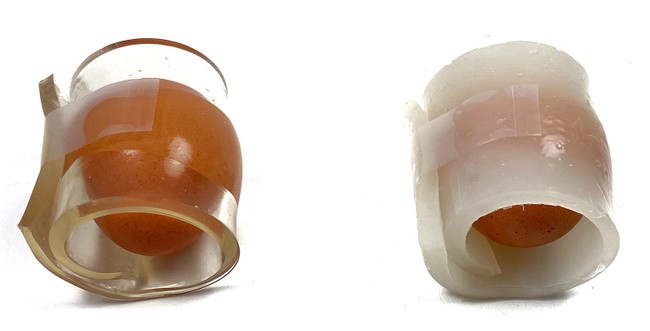
Figure 4. Eggs wrapped in two different hydrogel sheets. - With one hand, hold the ruler upright on a table or other flat surface, as shown in Figure 5. The surface should be relatively hard, like wood, marble, or stone. With the other hand, hold the wrapped egg next to the ruler so that its bottom lines up with the 38 cm (or 15 inch) mark. Hold the egg so the taped, double-layered hydrogel part is on the top, and the single-layered hydrogel part is at the bottom. Let the egg drop onto the hard surface. Carefully unwrap the egg and check whether it cracked upon impact. Record your result in the data table.
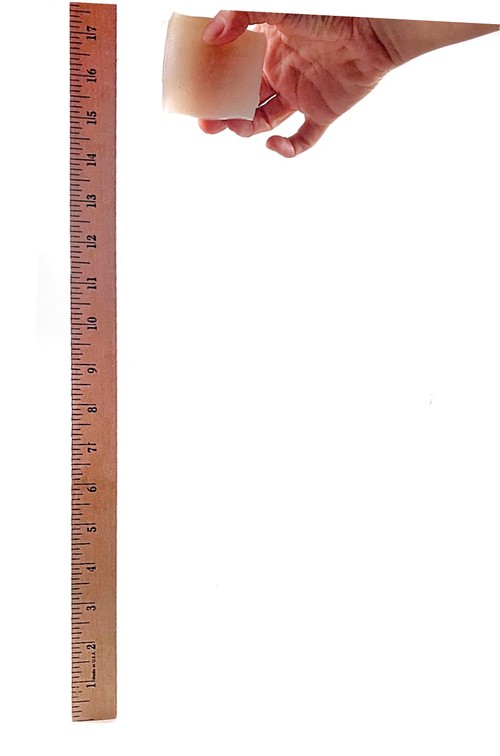
Figure 5. Experimental setup for the food packaging test. - Repeat steps b and c with the remaining two gel pieces with the same cornstarch percentage. Use a new egg for each trial.
- Repeat steps a–d with the 10% cornstarch and 20% cornstarch hydrogels.
/-/https/www.sciencebuddies.org/cdn/Files/19518/5/wrapped-eggs.jpg)
/-/https/www.sciencebuddies.org/cdn/Files/19519/5/egg-drop-setup-straight.jpg)
| Trial | Did the gel break during egg wrapping? | Did the egg break upon impact? | ||
|---|---|---|---|---|
| Hydrogel recipe 1: 0% cornstarch | ||||
| 1 | /-/https/www.sciencebuddies.org/cdn/Files/19331/9/check-yn.png) |
|
|
|
| 2 | |
|
|
|
| 3 | |
|
|
|
| Total | __ yes | __ no | __ yes | __ no |
| Hydrogel recipe 2: 10% cornstarch | ||||
| 1 | |
|
|
|
| 2 | |
|
|
|
| 3 | |
|
|
|
| Total | __ yes | __ no | __ yes | __ no |
| Hydrogel recipe 3: 20% cornstarch | ||||
| 1 | |
|
|
|
| 2 | |
|
|
|
| 3 | |
|
|
|
| Total | __ yes | __ no | __ yes | __ no |
Analyzing Your Data
- Coefficient of restitution
- For each hydrogel recipe and each trial, use the drop height H (25 cm) and your measured bounce height h of the marble in your data table 2 to calculate the coefficient of restitution. To do so, first divide the bounce height h by the drop height H (h/H) and then use a calculator to calculate the square root of h/H. Record the results in your data table.
- For each hydrogel, use the data from all three trials to calculate the average COR. To do so, add together the calculated CORs of all three trials, then divide the result by three. Record the results in your data table.
- Make a bar graph of your data. Put the cornstarch percentage on the x-axis (the horizontal axis) and the average COR on the y-axis (the vertical axis).
- Food packaging test
- Review your data table 4. For each question, count the total number of "yes" and "no" answers for each hydrogel. Record the results in your data table.
- Make a bar graph that shows how often the hydrogel broke while wrapping the egg. This data represents how stiff or flexible your hydrogel is.
- Put the cornstarch percentage on the x-axis and the number of "yes" answers for this question on the y-axis.
- Using a different color, add a second data series to the graph that shows the number of "no" answers for this question.
- Make a bar graph that shows how often your egg broke for each hydrogel. This data represents how well the hydrogel protects fragile food from impact.
- Put the cornstarch percentage on the x-axis and the number of "yes" answers for this question on the y-axis.
- Using a different color, add a second data series to the graph that shows the number of "no" answers for this question.
- Look at your data tables, graphs, and observations to draw a conclusion from your results about which hydrogel recipe makes the best food packaging material. Take the following questions into consideration.
- How did the different cornstarch percentages affect the hydrogel properties?
- What similarities or differences do you see between the different hydrogel sheets?
- How is the COR different for the different hydrogels? What does this mean for their suitability as a packaging material?
- Which hydrogel performed best in protecting the egg from impact? Did you expect your results?
- Is there a possibility that other factors could have affected your test results? If yes, which ones?
- Based on your results, do you think hydrogels like the gelatin/starch hydrogel are a good food packaging alternative to protect food from damage? Think about other factors that might be important for food packaging materials.
- Do you think the hydrogel you made in this project is more or less sustainable than conventional plastic packaging? Use the 12 principles of green chemistry to answer this question.

Ask an Expert
Global Goals
The United Nations Sustainable Development Goals (UNSDGs) are a blueprint to achieve a better and more sustainable future for all.
/-/https/www.sciencebuddies.org/cdn/Files/19755/5/E-WEB-Goal-12.png)
Variations
- In this project, you used an egg to test whether your hydrogel could protect fragile foods from collision damage. You can do a similar test with other foods—for example, blueberries. Cut two 6 cm x 6 cm pieces of the hydrogel and place a blueberry between the two sheets. Then take a 50 g or 100 g weight and drop it from a certain height onto the blueberry between the hydrogel sheets. Each time, check whether the blueberry has been crushed. Change the amount of weight or the drop height and investigate which of the hydrogels protects the blueberry best.
- Protection from damage is one reason for packaging fragile foods in plastic, but plastic packaging that seals a product (like plastic wrap or bags) can also prevent air, water, or harmful bacteria from coming into contact with the food. This means the food stays fresh longer. Can you design an experiment to find out whether sealing food in a gelatin/starch hydrogel can extend the shelf life of fruits or vegetables? How long does it take for fruit packaged in the hydrogel to spoil compared to unpackaged fruit or fruit packaged in plastic?
- Test how thick the hydrogels have to be to offer reasonable protection for fragile foods. Vary the thickness of your hydrogels and repeat the tests in this science project to find out how your results change.
- Making hydrogels from gelatin and cornstarch is just one possibility. There are other hydrogel materials, such as collagen or agar powder. Can you make hydrogels from these materials? How are their material properties different from the gelatin hydrogel you made in this project?
- Investigate how biodegradable the gelatin/starch hydrogel is. How long does it take to break down under different conditions?
- If you are fascinated by hydrogels and their applications, you might be interested in trying Science Buddies' other hydrogel projects, such as the Testing the Hydrating Power of Hydrogel Face Masks and Create and Test Your Own Hydrogel Face Mask Recipe! science projects.
Careers
If you like this project, you might enjoy exploring these related careers:
/-/https/careerdiscovery.sciencebuddies.org/cdn/Files/1429/17/unsplash-4pM4nhHyo9M.jpg)

/-/https/careerdiscovery.sciencebuddies.org/cdn/Files/20209/5/chemical-engineer-citgo.jpg)
/-/https/careerdiscovery.sciencebuddies.org/cdn/Files/1107/19/pexels-photo-3938023.jpg)
/-/https/careerdiscovery.sciencebuddies.org/cdn/Files/1147/17/unsplash-fJebhGIP0P4.jpg)

/-/https/img.youtube.com/vi/AYilKfcp3PM/0.jpg)
/-/https/img.youtube.com/vi/E6Kw1YL03zk/0.jpg)
/-/https/img.youtube.com/vi/ZWJfIdZOpP4/0.jpg)