/-/https/www.sciencebuddies.org/cdn/Files/21464/5/sb-logo.png)
/-/https/www.sciencebuddies.org/cdn/Files/21464/5/sb-logo.png)
Abstract
Have you ever wondered how you could help yourself or your classmates focus or perform better in class? Many students do! Some kids diagnosed with a neurodevelopmental disorder learn better in different ways, and easy changes while performing a task can make a huge difference to them. In this science project, you'll test if standing can significantly improve your performance and if this further improves performance for those who have neurodevelopmental disorders.
Summary
For ISEF-affiliated science fairs, studies involving human subjects require prior approval. For more information, see Projects Involving Human Subjects.
Readily available
No issues. Please be respectful when speaking about neurodevelopmental disorders.
/-/https/i.ytimg.com/vi/3RxkeBMEcBE/maxresdefault.jpg)
Objective
To test whether movement during executive function tasks can improve performance for individuals who are diagnosed with a neurodevelopmental disorder.
Introduction
When you're diagnosed with a neurodevelopmental disorder, what does that mean? Neurodevelopmental disorders include a large number of disorders, which means that your brain develops differently, resulting in differences in how it works. The most prevalent neurodevelopmental disorders include attention-deficit hyperactivity disorder (ADHD) and autism spectrum disorders (ASD). In the US, there is a high prevalence of these diagnosed disorders. What causes neurodevelopmental disorders? A majority of them are caused by genetic factors, meaning they are caused by changes in our genetic material. However, some are due to environmental factors. In fact, both genetics and environmental factors can contribute to changes in neurodevelopment. Often, these brain differences emerge early on in life, making some tasks easier and others harder. Some common features of these differences are seen in Figure 1. While neurodiversity may be used as a common term in the classroom to identify students with learning differences, it's important to remember that the meaning of this term is constantly evolving and is not a specific medical diagnosis.
/-/https/www.sciencebuddies.org/cdn/Files/21611/5/Figure1_Neurodevelopmental-Disorders-Strengths-Challenges.jpg)
Common challenges and strengths for neurodevelopmental disorders, include sensory sensitivity, emotional regulation, executive function, hyperfocus/special interests, and rejection sensitivity.
Since this population's brains have slightly different neuronal connections, many students struggle with traditional learning methods and classroom structures. However, alternative learning methods and strategies can sometimes help this population engage better in classrooms and thrive with their unique learning capabilities. For example, in a scientific study, kids with the neurodevelopmental disorder ADHD performed better at executive function tasks when they were moving (standing freely or walking) over sitting still. Executive function is a set of the brain's skills used to perform goal-directed tasks. For example, identifying cards with colored shapes and matching them with cards with a matching category (shape, color, number of shapes). Many educators have started to use this scientific knowledge to their advantage by helping students identify ways to improve their focus to maximize their thinking abilities.
In this science project, you will test whether these changes in movement can improve executive function for those with neurodevelopmental disorders. You will also learn if this change in movement improves overall executive function for everyone.
Terms and Concepts
- Diagnosed
- Neurodevelopmental disorders
- Attention-deficit hyperactivity disorder (ADHD)
- Autism spectrum disorders (ASD)
- Genetics
- Environmental
- Neurodiversity
- Population
- Executive Function
- Informed consent
- Cross-over study
- Blind
- De-identification
- Randomization
Questions
- What is a neurodevelopmental disorder?
- What are common neurodevelopmental disorders?
- What are some strategies that can help improve learning for someone with a neurodevelopmental disorder?
- What is executive function?
- What are some examples of how you can test executive function?
- How has executive function been shown to be improved for those with ADHD? Give an example.
- How do you learn best?
Bibliography
- Barudin-Carreiro, Amanda. (2024, March 13.) Acute Effects of Walking and Standing on Executive Function in Children with Attention Deficit/Hyperactivity Disorder: A Feasibility Study. Retrieved September 2, 2025.
Materials and Equipment
- 20 participants total (minimum), 10 diagnosed with a neurodevelopmental disorder (examples include ADHD or ASD)
- Each participant will be randomly assigned to one of the 2 conditions (sit, stand) to start
- Informed consent forms
- Computer or laptop to show the video or slide show
- Phone or video recording device (to record the performance and reaction time of participants)
- Provided video or PowerPoint presentation of the Wisconsin Card Sorting Test (WCST) that includes categories for shape, number, and color
- Lab notebook
Experimental Procedure
/-/https/www.sciencebuddies.org/cdn/Files/20483/6/icon-flask.png)
Working with Human Test Subjects
There are special considerations when designing an experiment involving human subjects. Fairs affiliated with Regeneron International Science and Engineering Fair (ISEF) often require an Informed Consent Form (permission sheet) for every participant who is questioned. Consult the rules and regulations of the science fair that you are entering, prior to performing experiments or surveys. Please refer to the Science Buddies documents Projects Involving Human Subjects and Scientific Review Committee for additional important requirements. If you are working with minors, you must get advance permission from the children's parents or guardians (and teachers if you are performing the test while they are in school) to make sure that it is all right for the children to participate in the science fair project. Here are suggested guidelines for obtaining permission for working with minors:
- Write a clear description of your science fair project, what you are studying, and what you hope to learn. Include how the child will be tested. Include a paragraph where you get a parent's or guardian's and/or teacher's signature.
- Print out as many copies as you need for each child you will be surveying.
- Pass out the permission sheet to the children or to the teachers of the children to give to the parents. You must have permission for all the children in order to be able to use them as test subjects.
- Use the provided video embedded in this page or download the accompanying PowerPoint presentation of the Wisconsin Card Sorting Test (WCST). The categories and cards are in random order.
- Note: If you are using the PowerPoint presentation, you can use the timing function to keep the time between trials and the total timing of the test for each participant consistent. This is important to ensure everyone receives the same timed test. The downloaded PowerPoint slides have a timer set to advance each slide after 5 seconds. If you are using your own slides and want to add a timer, you can do this under the transitions tab by selecting to advance the slide and applying this to all slides. If this is too fast in your initial testing by yourself or if you are working with a younger group of participants, you can increase the time to 10 seconds per slide. Just make sure you use the same timing for all participants.
- Inform the participants what the experiment will entail and obtain written informed consent from them to participate in the trial. Remind the participants that they can stop participating in the study at any time.
- Let the participants know that they will be asked to participate in the Wisconsin Card Sorting Task (WCST) to assess executive functioning. During the task, they may be asked to sit or stand. They will be a part of a cross-over study and repeat the WCST task for the opposite condition (sit or stand).
- Ask the participant if they are okay with being recorded so that you can accurately measure their reaction time and accuracy on the task. Inform the participant that the video will only be used for this study.
- Be respectful when speaking about neurodevelopmental disorders. Have a person not involved in the administration of the WCST politely ask the participants if they've been diagnosed with a neurodevelopmental disorder to check that you have enough participants for each diagnostic group (10 each). Then, inform the participants that you will temporarily de-identify their data from their diagnoses by giving them a random number.
- Ask the person to create a small key that has the participant's de-identification number and medical diagnoses in it. Do not use it, yet! You will use this key to analyze the group data later. Doing this will help you to be blinded during the data analysis part of the project. Blinding is used to prevent bias in the interpretation of the data. Although it is best practice to perform a study like this blinded, if you do not have another person to help with this, you can perform the process unblinded.
- Next, record the participant number and the age of each participant in Table 1.
Swipe left to see moreTable 1. Example data collection table for participants' intervention (sit, stand) and performance on the WCST. Participant De-identification Number Age (yr) Condition for WCST Trial 1 (sit or stand) Percent Accuracy on WCST Trial 1 (%) Average reaction time to answer WCST Trial 1 (sec) Condition for WCST Trial 2 (sit or stand) Percent Accuracy on WCST Trial 2 (%) Average reaction time to answer WCST Trial 2 (sec) 1 2 ... - Randomly assign each participant to one of the conditions (sit, stand) for their first attempt at the WCST. This is part of a process called randomization. Record which condition the participant partakes in trial 1 in Table 1.
- Before you start, inform the participant that they will be asked to identify which card below the dotted line matches the category of the top card. These categories include the shape, color, or number of shapes on the card. Show the example in Figure 2.
- For example, if the top card has two blue triangles, and the category is shape, you would choose the first card with triangles.
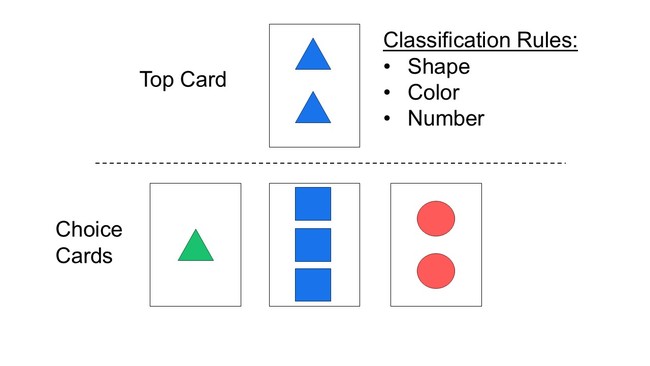
Image of example of Wisconsin card sorting test including top card that will state which classification rule to follow to pick the matching catch from the choice cards below the dotted line.
Figure 2. Example of the Wisconsin Card Sorting Test (WCST). This figure shows all three possible categories of potential matches. However, the provided WCST will only show two possible choice cards per category at a time.
- For example, if the top card has two blue triangles, and the category is shape, you would choose the first card with triangles.
- Administer the first trial of the WCST to the participant.
- Ask the participant to sit or stand.
- Then, ask them to place their finger on a piece of tape or mark on the table between each slide or after selecting the category that matches the top card, from the two choice cards below the dotted line.
- Before starting and with their consent, video record the participants throughout the task, so you can measure their reaction time and the accuracy of their performance in the test after administering it. Make sure the video includes the participant's hands, the table marking, and the screen with the WCST. Once the test has started, stand out of the participant's field of view or ensure not to interact with the participant during the test or react to their choices.
- Remember to keep the time that each card is presented to each participant consistent between trials and participants. This is kept consistent if using the provided PowerPoint slides or video.
- When you both are ready, start the PowerPoint slide show or start the video.
- After the presentation is complete, inform the participant that they have completed trial 1 of the WCST.
- Administer the second trial of the WCST, and ask the participant to perform the opposite condition (sitting or standing).
- Use the instructions above for how to administer the test. If participants sat for their first trial, ask them to stand for their second trial. Record in Table 1 which condition the participant participates in for trial 2. After the participants have completed each task, thank them for participating in your study.
- Analyze the performance of each participant using the recorded vidoes.
- Score the reaction time of each participant by measuring the time it takes for the participant to move their finger from the mark to the card they choose, regardless of whether it was the correct category choice or not. If you used the PowerPoint slides or video there are 9 rounds total in the WCST task provided. Use Equation 1 to calculate the average reaction time for each participant, and record the result in Table 1.
-
Count the number of correct answers given for the entire test. Then, calculate the percent accuracy of their category picks on the WCST, using Equation 2.
Equation 1.Equation 2.
- Using your de-identification key, identify which participants belong to which group. This process is known as unblinding yourself. Analyze the results of each participant's group so that you can analyze the impact that the standing intervention had on executive function, from a sample size of the larger population.
- Count the number of participants in each group and record the results in Table 2. This is why pre-screening for diagnoses is important, to represent each group similarly. Does each group have the recommended sample size? Does one group have more participants than another?
- Calculate the average age for each group, and record the results in Table 2. Are they similar, or do they drastically differ? Could this impact your results?
- Calculate each group's performance by calculating the average accuracy on the WCST while sitting or standing using Equation 3. Record your results in Table 2.
- Calculate each group's average reaction time while sitting or standing using Equation 4. Record your results in Table 2.
Equation 3.Equation 4.
Swipe left to see moreTable 2. Summary table of participants de-identified to their respective groups.
Participant group Control or Non-neurodevelopmental disorder group Neurodevelopmental disorder group Number of participants per group Average age (yr) Average group accuracy on WCST while sitting (sec) Average reaction time on WCST while sitting (%) Average group accuracy on WCST while standing (%) Average reaction time on WCST while standing (%) - Answer the following questions to further analyze the summary results from Table 2.
- Did all participants have higher accuracy on the executive task when standing or sitting? Was there a bigger difference between conditions (sitting or standing) in one participant group or the other?
- Was the reaction time shorter or longer on the executive task when standing or sitting? Was this similar or did this differ for each participant group?
- What do these results tell you about this intervention to improve executive function performance or time? Use your results to inform your answer.
- Do your results differ, or are they similar to previous studies (like the paper in the bibliography or other human clinical studies)?
/-/https/www.sciencebuddies.org/cdn/Files/21584/6/Figure2_Wisconsin_Card_Sorting_Test_Example.jpg)

Ask an Expert
Global Goals
The United Nations Sustainable Development Goals (UNSDGs) are a blueprint to achieve a better and more sustainable future for all.
/-/https/www.sciencebuddies.org/cdn/Files/19747/5/E-WEB-Goal-04.png)
/-/https/www.sciencebuddies.org/cdn/Files/19753/5/E-WEB-Goal-10.png)
Variations
- Test other learning interventions to see if they improve executive function for those with neurodevelopmental disorders. Does walking around or jumping during the task improve or worsen executive function?
- What was the age range of your participants? Does performance on these tests increase or decrease with age? As we age, our brains further develop, so we can perform better on executive functioning tasks. However, aging can also impact our performance on these tests due to reduced brain function. Is there a better way to subdivide or group this data by age group or brackets?
- Many other confounding variables can impact executive function task performance. Ask your participants about their general well-being before starting the assessment. Did poor sleep or a recent illness impact their overall performance? Did most participants perform better on trial 1 compared to trial 2? This can be a confounding variable called learning bias or practice bias, which is why the condition order is randomized. To learn more about how to assess someone's sleep quality, check out this project idea that uses a wearable device to infer and monitor sleep stages.
- Does movement help with executive function for other types of neurological disorders? For example, is it helpful for learning disabilities such as dyslexia or dyscalculia? What about neurodegenerative disorders, and does the stage of disease progression matter?
- Investigate other ways to assess executive function. For example, use our instructions to administer the Stroop Color-Word Test. Alternatively, you could use verbal card sorting tasks.
- Could you automate the data collection for this project by coding to create a program? Use Scratch to make data collection quicker for this project. Use a similar project we developed to help you get started!
Careers
If you like this project, you might enjoy exploring these related careers:
/-/https/careerdiscovery.sciencebuddies.org/cdn/Files/1522/17/unsplash-FVh_yqLR9eA.jpg)

/-/https/careerdiscovery.sciencebuddies.org/cdn/Files/1463/18/iStock-1156456853.jpg)
/-/https/careerdiscovery.sciencebuddies.org/cdn/Files/1470/17/iStock-1207514066.jpg)

/-/https/img.youtube.com/vi/flk0PX3WJe0/0.jpg)
/-/https/img.youtube.com/vi/MIMBqH2o8vw/0.jpg)
/-/https/img.youtube.com/vi/OEkw3F7RZ3w/0.jpg)