/-/https/www.sciencebuddies.org/Files/21464/5/sb-logo.png)
/-/https/www.sciencebuddies.org/Files/21464/5/sb-logo.png)
What To Do About CO₂?
Summary
/-/https/www.sciencebuddies.org/Files/18159/10/logo-beyond-benign-high-res.png)
/-/https/www.sciencebuddies.org/Files/18972/7/carbon-dioxide-dry-ice.jpg)
Overview
Where does CO₂ come from and how does excess carbon dioxide in the atmosphere affect the ocean and aquatic life? In this lesson students are introduced to the carbon cycle and explore pH and acidification with hands-on experiments. They then connect their experimental data with real-world data to evaluate claims about carbon dioxide and ocean acidification. Finally, students are introduced to how different companies and research groups are using green chemistry to build carbon capture technologies and use that carbon as a material for new eco-friendly products.
Learning Objectives
- Recognize and understand the pH scale.
- Determine through experimentation how carbon dioxide acidifies water.
- Understand that the atmosphere and hydrosphere are connected planetary systems.
- Analyze how the greenhouse gas CO2 contributes to climate change.
- Hypothesize the impacts of carbon capture technologies.
NGSS Alignment
This lesson helps students prepare for these Next Generation Science Standards Performance Expectations:- 5-ESS2-1. Develop a model using an example to describe ways the geosphere, biosphere, hydrosphere, and/or atmosphere interact.
- MS-ESS3-4. Construct an argument supported by evidence for how increases in human population and per-capita consumption of natural resources impact Earth's systems.
- HS-ESS2-2. Analyze geoscience data to make the claim that one change to Earth's surface can create feedbacks that cause changes to other Earth systems.
Materials
Decide if you will be doing both experiments outlined in the Explore section, or just one of them.
For Experiment #1 each student group will need:
- Saltwater, 50 mL
- Dry ice, 2 pieces. Search the internet for dry ice suppliers near you.
- Universal indicator, 3 drops
- pH test strips, 2
- Wash bottle
- 50 mL graduated cylinder
- 100 mL beaker
For Experiment #2 each student group will need:
- Saltwater, 15 mL
- Soda or carbonated water, 50 mL
- Universal indicator, 2 drops
- Large plastic cup, clear (1)
- Medium plastic cup, clear (1)
- Small dixie cup, clear (1)
Also needed:
- Student worksheets (1 per student)
- Lesson slides
- Bowl of dry ice
Background Information for Teachers
This section contains a quick review for teachers of the science and concepts covered in this lesson.The pH scale ranges from 1 (acidic) to 14 (basic) with 7 designated as neutral. Ocean water is typically slightly basic.
Atmospheric carbon dioxide from both natural sources and human impact (e.g., the burning of fossil fuels) can be absorbed by ocean water where it dissolves and becomes carbonic acid. In the last century, the increased output of carbon dioxide from human activities has led to a measurable increase in atmospheric carbon. In turn, this has led to a measurable increase in dissolved CO2 in the ocean, and more acidic ocean waters. This phenomenon is known as ocean acidification. Ocean acidification reduces the availability of calcium carbonate minerals which are heavily used in the building and repair of many skeletons and exoskeletons in marine organisms including coral and shellfish.
The principles of green chemistry are being applied to prevent ocean acidification by capturing excess carbon dioxide before it is released into the atmosphere. This technology is cutting edge and evolving quickly. Watch the video to learn more about green chemistry.
/-/https/i.ytimg.com/vi/kKe6ycZpuJ0/maxresdefault.jpg)
/-/https/www.sciencebuddies.org/Files/20511/4/google-classroom.png)
/-/https/www.sciencebuddies.org/Files/20512/4/ms-teams.png)
/-/https/www.sciencebuddies.org/Files/20469/4/Canvas_Bug_Color_RGB.png)
/-/https/www.sciencebuddies.org/Files/20470/5/Schoology-Logo.png)
/-/https/www.sciencebuddies.org/Files/20471/4/lms.png)
/-/https/www.sciencebuddies.org/Files/20469/4/Canvas_Bug_Color_RGB.png)
/-/https/www.sciencebuddies.org/Files/20470/5/Schoology-Logo.png)
/-/https/www.sciencebuddies.org/Files/20471/4/lms.png)
Prep Work (20 minutes)
Make the "ocean" salt water by dissolving 35 grams of salt (approximately two tablespoons) per liter of water. Make enough for the whole class.
Set up a bowl of dry ice to show students.
If doing Experiment #1, use protective gloves to put two pieces of dry ice in each wash bottle. One wash bottle per student group.
Get worksheets and slides ready for students.
Teacher Tool Box
Engage (20 minutes)
- Have students work in groups for one minute to come up with a definition for green chemistry. Break down the meaning of both words.
 What is chemistry? What does chemistry mean to you? Do you think of good things or bad things?
 Establish that chemistry is the science of making products. Chemists make "stuff" like materials and medicines.Who has heard of companies going green? What does that mean?Eco-friendly, good for the environment, sustainable. Green chemistry is about preventing pollution at the molecular level when products are first being designed.Teaching Tip
Use wait time. Build off their prior knowledge. Acknowledge student responses and prompt them for more information. Control the conversation by asking for a certain number of answers.
- Once you have worked together to define green chemistry, work together to define what green chemists do.
Is there anything in this room that a chemist invented? What about the material for the desks, paint, floor etc.? Who has taken medicine? Who has used a computer or cell phone?Chemists are inventors. They help to design just about every material and product out there. Traditionally chemists were not taught about the environmental impact or toxicology. We have had many advances and helpful inventions, but we have also had inventions that have caused harm to the environment. Green chemists design products taking into account the entire process, energy efficiency, renewable resources, and the product itself along with the end-of-life impact of the product.
- Next, set the scene by connecting the dots and introducing the activity topic. Let the students know that they are the future scientists who will help to discover and invent the solutions to environmental challenges. Tell them they will be learning about carbon dioxide today and investigating its effect on the environment. Start by discussing carbon. Allow the class to share what they know openly, then follow with more guiding questions.
What do we know about carbon? What is carbon? What types of carbon do we know about? What types of things are made up of carbon?Examples of things made up of (mostly) carbon: living things, diamonds, graphite (used in pencils), plastics, gasoline, oil, and coal.
The main points here are that: (a) Carbon is an element on the periodic table (b) carbon comes in a lot of different forms (c) carbon makes up a majority of what we interact with on a daily basis from ourselves to the natural world, plastics, etc.
Nearly 10 million molecules with carbon have been discovered and it's estimated that about 95% of all known molecules have carbon playing an important role in their function!
Petroleum, also called oil, is a source of carbon used to make things like plastics. Is petroleum a renewable or non-renewable resource? What is the difference between renewable and non-renewable resources?Think of going to the library—what do you do when you already have a book and you want to extend how long you have it for? You renew it! So, if renewing means you get something again, non-renewable means that you can't get it again. Petroleum, which makes up fossil fuels like gasoline and heating oil, is a non-renewable resource. We only have so many fossil fuels in the world—once we run out, we will have no way to replace them!As a society we want to make things that work just as well or better, cost about the same or less, AND are better for human health on the environment. With carbon being so important to us, we want to think about how we can use green chemistry to find new ways of making carbon products while using more sustainable resources!
- Move the discussion from carbon and fossil fuels to carbon dioxide. Have a bowl of dry ice ready to show. If you want a more dramatic visual, add a little bit of water to the bowl when you show it.
Some chemical reactions, like the burning of fossil fuels, result in unwanted byproducts or waste. Do you know what byproduct is produced when we burn fossil fuels? Hint: it's the same byproduct you see coming from this bowl of dry ice.Burning fossil fuels results in carbon dioxide. Carbon dioxide is a gas where each molecule is made up of two carbon atoms and one oxygen atom. We often refer to it by its chemical formula, C0₂.
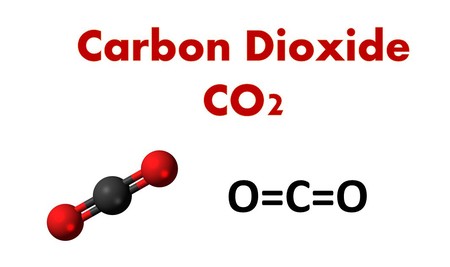 Where else have you heard of carbon dioxide being? One important way that green chemists think about the world is by considering how their products and the process of making them impacts the environment Has anyone heard people talk about C0₂ and the environment?In addition to being a byproduct of processes like burning fossil fuels, it is a part of the natural world. Humans and other organisms breathe out carbon dioxide. When plants and other matter decay, carbon dioxide is released. You may have heard of C0₂ referred to as a greenhouse gas that contributes to global climate change.
 - Show students this short video about the carbon cycle to help them understand how carbon atoms move through the different processes on Earth and the role that carbon dioxide plays. Use the video as a jumping off point to introduce the experiment.
Did you hear the video say that carbon dioxide is absorbed by the ocean? Because carbon dioxide is a gas, it can dissolve in water. That's how we make fizzy drinks like sodas and sparkling water. The name "carbonated beverage" comes from this process of dissolving carbon dioxide in water. With all the carbon dioxide in the atmosphere, some of it ends up dissolving in the oceans. Does that matter? Does it change the ocean water in some way? Today you will do an experiment to find out.
/-/https/www.sciencebuddies.org/Files/14174/23/note-question-mark-30.png)
/-/https/www.sciencebuddies.org/Files/14175/24/conversation-bubbles-30.png)
/-/https/www.sciencebuddies.org/Files/18973/7/carbon-dioxide-CO2-chemical-structure.jpg)
/-/https/i.ytimg.com/vi/KNLUzqW8IuA/maxresdefault.jpg)
Explore (30-50 minutes)
There are two experiments outlined for students. If you do not have the time or materials to do both, choose the one that best fits your classroom.
- Classroom Demonstration Tell the students you will compare saltwater with and without carbon dioxide dissolved in it. Measure 50 mL of saltwater solution. Pour the saltwater into a 100 mL beaker. Make sure all students can see the beaker. Using a protective glove, place two pieces of dry ice in a wash bottle with some warm water. Insert the wash bottle spout into the beaker with the saltwater. Materials tip: if you choose to only do Experiment #2, use the setup from that experiment to do this demonstration instead.
What do you observe?Students should report seeing bubbles from the wash bottle enter the saltwater. This is the carbon dioxide gas bubbling through the saltwater.
- Remove the wash bottle and ask the students to compare the saltwater after adding carbon dioxide to before adding carbon dioxide.
Has the saltwater changed?Students should report not being able to see any changes. Not all changes are visible. When doing a science experiment, it is important to know what the properties are that might change during an experiment and have a way of measuring them. pH is one of the most important properties of a solution. It is the measure of how acidic or basic a solution is. pH is measured on a scale that goes from 1 to 14. Acidic solutions have pH's that fall below 7 while basic solutions have pH's above 7. Seven is considered neutral.
- pH Scale Activity Explore the pH scale as a class by working through the pH Scale slides in the Lesson Plan Slideshow. As each item is shown, have the class guess where it belongs on the pH scale.
- Once the pH scale activity has been completed, talk about the importance of pH. Our stomachs are really acidic, which helps break down foods. That's why when we have an upset stomach, we can take "antacids", like Tums, to help bring the pH of our stomach back into balance. The ocean is also at a certain pH and all of its inhabitants are accustomed to that pH.
- Now that we know a little about pH, lets see how we can measure it in our experiment. Introduce students to the pH paper and to the universal indicator. If these are new to them, show them how to use both using plain water, an acid like lemon juice, and a base like baking soda or bleach.
- Experiment #1 Have students follow the procedure on their worksheet to determine if dissolving carbon dioxide in saltwater changes its pH. The steps of the experiment are written out here too:
- Measure 50 mL of saltwater using the graduated cylinder.
- Pour salt water into a 100 mL beaker.
- Test the pH of the saltwater with a pH strip. Record your results in your data table.
- Add 5 drops of universal indicator.
- Your teacher will place 2 pieces of dry ice in a wash bottle with some warm water for you. The wash bottle should have a steady stream of CO₂ coming from the spout. Insert the wash bottle spout into the container with the seawater for one minute. Observe what happens.
- Test the pH of the saltwater with a pH strip after adding CO₂. Record your results in your data table.
- As a class, discuss the experiment.
How does carbon dioxide change ocean water? Do you think this has an effect on ocean life?C0₂ dissolved in the ocean decreases the pH of the ocean and creates an effect we call ocean acidification. All of the ocean's inhabitants are accustomed to the normal pH of the ocean, so acidification of the water can lead to some big changes. For example, shellfish and coral reefs start to dissolve and break down when the pH of the ocean is too low. Much of the life in the ocean is dependent on shellfish and reefs. When they are damaged or die from ocean acidification it can cause problems for the health of the ocean and the parts of our world that depend on the ocean.
- Experiment #2 As scientists, we want to make sure we're drawing conclusions based off of more than one piece of evidence. Invite the students to think how else they might test the effects of carbon dioxide.
How can we be sure that it's really carbon dioxide that's creatin the change in pH? Where else might we get a source of carbon dioxide to test with?Encourage students to think about sources of carbon dioxide they interact with on a regular basis. Students may think of several options including their own breath and a carbonated beverage. Show the can/bottle of soda you plan on using as the source of carbon dioxide.
- Provide each group with the materials for Experiment #2:
- Medium cup (for soda/carbonated water)
- Dixie cup (for saltwater)
- Large cup (to enclose the system in a dome so that the carbon dioxide does not dissipate)
- Ask the group how they might test the effects of carbon dioxide on pH using the CO₂ from the soda and the materials they have in front of them. Have them brainstorm with their partner for 1-2 minutes and then share their ideas with the rest of the class. Be sure to affirm their creativity!
- Once the proper technique has been shared—or if you've heard 3-4 ideas without hearing the technique—show the group how to set up the system.
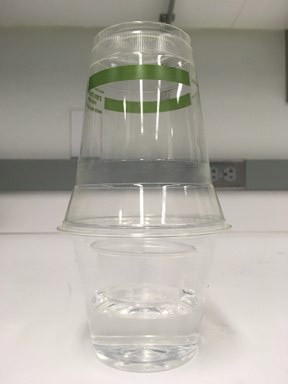
A medium size plastic cup is filled part way with soda. A smaller dixie cup with saltwater sits inside of the plastic cup. Both cups are covered by a large plastic cup which acts like a dome preventing the carbon dioxide from escaping.
- Have students follow the procedure on their worksheet to determine if dissolving carbon dioxide in saltwater changes its pH. The steps of the experiment are written out here too:
- Fill the medium cup about a third of the way with soda.
- Add about 15 ml (a tablespoon) of ocean water to the small cup.
- Add 2 drops of indicator to the small cup.
- Place the small cup inside the medium cup on top of the soda.
- Place the large cup upside down on top of the medium cup so that you create an enclosed system.
- Hold the bottom of the medium cup flat on the desk while gently swirling the system. [Demonstrate how to do this for your students.]
- Make observations and record them on your worksheet.
- Ask students to what they observed and the conclusions they can draw.
What did you observe? What does it mean? What conclusions can you draw about carbon dioxide and ocean water based on your experiments.Students should observe that in experiment #1 and experiment #2 the carbon dioxide dissolved in the saltwater and made it more acidic. From these experiments, we can conclude that if there was an increase in CO₂ from natural and/or man-made sources it could make oceans more acidic. In turn, the more acidic oceans might have negative effects on ocean life.
/-/https/www.sciencebuddies.org/Files/18974/7/dissolve-CO2-in-water-experiment.jpg)
Reflect (20 minutes)
- As a class review real world data, provided in the Lesson Plan Slideshow, to determine whether there have been changes to atmospheric carbon and ocean pH levels. Start with the graph showing atmospheric CO₂ from the 1960's through 2020. [Source: NOAA Earth System Research Laboratories, Global Monitoring Laboratory retrieved September 21, 2022.]
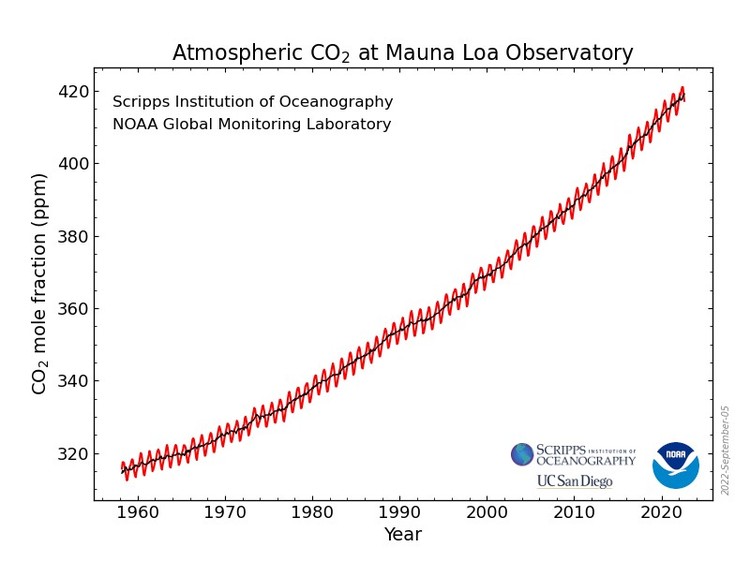 Carbon dioxide isn't bad in itself—plants need it for life and so do we! But are we putting more carbon dioxide into the atmosphere? What does this graph tell us?This graph shows an increasing amount of CO₂ in the atmosphere at the Muana Loa Observatory in Hawaii, United States.
 - Next show students the combined graph of atmospheric and dissolved oceanic carbon dioxide in Hawaii and the pH of the ocean water there over time. [Source: NOAA Pacific Marine Environmental Laboratory (PMEL) Carbon Program retrieved September 21, 2022.]
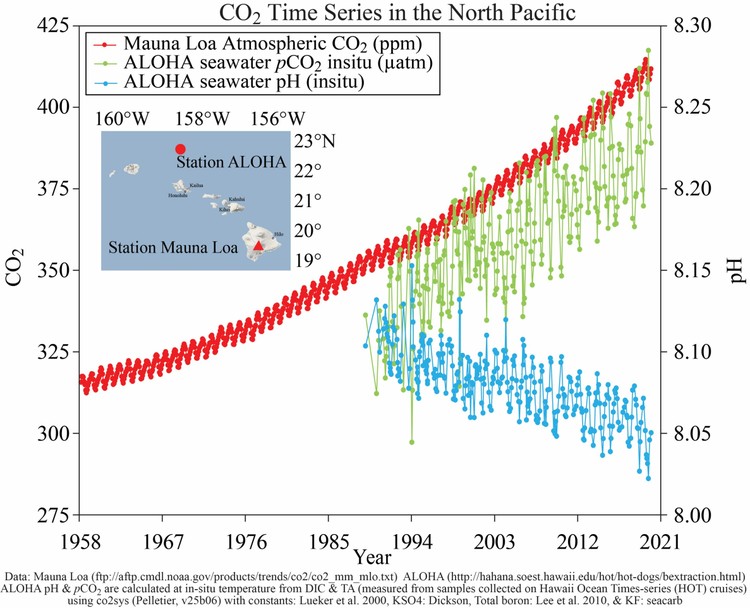
Graph with three trend lines. The first line shows the rise of atmospheric CO2 at Station Mauna Loa in Hawaii from 320ppm to 420ppm from the years 1958 to 2021. The second line shows the rise of dissolved CO2 in seawater at the ALOHA Station in Hawaii from a low of approximately 300 uatm to a high of approximately 420 uatm from the year 1990 through 2021. The third trend line shows the fall of saltwater pH at the ALOHA Station from a high of approximately 8.12 in 1990 to a low of about 8.03 in 2021
Based on your experiment, what do you expect the increase in atmospheric carbon dioxide to do to the levels of CO₂ in the nearby ocean water? What about the pH of the ocean water? Does the real-world data match your expectations?From our experiments we expect dissolved carbon dioxide to increase as atmospheric carbon dioxide increases. We expect the ocean to become more acidic as the dissolved carbon dioxide increases. This is exactly what the real-world data shows. Carbon dioxide has become a problem in our world because of how much humans have put into the atmosphere. - Discuss carbon capture technology as a potential solution.
What do we need to do to solve the problem of carbon dioxide in our atmosphere? What might be the first step that we need to take?The first step to solving our problem with excess carbon dioxide is figuring out how to get it out of the atmosphere! There are a lot of scientists around the world working on doing just that!
- As a class look at the slide about carbon capture materials and talk about a few solutions that scientists are working on using green chemistry.
Two of these items are being used in carbon capture technology. Which do you think they are?The Green Chemistry Centre of Excellence at the University of York in England has been using waste biomass to invent carbon capture technologies. In their Starbons© invention, they use starch from waste potato peels and alginic acid from seaweed to capture carbon from the atmosphere.Researchers are also looking for all sorts of ways to use the carbon dioxide we capture. York is looking for ways to convert the carbon dioxide into the building blocks for lithium batteries found in electronics like smartphones, computers, and even electric cars! Another company, Blue Planet, is using captured carbon dioxide to make building materials. Instead of using limestone rocks that have to be mined as the basis for concrete, Blue Planet turns captured carbon into carbonate rocks. By doing this, they help reduce how much carbon dioxide is released during concrete production and they're helping reduce how much carbon dioxide is already in the air! This is a great example of green chemistry at work!
/-/https/www.sciencebuddies.org/Files/18975/7/Atmospheric-CO2_annual-rise.jpg)
/-/https/www.sciencebuddies.org/Files/18976/7/Atmospheric-ocean-CO2-pH.jpg)
Assess
The worksheet can be collected as a formative assessment. An answer key is available.Make Career Connections
Discussing or reading about these careers can help students make important connections between the in-class lesson and STEM job opportunities in the real world.
/-/https/careerdiscovery.sciencebuddies.org/Files/1107/19/pexels-photo-3938023.jpg)

/-/https/careerdiscovery.sciencebuddies.org/Files/1141/17/iStock-1170687091.jpg)
/-/https/careerdiscovery.sciencebuddies.org/Files/1359/18/VNIIOarctic.jpg)
/-/https/img.youtube.com/vi/KCSAL2TLXi8/0.jpg)
/-/https/img.youtube.com/vi/9G3TaquPqDE/0.jpg)
/-/https/img.youtube.com/vi/a0A-JbP9T0I/0.jpg)