/-/https/www.sciencebuddies.org/Files/21464/5/sb-logo.png)
/-/https/www.sciencebuddies.org/Files/21464/5/sb-logo.png)
Evolutionary Puzzles
Summary
/-/https/www.sciencebuddies.org/Files/18749/10/tech-interactive.png)
/-/https/www.sciencebuddies.org/Files/19057/4/EvolPuzzles-pedigree-chart.jpg)
Overview
This lesson uses problem-solving and logical thinking to introduce students to phylogenetic trees. Students will create, organize, and structure data to explore patterns of heredity.
Learning Objectives
Students will:
- Explore how phylogenetic trees organize species based on shared characteristics.
- Discover both the power and the limitations of phylogenetic trees as a tool for making inferences about the evolutionary history of different species.
- Engage in authentic science practices through data analysis.
NGSS Alignment
This lesson helps students prepare for these Next Generation Science Standards Performance Expectations:- MS-LS4-2. Apply scientific ideas to construct an explanation for the anatomical similarities and differences among modern organisms and between modern and fossil organisms to infer evolutionary relationships.
|
Science & Engineering Practices
Engaging in Argument from Evidence.
Constructing Explanations and Designing Solutions. |
Disciplinary Core Ideas
LS4.A: Evidence of Common Ancestry and Diversity.
Anatomical similarities and differences between various organisms living today and between them and organisms in the fossil record, enable the reconstruction of evolutionary history and the inference of lines of evolutionary descent.
|
Crosscutting Concepts
Patterns.
Patterns can be used to identify cause and effect relationships. (MS-LS4-2)
Graphs, charts, and images can be used to identify patterns in data. (MS-LS4-1), (MS-LS4-3) |
California Computer Science Standards
- 6-8 6-8.DA.7: Represent data in multiple ways. (P4.4)
Teacher Tool Box
- PDF of this Lesson
- Evolve a Tree Handout
- Be a Science Sleuth Handout
- Mystery Trees Handouts
- Answer Key for the Mystery Trees
- Evolutionary Trees Evolve a Tree Video (1:13 min)
- Evolutionary Trees Be a Science Sleuth Video (2:21 min)
Materials
Handouts (1 set per pair of students)
- Evolve a Tree
- Be a Science Sleuth
- Mystery Trees (2-3 animals per pair)
- Snake
- Shark
- Butterfly
- Duck
- Bee
Tools (1 set per pair)
- Markers, coloring pencils, or crayons
- Scissors
- Pencils
- 1 six-sided die
Educator Resources
- Evolutionary Trees videos
- Evolve a Tree (1:13 min)
- Be a Science Sleuth (2:21 min)
- Answer Key for the Mystery Trees
Background Information for Teachers
Pedagogy and Approach
Activities from The Tech Interactive's BioTinkering Lab create meaningful opportunities for students to experience science as creative and personally empowering. Evolutionary Puzzles introduces students to key scientific concepts, such as the process and limitations of evolutionary genetics research, within the context of open-ended exploration. This approach can help them develop confidence, persistence, and a positive STEM identity.
Phylogenetic Trees
By middle school, most students recognize that biology is not static. The study of evolution shows that the characteristics or traits of an organism can mutate, or become different due to changes in its DNA. The result is a new species with unique traits. The process by which a single population of organisms splits and becomes two distinct species is called speciation. This process is extremely slow, occurring over many generations. Therefore, scientists cannot usually directly observe how a species changes. So how can they develop a timeline for when a population of animals evolved?
Scientists use phylogenetic trees to build a hypothesis about when speciation occurred and how different species evolved over time. These diagrams depict a common ancestor and the species, organisms, or genes that descended from it. They can show how particular species might be related and provide insight into their evolutionary history. In the past, scientists arranged species on a phylogenetic tree based on physical characteristics alone. Today, DNA analysis offers scientists another tool, allowing them to group species based on genetic similarities.
/-/https/www.sciencebuddies.org/Files/19058/4/EvolPuzzles-phylogenetic-tree-mammals.jpg)
This phylogenetic tree looks at how mammals are related. Four main clusters are shown in this tree. The first cluster consists of sea lions and seals which are closely related. Their nearest cousins are elephants and then armadillos. The second cluster consists of the highly related humans and apes, whose nearest cousin is shown as mice. The third cluster consists of dolphins and whales who are in turn related in order of increasing distance to hippos, cows, and pigs. The fourth and final cluster consists of cats and sea otters which are distant relatives of pigs. As a whole, the tree shows that mammals have a distant relative in the platypus and even more distant relative in chickens.
A phylogenetic tree differs from a human family tree in one important respect: it describes populations and species, not individuals. It is also important to note that phylogenetic trees are not set in stone. Each one represents a well thought-out hypothesis that may change if new information comes to light or new insights arise.
When creating phylogenetic trees with students, keep in mind:
- The simplest explanation is presumed to be the correct one.
- Since it may be difficult for students to tell which traits of a population are new and which were present in a shared ancestor, ancestral traits are usually identified for them in some way.
- In this activity, all traits in the original ancestral population remain "uncolored."
- It may be difficult to distinguish between traits that reflect shared ancestry and ones that occurred independently.
- For example, ostriches and parrots both have wings because they share a winged bird ancestor. However, ostriches and bats do not share a common winged ancestor. Wings have evolved multiple times, in different lineages.
- Traits may be gained or lost multiple times over the evolutionary history of a species.
- For example, although all birds are descended from an ancestor that gained the ability to fly, ostriches have a more recent ancestor that lost this ability.
Vocabulary
- Evolution: Change in the heritable characteristics of biological populations over successive generations.
- Hypothesis: An idea or explanation that you then test through study and experimentation.
- Mutation: A new change to an organism's DNA sequence.
- Population: A group of organisms of the same species that live in a particular geographic area at the same time and are capable of interbreeding.
- Phylogenetic tree: A diagram that depicts the lines of evolutionary descent of different species, organisms, or genes from a common ancestor.
- Simulation: A model or representative example of a process. Simulations allow scientists to study slow processes (like evolution) much faster than with living organisms.
- Speciation: The evolutionary process by which populations evolve to become distinct species.
Resources and References
- How Do Scientists Build Phylogenetic Trees?, Ask a Geneticist, The Tech Interactive.
- Building a Phylogenetic Tree, Khan Academy.
- Creating Phylogenetic Trees from DNA Sequences, HHMI | BioInteractive.
- Reconstructing Trees: A Simple Method, Understanding Evolution, University of California-Berkeley.
- Bats Without Sonar Shed Light on Evolution of Echolocation, by Patrick Monahan, Science, Jan. 9, 2017.
- Tracking the 2014 Ebola Outbreak Through Its Genes | Science, by Helen Thompson, Smithsonian Magazine, August 28, 2014.
- Take a look at SARS-CoV-2's family tree. It's full of surprises, by Michaeleen Doucleff, National Public Radio, February 9, 2022.
- DNA to the Rescue: How Researchers Are Finding Illegal Shark Fins, by Melissa Cristina Marquez, Forbes, May 10, 2019.
- FIU Scientist Leading Research of Shark Fin Trade, by Angie Lassman, NBC Miami, May 15, 2020.
For more lesson plans, videos and other facilitation resources see thetech.org/resources.
Prep Work
Lesson Preparation
- Collect activity supplies using the materials list above.
- Print out student handouts.
- Watch the Evolutionary Trees videos.
- Try out the activity yourself or with others. This practice with the materials will help you anticipate students' questions.
- Have students use an online dice roller.
- Use Paint (or a similar digital tool) to color in their sheet online.
For more tips on adapting Design Challenges to a virtual setting, see The Tech Interactive's Educator Tips for Remote STEM Learning.
Lesson Instructions
| Lesson Outline | |
|---|---|
| Frame the Activity | 10 min total |
| Activate Prior Knowledge | 5 min |
| Introduce the Activity | 5 min |
| Activity | 50 min |
| Part 1: Evolve a Tree | 10 min |
| Part 2: Be a Science Sleuth | 15 min |
| Discuss and Reflect | 5 min |
| Part 3: Mystery Trees | 15 min |
| Debrief | 5 min |
Frame the Activity
Activate Prior Knowledge (5 min)
- Ask students to share what they know about how species evolve. Use some of these questions to guide the discussion.
- How does one population of animals become two different species?
- How can we tell if two species are related to each other?
- How do scientists model and understand the evolution of different species?
- During the discussion, introduce relevant vocabulary (evolution, mutation, population, simulation, species) and concepts:
- Mutations...
- can cause changes in characteristics passed from a parent to a child.
- occur and are inherited randomly.
- have to work within the existing biology of an organism. (For example: No single mutation will give a frog wings, but one might change the color of its spots.)
- When scientists attempt to solve evolutionary puzzles—which organisms descended from a common ancestor, and which did not—they build hypotheses by comparing the characteristics that species have in common.
- The more shared characteristics two species have, the more closely related they may be.
- Biological change is slow, but diagrams like phylogenetic trees can help us understand a series of changes that occurred over long stretches of time.
- Mutations...
Introduce the Activity (5 min)
- Inform students that today they are scientists tasked with building and solving phylogenetic trees, or diagrams that show evolutionary relationships among different species.
- Explain the overall goals:
Swipe left to see morePart 1: Evolve a Tree First, you and your partner will build a tree by evolving a single population of animals into several different species. Part 2: Be a Science Sleuth Then, you will swap species with another pair. As science sleuths, you will match the other pair's species with a blank tree and hypothesize how they evolved. Part 3: Mystery Trees Finally, you will apply what you have learned by hypothesizing the evolution of populations on a set of "mystery" trees. - Demonstrate how to "evolve" a tree by either showing the video or walking students through an example.
Create AssignmentEmbed Link
 Google Classroom
 Microsoft Teams
 Canvas
 Schoology
 Other
Other - Make sure students are aware of these key aspects of the tree:
- Each image represents a population of animals.
- The animal at the top of the tree is the ancestral (original) population.
- A line connects a "parent" population of animals to a "child" population.
- Two new child populations descend from each parent.
- One child population will get a mutation, or change in one trait, while the other stays the same as the parent.
- Each animal has six features that could change, depending on the roll of the die.
- In this activity, only one type of mutation can occur: changes in color.
- The same feature could change color more than once on the same tree. For example: This parent population has already evolved to have orange feet. So one child population will retain orange feet but the other one will change to another new color.
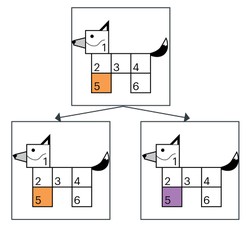
Parent fox has left foot labeled 5 and colored orange. Child fox on the left is identical. Child fox on the right has the left foot colored purple.
- Point out the Puzzle Squares at the bottom of the tree.
- Explain that after evolving their tree, students will copy each child population with no descendants into the accompanying Puzzle Square.
- Inform students that when they are finished, they will cut out the Puzzle Squares and trade them for another pair's. Then each pair will try to re-create the other's tree.
/-/https/i.ytimg.com/vi/v-F8yl3qWFQ/maxresdefault.jpg)
/-/https/www.sciencebuddies.org/Files/20511/4/google-classroom.png)
/-/https/www.sciencebuddies.org/Files/20512/4/ms-teams.png)
/-/https/www.sciencebuddies.org/Files/20469/4/Canvas_Bug_Color_RGB.png)
/-/https/www.sciencebuddies.org/Files/20470/5/Schoology-Logo.png)
/-/https/www.sciencebuddies.org/Files/20471/4/lms.png)
/-/https/www.sciencebuddies.org/Files/20469/4/Canvas_Bug_Color_RGB.png)
/-/https/www.sciencebuddies.org/Files/20470/5/Schoology-Logo.png)
/-/https/www.sciencebuddies.org/Files/20471/4/lms.png)
/-/https/www.sciencebuddies.org/Files/19059/4/EvolPuzzles-body-6-parts.jpg)
Part 1: Evolve a Tree (10 min)
- Put students in pairs. Pass out an Evolve a Tree handout, coloring and writing tools, scissors, and a die to each pair.
- Have pairs work together to "evolve" their phylogenetic tree.
Step 1: Choose which child population will receive the change.
/-/https/www.sciencebuddies.org/Files/19060/4/EvolPuzzles-3-animals.jpg)
Step 2: Roll the die to determine which feature will change.
/-/https/www.sciencebuddies.org/Files/19061/4/EvolPuzzles-6-sided-die-6-block-animal.jpg)
Step 3: Choose a color and fill in the feature that changed. For example: One child population now has a blue head.
/-/https/www.sciencebuddies.org/Files/19062/4/EvolPuzzles-blue-headed-block-animal.jpg)
Step 4: Repeat Steps 1-3 for the remaining generations.
/-/https/www.sciencebuddies.org/Files/19063/4/EvolPuzzles-3-generations-evolutionary-traits.jpg)
A phylogenetic tree showing an animal with no color giving rise to an identical animal and an animal with a blue head in generation 1. In generation 2 the blue-headed animal gives rise to an identical animal and one with a blue head plus a yellow middle. In generation 3 the animal with a blue head and yellow middle gives rise to an identical animal and one which has the same traits plus purple front legs.
Step 5: Copy the child populations with no descendants into the Puzzle Squares at the bottom.
/-/https/www.sciencebuddies.org/Files/19064/4/EvolPuzzles-four-empty-squares.jpg)
Step 6: Cut out the Puzzle Squares.
Tip: Make sure students cut carefully on the lines. That way, the original order cannot be determined based on irregular cut marks.
/-/https/www.sciencebuddies.org/Files/19065/4/EvolPuzzles-cut-squares.jpg)
Part 2: Be a Science Sleuth (15 min)
- Match up pairs of students, making groups of four, when they finish evolving their trees. Give each pair a Be a Science Sleuth handout. (Option: Play the video to introduce the activity.)
- Tell students they will now use their skills as scientists to explore the evolutionary puzzle of the other pair's tree. They will use the information available to them to form a hypothesis about how the other pair's species could have evolved.
- Note: Point out that students may have an accurate hypothesis without having a solution that matches the other pair's original tree. (For more information, see the section on Multiple Solutions.)
- Have the two pairs exchange their Puzzle Squares. Each pair will work independently to re-create the other pair's original tree.
- Encourage students to look for patterns among their squares before they start to build the tree. For example, squares with features in the same color may be related.
- Before they color their tree, ask students to label, in pencil, the change they think occurred at each branch. That way, if they make a mistake, they will not need a new handout.
- While pairs are solving their trees, use open-ended questions to guide the process:
- What similarities between the species might help you group the populations?
- Which characteristics can be found in several of the animals?
- Which combinations of characteristics suggest which animals might be more closely related?
- When both pairs have finished coloring in their trees, have them compare their completed trees.
- Do they match? If not, how are they different?
/-/https/i.ytimg.com/vi/3wxGP3g21aM/maxresdefault.jpg)
5 + 3 is the same as 3 + 5. They both equal 8.
Similarly, the children populations of a parent do not have a specific order. Swapping the order of two children will result in an equivalent tree.
For example: The parents and relationships in these trees are the same, despite being shown in a different order.
/-/https/www.sciencebuddies.org/Files/19066/4/EvolPuzzles-two-phylogenetic-trees.jpg)
As students begin to think like scientists, they will discover that some trees have multiple "correct" solutions—they are all based on valid hypotheses. Without a time machine there is no way to go back and observe what actually happened.
Rather than focusing on getting the "right answer," encourage students to explain the reasoning behind a particular hypothesis and the evidence that it is based on. They might also consider how additional evidence could shift their ideas.
For example: Both of these trees offer valid hypotheses. The leg color or body color mutation could have happened in either generation two or generation three.
/-/https/www.sciencebuddies.org/Files/19067/4/EvolPuzzles-two-phylogenetic-trees-purple.jpg)
Solving a tree backwards can be tricky! Encourage students who need more support to consider these methods:
- Group similar species together: Look for Puzzle Squares with similarities. Do two or more of the child populations share a trait, such as a red tail? These populations are likely related and can be grouped together. In this activity, a parent with a red tail is guaranteed to have at least one child that also has a red tail.
- Look for more mutations in later generations: Puzzle Squares that have more than one feature colored are likely child populations in one of the later generations. These populations have had more chances (more die rolls) to develop a mutation, resulting in more changes to their appearance.
- Use computational thinking: Engaging in computational thinking can provide a structure for problem solving. Introducing this process into unplugged settings like this one, builds these skills without the use of a computer. Use these questions to apply computational thinking:
- Decomposition: How can the big problem of solving the tree be broken down into smaller problems?
- Pattern recognition: What patterns do you notice? How can they help you determine a sequence?
- Algorithms: What step-by-step process could you use to develop your hypothesis?
See The Tech Interactive's Computational Thinking Tech Tip for more ideas on how to build these skills.
Discuss and Reflect (5 min)
- Bring the class back together, and have pairs share how they developed their hypotheses.
- What strategies did you find most useful (grouping, looking for patterns etc.)?
- You had the unusual opportunity to talk to people who watched these species evolve. Did your hypothesis match what they said happened? How was it different?
- Did you see the commutative property anywhere in the puzzles? Did anyone develop a valid hypothesis that did not match the original? What did you notice about these situations?
- Have students connect their own experience to that of scientists in the real world.
- When scientists discover multiple valid hypotheses, how might they determine which is correct or most likely to be correct?
- What other challenges do scientists face when trying to determine how a species has evolved over time?
New Information, New Trees
When scientists first created phylogenetic trees for bats, they grouped all the small echolocating bats together, separate from the large non-echolocating ones. As echolocating is a complicated trait, it made sense to group bats in this way. However, recent genetic analysis has shown that some small echolocating bats are closely related to larger non-echolocaters! This has completely changed how scientists think about the evolution of bats and echolocation.
- Bats Without Sonar Shed Light on Evolution of Echolocation, by Patrick Monahan, Science, Jan. 9, 2017.
Tracking an Epidemic
Scientists routinely build phylogenetic trees of viruses to study outbreaks of infectious disease. These important tools help identify where a virus came from, whether it is new, how and when it spreads, whether it has been spreading undetected, how often it mutates, and what variants exist. This knowledge is used in making public health decisions.
- Tracking the 2014 Ebola Outbreak Through Its Genes | Science, by Helen Thompson, Smithsonian Magazine, August 28, 2014.
- Take a look at SARS-CoV-2's family tree. It's full of surprises, by Michaeleen Doucleff, National Public Radio, February 9, 2022.
Mystery Meat
While commercial whaling was banned throughout the world in 1986, some countries continue to permit the hunting of specific species of whales. In the 1990s, scientists were able to show that this loophole provided a cover for the sale of illegal whale products. Similar techniques have also been applied to the illegal trade of shark fins. Scientists take DNA samples of meat sold in various retail markets and create phylogenetic trees. The results are used to identify the species and pinpoint the location it came from.
- DNA to the Rescue: How Researchers Are Finding Illegal Shark Fins, by Melissa Cristina Marquez, Forbes, May 10, 2019.
- FIU Scientist Leading Research of Shark Fin Trade, by Angie Lassman, NBC Miami, May 15, 2020.
Part 3: Mystery Trees (15 min)
- Put students back in their pair groups. Pass out the Mystery Trees handout set (Butterfly, Bee, Shark, Duck, Snake), 2-3 trees per pair.
- Let students know they are not required to solve all of the trees in the allotted time. They can explore as many as possible.
- Have the pairs solve the trees at their own pace. Note that all of the puzzles have multiple correct answers (see Educator Answer Key).
Debrief (5 min)
Help students make connections between the activity and the science of reconstructing evolutionary trees. Possible debrief questions include:
- How did your approach to developing a hypothesis change throughout the activity?
- How would you have changed your approach to solving a tree if you didn't know the rules of the system?
- What other uses for this type of information sorting can you think of?
- What did you learn about how scientists create phylogenetic trees and deal with situations when there are multiple valid hypotheses?
- What other types of evidence could help scientists figure out how species of animals are truly related?
If there is extra time at the end of the activity, have students share their Mystery Trees with the rest of the class in one of these ways:
- Stand and share: Call on groups or students to share with the larger class.
- Closing circle: Each student shares one decision they made and why.
- Networking: Set a timer, and have students mingle and share with at least three different people in three minutes.
/-/https/img.youtube.com/vi/BsSRQozNZk0/0.jpg)
/-/https/img.youtube.com/vi/Wg8VoLTMz1M/0.jpg)
/-/https/img.youtube.com/vi/YZ0SOAFXVAQ/0.jpg)