/-/https/www.sciencebuddies.org/cdn/Files/21464/5/sb-logo.png)
/-/https/www.sciencebuddies.org/cdn/Files/21464/5/sb-logo.png)
Make Mushroom Packaging to Explore Long-Term Ecological Impact
Summary
/-/https/www.sciencebuddies.org/cdn/Files/17557/5/mycelium-assessment-thumbnail.jpg)
Overview
Are your students passionate about the environment? Do they like to explore new ideas for more eco-friendly products? This lesson will give your students a chance to grow a product out of mycelium composite, a material that recently gained traction as an eco-friendly alternative for many plastics and foams. Students will analyze the impact of this product on the environment at every step of its life cycle, from raw material to the end of its life, and compare it to a plastic or cardboard alternative. Will it come out on top in overall eco-friendliness? Try it out and see!
Learning Objectives
- Understand what a life cycle assessment is, and why it is important.
- Question claims on environmental impact of a product in light of a life cycle assessment.
- Understand that the environmental impact of a product is complex.
NGSS Alignment
This lesson helps students prepare for these Next Generation Science Standards Performance Expectations:- HS-ESS3-4. Evaluate or refine a technological solution that reduces impacts of human activities on natural systems.
|
Science & Engineering Practices
Analyzing and Interpreting Data.
Analyze data using computational models in order to make valid and reliable scientific claims.
Using Mathematics and Computational Thinking. Use mathematical and/or computational representations of phenomena or design solutions to support explanations. Constructing Explanations and Designing. Design or refine a solution to a complex real-world problem, based on scientific knowledge, student-generated sources of evidence, prioritized criteria, and tradeoff considerations. Engaging in Argument from Evidence. Evaluate competing design solutions to a real-world problem based on scientific ideas and principles, empirical evidence, and logical arguments regarding relevant factors (e.g., economic, societal, environmental, ethical considerations). |
Disciplinary Core Ideas
ESS3.A: Natural Resources.
All forms of energy production and other resource extraction have associated economic, social, environmental, and geopolitical costs and risks as well as benefits. New technologies and social regulations can change the balance of these factors.
ESS3.C: Human Impacts on Earth Systems. Scientists and engineers can make major contributions by developing technologies that produce less pollution and waste and that preclude ecosystem degradation. ETS1.B: Developing Possible Solutions. When evaluating solutions, it is important to take into account a range of constraints, including cost, safety, reliability, and aesthetics, and to consider social, cultural, and environmental impacts. |
Crosscutting Concepts
Influence of Science, Engineering, and Technology on Society and the Natural World.
Engineers continuously modify these technological systems by applying scientific knowledge and engineering design practices to increase benefits while decreasing costs and risks.
Analysis of costs and benefits is a critical aspect of decisions about technology. |
Materials
/-/https/www.sciencebuddies.org/cdn/Files/17282/8/Mycelium-growth-materials.jpg)
For Growing Mycelium Products:
For each student:
- Disposable gloves, three pairs
Per group of 4–5 students:
- Mycelium growing material, like the Grow-It-Yourself Mushroom® material sold by Grow.bio
- Spray bottle
- 70% isopropyl alcohol
- Flour, people with gluten allergies can use maltodextrin as a substitute
- Water
- Measuring spoon
- Measuring cup
- Large bowl
- Clips or tape
- Growing containers to mold the product. The type of container will depend on the product the students choose to make. Please read the information on growing containers below for more detail.
To share with the class:
- Scissors
- Plastic wrap
- Kitchen scale
- Wire cooling rack
- Optional: Oven or fan
- A place away from direct sunlight, where the growing products can stay undisturbed for 4–6 days
For the Life Cycle Assessments:
- Access to the internet to perform research
- At least two colors of pens or pencils
Note on Growing Containers:
Mycelium composite can be molded into any form you would like: a box, an egg shape, etc. The growing containers will serve as molds for the product. Students can make their own growing containers or use existing containers. A good growing container has the following qualities:
- It is made from non-porous material, like plastic or metal or glass, or covered with a non-porous material like tape or plastic wrap.
- It can hold moisture inside. It is okay to cover a side with plastic wrap to hold moisture inside.
- It has holes to allow air exchange. It is okay to have the holes only on one side; for example, in the plastic wrap that covers the top.
- It allows easy removal of the product once it is ready and grown into one piece. It could consist of two or more parts sticking together, or have a side covered with plastic wrap, or a lid that allows you to remove the product in one piece.
- To make removal easier, we suggest that you create a product with sides that slant outward by 2 degrees or more.
Food containers, flower pots, baking pans, and silicon molds are good options for a mold. A few options are shown in the figure. If you can, have at least one group of students choose a transparent growing container so students can see the mushroom roots grow.
/-/https/www.sciencebuddies.org/cdn/Files/17285/8/Mycelium-growing-containers.jpg)
Background Information for Teachers
This section contains a quick review for teachers of the science and concepts covered in this lesson.More than half of all plastic ever manufactured was created in the last 20 years (data from ourworldindata)! The same source claims that global plastic waste amounted to 275 million tons in 2010 alone, more than the amount of plastic produced that same year. Of all this plastic waste, only 16% was recycled in 2010, 22% was incinerated, and 62% was left as pure waste in landfills, or found its way to oceans, etc. It can easily take over 100 years until most plastics begin to degrade in a landfill. We are facing an ecological problem.
The packaging sector is by far the largest contributor to all the plastic waste. In this project, students will explore if mycelium composite material—a compostable material obtained from organic waste and mushroom roots—can serve as a viable eco-friendly packaging alternative. Students will grow a mycelium composite product, evaluate its effectiveness as packaging material, and then explore its overall ecological impact. As comparison, students will also analyze the impact of a similar product made from a different material. In the process, students will gain an appreciation for the complexity of ecological questions and start to understand why ecological challenges rarely have a simple answer.
Mushrooms are part of the kingdom of fungi. The larger part of the fungus is the root system, the mycelium. It is a network of strong bonds, that, when grown in molds around biological waste like wood chips, can create strong, lightweight, biodegradable products. These characteristics make it a viable candidate for packaging material. Figure 1 shows a packaging mold grown from mycelium and hemp by Science Buddies staff. It has been designed to hold two fragile bottles.
/-/https/www.sciencebuddies.org/cdn/Files/17295/9/mushroom-material-as-packaging-material.jpg)
Figure 1. An example of mycelium composite packaging material.
One might think that due to its biodegradable characteristics, mycelium composite material can reduce the trash problem and thus is eco-friendlier; however, only a wider perspective like the one seen in a life cycle assessment (LCA) can reveal its overall impact. An LCA is a systematic study of the environmental impacts of a product or service throughout its entire lifespan, from the extraction of raw materials to the end of its life. The life cycle of a product is usually broken down into five steps, as shown in Figure 2. The cycle starting at the extraction of raw materials and ending in disposal is often referred to as cradle-to-grave. When the disposal stage is exchanged for recycling processes, the loop is closed (Figure 3). This is referred to as the cradle-to-cradle, closed-loop recycling, or circular economy.
/-/https/www.sciencebuddies.org/cdn/Files/17558/5/cradle-to-grave-life-cycle.png)
Figure 2. Main steps in the life cycle of a product that is not recyclable, also referred to as the cradle-to-grave cycle.
/-/https/www.sciencebuddies.org/cdn/Files/17559/5/cradle-to-cradle.png)
Figure 3. Main steps in the life cycle of a product that is recyclable. This is also referred to as the cradle-to-cradle cycle.
A life cycle assessment can be broken down into four steps. First, one defines the scope of the assessment. An LCA usually provides the groundwork of a sustainability decision or claim, and the goal largely sets the scope. The scope includes the unit of the study, how deep the study needs to go, and what will and will not be included. For example, if the goal is to create an environmental product declaration, the unit of the study will be the product, the study could follow a cradle-to-grave concept and analyze the impact categories required for the declaration. Once the scope is set, one takes the inventory of everything that flows in and out of the system (e.g., materials, water, different types of energy, gases, etc.). The impact of each of these flows is evaluated in a third step. The last step is the interpretation of the results. This includes listing the limitations of the study and the assumptions made during the study.
Students will make a partial LCA of mycelium composite and an alternative material. The goal is to get a more realistic view of the impact of mycelium composite compared to that of an alternative material. Because they are studying a packaging material, students are not asked to include the retail and use stage of the product. During their assessment, they may—but do not have to—include adjustments for recycling, or byproducts. More details on how these can be included are given in the explore section.
An LCA evaluates the impact across many categories like global warming potential, ecotoxicity potential, human toxicity potential, acidification potential of land and water, eutrophication potential, non-renewable energy (or fossil fuel) indicator, depletion potential for non-fossil resources, ozone depletion potential, freshwater depletion, solid waste, etc. Students will only evaluate two parameters of their choice.
Measurements within the LCA are usually expressed in equivalents. An example is CO2-equivalent for global warming potential. The use of equivalents allows us to capture the impact of several different components in one indicator. For example, if the production of 1 ton of a product releases 250 kg of nitrous oxide, and 1,000 kg of CO2. Because nitrous oxide is 298 times more potent in creating global warming compared to CO2, its contribution gets multiplied by 298 when the total is expressed in CO2-equivalents. For the example, this stage will contribute (250 times 298 kg + 1,000 kg) or 75,500 kg of CO2-equivalents.
No LCA is ever perfect, it is always a snapshot in time, based on the information available and plausible assumptions. It can, however, give valuable information of the environmentally taxing points along the life cycle of a product, allows comparison of the full impact of several products, and can quantify the ecological impact of a change in the life cycle of a product.
As students perform their own assessments, they will gain an appreciation for the complexity of ecological claims.
Additional Background Links
- Life Cycle Assessment (LCA)-Complete Beginner's Guide, Ecochain
- The Groundbreaking Mycelium Growth Behind Ecovative Design, Plasticpollutioncoalition
- Mushroom Packaging (Data Sheet), Mushroom® Packaging 2020
- Mushroom Packaging, Sustainability Guide
Prep Work (20 minutes)
- This project will span several lessons. It consists of the following parts:
Section Time required Purpose I. Introduction 45 minutes Engage II. Growing a Mycelium Composite Product Timing information is listed below. Explore III. Product Life Cycles 1.5 hours with optional homework Explore IV. Life Cycle Assessments 1.5 hours with optional homework Explore V. Conclusions 1.2 hours Reflect VI. Closing Thoughts 20 minutes Reflect Growing a mycelium composite product takes 6 to 10 days, with about 20 minutes of active time on the first day, about 45 minutes in the middle, and another 20 minutes on the final days.
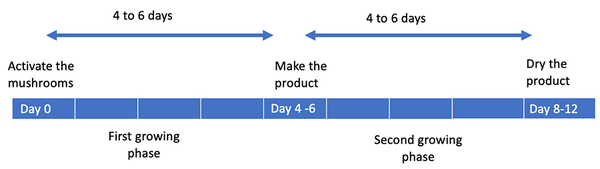
Figure 4. Timeline for growing a mycelium composite product.Sections III. and IV.—setting up and assessing life cycles—can happen during or after growing a product. Note that these steps require looking up data.
- Order the mycelium kits ahead of time, as they can take a week or two to arrive. Store the kits in a cool, dry place. It is best to use the kits within 3 months. To calculate how many kits you will need, consider the size of the kits. Some kits are large enough to make several products from, depending on the chosen products.
- Watch the video 'Making Everyday Objects Out of Mushroom roots' so you understand the process of making mycelium composite products.
/-/https/www.sciencebuddies.org/cdn/Files/17283/11/Mycelium-growing-timeline.png)
/-/https/i.ytimg.com/vi/B937Ox9JNEQ/maxresdefault.jpg)
/-/https/www.sciencebuddies.org/cdn/Files/20511/4/google-classroom.png)
/-/https/www.sciencebuddies.org/cdn/Files/20512/4/ms-teams.png)
/-/https/www.sciencebuddies.org/cdn/Files/20469/4/Canvas_Bug_Color_RGB.png)
/-/https/www.sciencebuddies.org/cdn/Files/20470/5/Schoology-Logo.png)
/-/https/www.sciencebuddies.org/cdn/Files/20471/4/lms.png)
/-/https/www.sciencebuddies.org/cdn/Files/20469/4/Canvas_Bug_Color_RGB.png)
/-/https/www.sciencebuddies.org/cdn/Files/20470/5/Schoology-Logo.png)
/-/https/www.sciencebuddies.org/cdn/Files/20471/4/lms.png)
Teacher Tool Box
Engage (45 minutes)
The Engage section covers the introduction.
I. Introduction
- Divide your class into groups of 3 or 4 students.
- Evaluate students' current knowledge.
Show students Figure 5 (Slide 2 of the slideshow) to illustrate where everyday products, such as plastic bags, can end up at the end of their useful life. Let students discuss questions 1–4 of the Student Worksheet in their groups and write their answers on their worksheet. These questions can also be done as homework before the lesson.
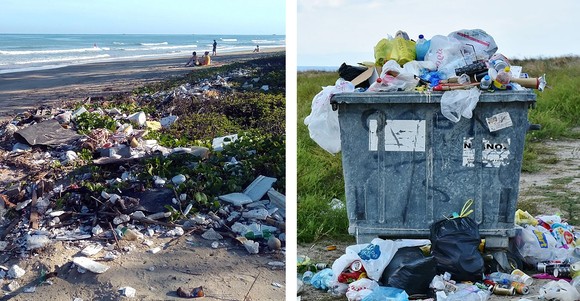
Figure 5. Examples of plastic pollution.Briefly discuss questions 1 and 2 with the class before going to question 4.
 What did you choose as the correct statement in question 4 of the worksheet?
- An end-of-life rating is identical to an environmental impact rating.
- An end-of-life rating is the most important component of an environmental impact rating.
- An end-of-life rating is only one out of many factors that make up an environmental impact rating.
- An end-of-life rating is not related to an environmental impact rating.
 Count the number of students who chose each answer.
 - Introduce the term life cycle assessment.
Question 3 of the worksheet asks you to compare the environmental impact of different types of shopping bags. Who noted one type of grocery bag is definitively the best, or noted that one was definitively the worst choice? Ask a few students that have their hand up for their best or worst bag choice.Listen to the students' answers, then introduce The Truth About Green Grocery Bags video as a way to present the answer to the question.
Working within their groups, let students answer questions 5–9 on their worksheet.
Have a class discussion about what the students thought about this video. Make sure to touch on some reasons why one would make the effort to make a life cycle assessment.
In the video, the study evaluated climate change potential and expressed the results in CO2-equivalent. If needed, explain the unit carbon dioxide equivalent (CO2-e). Each greenhouse gas has its own potential to warm the planet. For example, nitrous oxide is 265 to 298 times more potent at creating global warming than CO2. For that reason, one cannot just add up the amount of greenhouse gases released to calculate the potential for global warming. Instead, scientists calculate the CO2-equivalent, or how much CO2 would create the same effect on global warming as the gases released. This allows for an easy comparison.
- Introduce mycelium material.
The video on grocery bags shows that it is not intuitive or easy to state which product has the least impact. In this lesson, we will study a new packaging material that is branded as being eco-friendly. We will attempt to make a life cycle assessment of this new product and compare it to an alternative packaging choice.
The following video introduces this new material. Later in this project, we will try growing this material ourselves.
Show your students the How Mushrooms Are Turned Into Bacon And Styrofoam video until the timestamp 02:47.
What questions come up when you see this video. What aspects do they address in the video that shows that their mycelium composite is eco-friendly, and what questions remain?Have a discussion as a class, then let students write down the answers to questions 10–12 of their worksheet in their groups. - Explain the project.
Inform students that in this project, they will grow a mycelium composite packaging product themselves.
They will also try to do a partial life cycle assessment for this product and for an alternative packaging product, and lastly, compare the environmental impacts these products have throughout their life cycle.
/-/https/www.sciencebuddies.org/cdn/Files/17560/5/plastic-garbage-pollution.jpg)
Explore (4 hours)
The explore section covers growing a mycelium composite product, exploring the product life cycles and life cycle assessments. The exploration of life cycles and their assessments can be done in parallel with growing a mycelium composite product.
II. Grow a Mycelium Composite Packaging Product
Choosing a product.Explain to students that they will grow a mycelium composite replacement for an existing packaging product. The chosen product will be referred to as the "alternative product" or "typical product." We suggest cardboard or a particular plastic. Polystyrene should be avoided because a partial life cycle assessment of polystyrene is provided as an example in the lesson and worksheet.
Allow students to choose from a few packaging materials, for example:
- Molded cardboard packaging material for fragile objects like glass bottles, candles, etc.
- Plastic plant containers like the containers shown in Figure 6.
- Cardboard boxes for transport of fruits and vegetables.
- Plastic boxes for transport of fruits and vegetables.
/-/https/www.sciencebuddies.org/cdn/Files/17561/5/plastic-plant-containers-seedlings.jpg)
Figure 6. Plastic plant containers can be replaced by mycelium composite containers.
Students who choose the same product will work together to create and assess the life cycles of both products (the mycelium composite product and its alternative). Ideally, groups should contain 4–5 students. These groups do not need to be the same as in the Engage section. Let students complete questions 13 and 14 of the worksheet.
Grow a mycelium composite product.Growing mycelium composite products takes about 1–2 weeks. The teacher preparation section has more information about how to plan the project.
Here is a summary of how to grow a mycelium product. More detailed instructions are available in the Making Everyday Objects Out of Mushrooms: Environmentally Friendly Design activity and in the instructions that come with the kit.
Inform students that it is essential to keep everything clean. Mushroom roots grow in a moist and nutrient-rich environment, an environment in which many bacteria, yeasts, and molds can thrive as well. They should wear gloves and disinfect tools and gloves by spraying them with 70% isopropyl alcohol. This will prevent bacteria, yeasts, and molds from getting into the growing environment and interfering with the project.
Follow the process described below to grow a mycelium composite product:
- Start by activating the mushroom roots in the kit. This is done by mixing them in a water-flour mixture.
- While the mycelium is growing, let students look for or make growing containers.
- After 4–6 days of mycelium growth (Figure 7.a.) break up the mycelium bonds (Figure 7.b.), add some flour, and mold the material (Figure 7.c.).
- A second growing period takes another 4–6 days.
- After the second growth period, remove the product from the mold (Figure 7.d.).
- Students can let mycelium grow for another 1–2 days in a moist environment until it develops a white coating (Figure 7.e.).
- To finish, let the product dry. This stops mycelium growth.
- Baking the product at 200°F is optional; it kills the mycelium and prevents any future growth.
/-/https/www.sciencebuddies.org/cdn/Files/17562/5/growing-mycelium-overview.jpg)
a. Growing kit that looks white. b. Container with crumbled wood-filings that partially stick together. The content looks light brown. c. The wood-filing crumble molded into a bear mold. The mold is covered with plastic wrap. A utility knife pokes a hole in the plastic wrap. d. A mycelium composite bear figure next to its mold. The bear is light brown with some whiter areas. e. The same mycelium composite bear coated with a white, fuzzy layer.
Figure 7. Illustration of the process of growing a mycelium product.
The number of students that can share a kit will depend on the size of their product and the size of the kit. Questions 15–17 of the worksheet asks students to take notes on information that will be useful when making the life cycle assessment.
Help students grow their product and test its performance. How well does their finished product work as packaging material? Students can try to answer this question and indicate areas that need improvement (worksheet questions 18 and 19).
Figure 8 shows an example of a mycelium composite replacement of a plastic plant container.
/-/https/www.sciencebuddies.org/cdn/Files/17563/5/mushroom-planter.jpg)
Figure 8. Mycelium composite planter grown by Science Buddies staff.
III. Product Life Cycles
In this section, students make an inventory of everything that flows in and out at every stage along the life cycle of a mycelium composite packaging product and of a more typical packaging product.
Refer to the video "Truth About Green Grocery Bags" (See Introduce the term life cycle assessment in the Engage section) to help students recall the term life cycle assessment and show students the generic life cycle of a product (Figure 9, Slide 4).
/-/https/www.sciencebuddies.org/cdn/Files/17564/5/cradle-to-grave-life-cycle-product.jpg)
Figure 9. Visual representation of the life cycle of a product.
/-/https/www.sciencebuddies.org/cdn/Files/14174/23/note-question-mark-30.png) | Can you give me some examples of information you would need to know about your product to assess its environmental impact? |
/-/https/www.sciencebuddies.org/cdn/Files/14175/24/conversation-bubbles-30.png) | Listen to the students' answers and give hints where needed.
Some examples are:
In summary, any information on what flows in and out (materials, different types of energy use, water use, waste, byproducts, etc.) will be helpful to make the life cycle assessment. |
Show students the example life cycle of polystyrene packaging (Slide 5 of the slideshow). Explain that polystyrene was/is a common packaging material. Students might know it under the name brand "Styrofoam."
| What is some of the information that it listed on this annotated life cycle? |
| Listen to the students' answers and add follow-up questions, for example:
|
Ask if there are any questions before sending groups off to do their own annotation.
Give groups time to annotate the life cycle of the product they are studying (step 21 on the worksheet explains how to do this in more detail). The example of an annotated life cycle of polystyrene is also provided on the worksheet.
Encourage students to work as a team and to divide the research work. Reassure students that it is fine if they do not find all the information they would like to have. Be available for questions. Some problems students might encounter are different sources quoting different numbers, or having a hard time expressing data in terms of the base unit.
If some groups run out of time, allow them to continue as homework or allow them to use the polystyrene example provided on the worksheet as their alternative material.
Next, ask groups to annotate the life cycle of industrially created mycelium composite packaging material (step 22 on the worksheet). They can use the experience they have from growing mycelium composite packaging material and information they find online to complete this step.
IV. Life Cycle Assessments
In this section, students will evaluate two environmental impact aspects of each of the flows identified in the previous step.
Explain to students that a life cycle assessment evaluates the product on several aspects. Go over the following common aspects included in a life cycle assessment:
- Global warming potential (expressed in CO2-equivalent in kg) – the heat being absorbed by any greenhouse gas in the atmosphere.
- Ecotoxicity potential (expressed in 1,4-dichlorobenzene-equivalent in kg) – the potential of biological, chemical, or physical toxic effects on ecosystems.
- Human toxicity potential (expressed in 1,4-dichlorobenzene-equivalent in kg) – the potential at which substances can harm humans or animals.
- Acidification potential of land and water (expressed in SO2-equivalent in kg) – the potential certain chemicals have to acidify land and water.
- Eutrophication potential (expressed in (PO4)3--equivalent in kg) – the potential of over-fertilization and excessive supply of nutrients to impact land and water.
- Non-renewable energy (or fossil fuel) indicator – indicator of the use of non-renewable energy, mainly acquired by the burning of fossil fuels.
- Depletion potential for non-fossil resources (expressed in Sb-equivalent in kg) – indicator of use of non-renewable resources other than fossil fuels, e.g., clay, minerals, etc.
- Ozone depletion potential (expressed in CFC-11-equivalent in kg) – potential to degrade the ozone layer.
- Freshwater depletion – potential to deplete freshwater reservoirs.
- Solid waste – potential to create solid waste.
(The list is included in the worksheet just before step 23.)
The brief explanation should give students an idea whether this aspect plays a role in the life cycles they explore, and whether their group is interested in looking further into this aspect. It is not intended to be comprehensive.
Show students the example partial life cycle assessment of polystyrene packaging (Slide 6 of the slideshow. This is also included on the worksheet).
| What was studied in this partial assessment? |
| Global warming potential and water use. |
| What would you do to make a partial assessment like this? |
| Listen to the students' answers and add follow-up questions. |
Below is a systematic way of working toward a partial assessment.
- Look up the aspects you are studying and what the unit they are defined in means.
- Indicate the instances in the life cycles that contribute to the chosen aspect. For example, extracting raw materials and production contribute to the total freshwater use for the polystyrene life cycle.
- Look up quantitative data on each of these instances. For example, find quantitative data on how much fresh water is used to extract the raw materials to produce 1 ton of polystyrene. This step will take some effort, and you might need to make assumptions, or do some calculations. Keep track of these and of the references used.
Here are some guidelines to find data where no exact numbers are available:
- Consider using an average.
- Consider making educated guesses where needed, for example on the transportation method used, and distance traveled. Use these educated guesses to calculate a reasonable estimate; for example, for the carbon emission due to transportation.
Write the result; for example, 9,022 L water, next to the instance on the life cycle overview. Use a new template to collect the assessment information, one template per product.
- Once you have evaluated all instances for this aspect on both life cycles, compare the different instances. Visualize the numbers (approximations are fine) so the large contributors are instantly identifiable.
As an example of assumptions and calculations, an explanation of how the global warming potential attributed to transportation was calculated is listed. The calculation assumes a diesel truck is used, and that the distance over which the goods are transported is, on average, 400 km (approximations for the U.S. in 2021). The maximum load of this type of truck (2 tons) is used to calculate what fraction of the trip needs to be attributed to 1 ton of finished product. Finally, using the average mileage per liter for this type of truck, and the CO2 emission per gallon of diesel, the calculation can be completed as follows:
Let groups choose two aspects they will study (step 23 on the worksheet) and annotate the life cycles of the products they are studying (step 24 on the worksheet). An example of an annotated life cycle of polystyrene is provided on the worksheet and the slideshow (Slide 6).
There will be several areas where students will need to make an educated guess, or use averages, to calculate an estimated impact. Be available for questions, as students might feel unsure about their assumptions and calculations.
Discuss some harder-to-define areas when they encounter them. Some situations they might encounter are:
- When using a material that is a byproduct of the production of another product as raw material, how should you allocate the environmental impact of growing/extracting this material?
A value-weighted portion is sometimes used to solve this issue. For example, corn stover is a byproduct of maize production. If one acre of land produces $620 worth of maize and $160 worth of stover, one could allocate 160/620 or 8/31 of the impact of growing maize to corn stover and 23/31 of the impact to maize.
- How can one incorporate recycling?
Recycling of materials is usually handled as follows: add the impact of the recycling process and deduct the impact of producing/extracting new material that would be needed to make the quantity of recycled material. For example, if one recovers .8 tons of paper, include the impact of recycling .8 tons of paper, and subtract the impact one would encounter if one had to create/extract the recovered products from scratch.
- Some waste management companies recover energy from burning waste; should this be incorporated? This can be incorporated in a similar way as recycling. Include the cost for operating the waste management plant and subtract the impact the production of the amount of recovered electricity would have. In theory, one should use the energy production composition currently used for the area (% of renewable energy, etc.).
The research and calculations can quickly become overwhelming. Tell students that for the purpose of this lesson, approximations are fine, and ask students to keep track of their approximations and assumptions.
If some groups run out of time, allow them to:
- continue as homework, or
- to use the polystyrene example provided on the worksheet and to evaluate the same aspects for the mycelium composite, or
- to evaluate only one aspect for mycelium composite and their alternative product, or
- allow groups to share information with each other, reminding them to share assumptions as well, and to make sure the information is translated to the correct base unit.
Each group should have information on at least one aspect evaluated for both mycelium composite and for an alternative material.
Reflect (90 minutes)
V. Conclusions
Give groups time to look at their findings and answer questions 25–28 of the worksheet.
Give students time to make a poster and/or short presentation to communicate their findings with the class. Their poster and/or presentation should include the following:
- The product and materials they studied.
- A brief explanation of the two aspects of a life cycle assessment they evaluated.
- An overview of their assessment findings.
- Conclusions drawn from their findings.
- A takeaway message.
Let students present their posters and/or presentations to each other.
Different groups might get considerably different quantitative results for the same aspect and step in the life cycle. If this happens, ask students what might be at the root of these differences. Some plausible causes are differences in assumptions made during the calculations, differences in the data used to do the calculations, and different methods used to include aspects like recycling, byproducts, etc.
VI. Closing Thoughts
Guide the students through a closing discussion.
| After seeing all these life cycle assessments, what stands out to you? |
| Answers will depend on the results and the students. |
| Why do you think life cycle assessments are useful and what are some of their limitations? |
| Some reasons that life cycle assessments are useful include:
Some limitations of life cycle assessments are:
|
At the end of the project, ask students to answer question 30 on the worksheet.
Assess
You can use this quiz to assess student learning after the activity:
- Online Quiz, assignable in any LMS
- Quiz (pdf) and Answer Key (pdf)
The life cycle assessments that the groups made, as well as student engagement, can both be used to evaluate student performance. The poster and/or presentation is another opportunity to assess student understanding.
Make Career Connections
Discussing or reading about these careers can help students make important connections between the in-class lesson and STEM job opportunities in the real world.
/-/https/careerdiscovery.sciencebuddies.org/cdn/Files/1832/17/iStock-1158126977.jpg)

/-/https/careerdiscovery.sciencebuddies.org/cdn/Files/20218/6/EnvEng_KeyPhoto.jpg)
/-/https/careerdiscovery.sciencebuddies.org/cdn/Files/1288/18/Career-Map-Environmental-Scientist.jpg)
Lesson Plan Variations
- If there is not enough time to do the full lesson, different parts of the lesson can be abbreviated. Here are some suggestions:
- Let students assess water use and the carbon footprint of industrially manufactured mycelium composite packaging material and compare that to the partial life cycle assessment of polystyrene provided in the lesson.
- Let students grow a mycelium composite product and discuss how the life cycle of an industrially made mycelium composite product would differ from the life cycle of the product they made.
- This lesson works with packaging products. You can also choose a product that has more value for the students, or that lines up better with their current interests. Let students look up examples of what has been made with mycelium composite and let them choose to make a model of an object of their preference. Let them explore how the environmental impact of this object compares to its alternative. An example could be a mycelium canoe compared to a fiberglass canoe.
/-/https/img.youtube.com/vi/5W9KozawQVw/0.jpg)
/-/https/img.youtube.com/vi/SjNR8mQKDqo/0.jpg)
/-/https/img.youtube.com/vi/QSITi4j_HZI/0.jpg)