/-/https/www.sciencebuddies.org/Files/21464/5/sb-logo.png)
/-/https/www.sciencebuddies.org/Files/21464/5/sb-logo.png)
Motor Imagery Visualization's Impact on Fine Motor Skills for Space Flight
Abstract
In this science experiment, you will model and test how visualization of a task can change the accuracy of your fine motor skill performance. You will use the small muscles in your hands to model how your body would perform on Earth versus a space launch.
Summary
None required.
All materials are readily available.
No safety issues.
/-/https/i.ytimg.com/vi/JKCYcYp3ebQ/maxresdefault.jpg)
Objective
To model and test how visualization of a task can impact fine motor skill accuracy and performance.
Introduction
In space travel, weightlessness can start to feel normal relatively quickly. On earth, your muscles gain strength faster from moving around in normogravity, or normal gravity, due to the gravitational forces on our bodies. These forces helps strengthen our muscles due to mechanical stress on our bones and muscles. Space explorers on long space missions often have muscle atrophy or loss due to a reduction of these forces, called microgravity. This muscle loss can impact the integration of our brains into our bodies by affecting the movement carried out by our neuromuscular junctions. Neuromuscular junctions are neurochemical synapses or connections between the neurons of our nervous system and the muscle fiber cells of our muscles. These junctions between our nervous system and musculature allow us to move, flex, and even relax our muscles. This ability to move our muscles with our brain is called our motor skills.
Motor skills are how our body's central nervous system, specifically the motor cortex, tells our muscles to move or perform specific tasks. There are two subsets of motor skills: gross and fine motor skills. Gross motor skills refer to our brain's ability to move large muscles such as the arms, legs, and abdomen. These specific skills are essential for kicking a ball, balancing a bike, or walking. The second subset of motor skills is our fine motor skills, essential for small coordinated movements of small muscles such as the ones in our hands, feet, and even our eyes. These small muscles help create tiny muscle movements that allow us to type, write, or read. Fine motor skills are essential for space missions because these skills allow us to interact with technologies that require our input, like spacesuits. We even need them to operate machinery during a space launch, navigate a space habitat, or operate a land-roving vehicle. Research on astronauts has shown that our fine motor performance is reduced during major changes in gravity, like during a space launch. Can we model this on Earth?
/-/https/www.sciencebuddies.org/Files/20960/6/8718-Figure1.jpg)
Comparison of gross motor skills compared to fine motor skills with visuals of examples.
So, how can astronauts train for the changes expected to occur in their bodies during a space flight? Visualization has been scientifically shown to improve the accuracy of our motor function on Earth. Visualization occurs when we create a mental image of an act or process before physically acting it out. For example, we can imagine climbing a set of stairs without tripping before going up the stairs. In this example, visualization could reduce the frequency of tripping up the stairs. Visualization is powerful because the simple act of our brains imagining or acting out what we do before we do it tricks our brain into thinking we've already performed the task before and, therefore, acts as a way of practicing it. Since space flight is often a once-in-a-lifetime experience, visualization is an excellent neurobehavioral tool to trick our brains into training or thinking we've successfully performed a space flight before.
Terms and Concepts
- Normogravity
- Gravitational forces
- Muscle atrophy
- Microgravity
- Neuromuscular junctions
- Motor skills
- Central nervous system
- Motor cortex
- Gross motor skills
- Fine motor skills
- Visualization
- Neurobehavior
Questions
- How does gravity impact our motor function?
- What part of our brain tells our muscles what to do?
- How does our nervous system integrate with our muscles?
- What are motor skills, how many types are there, and what muscles are involved in each type?
- What is visualization?
- How can visualization improve our motor function?
Bibliography
- Guillot, A., et al. (2019, April 11). Benefits of Motor Imagery for Human Space Flight: A Brief Review of Current Knowledge and Future Applications. Retrieved October 9, 2024.
- Whitesides, L. (2022, December 30). Your First Spaceflight— a 10 min Guided Meditation. Retrieved October 8, 2024.
- NASA. (2024). Visualize a Space Mission Using Virtual Reality. Retrieved October 10, 2024.
- Roychowdhury, D. (2023). Performance Psychology: Power of Visualization: Enhancing Performance in Sport and Excercise Retrieved October 11, 2024.
Materials and Equipment
- Eight pieces of paper
- Pen or pencil
- Colored markers
- Ruler or stencil (optional if hand-drawing shapes)
Experimental Procedure
/-/https/www.sciencebuddies.org/Files/20483/6/icon-flask.png)
Experiment Background
In this science project, you will perform a fine motor task and simulate visualization's impact on your performance in space. In this activity, your dominant hand will model your performance on Earth, while your non-dominant hand will model your performance during changes in gravity during space flight. You will trace each shape 3 times with each hand. Then, you will close your eyes and visualize your performance for 1 minute before repeating the activity. After each experiment, you will calculate the tracing accuracy using the equations below. You will create a data table like Table 1 for each condition, which includes each hand with and without visualization (4 data tables). Then, you can put the averages from each table into a summary table, like Table 2, to compare your overall fine motor performance to see if visualization can improve fine motor skills.
Experimental Method
Download Figure 2 (PDF)
- Print or draw shapes for each hand for each condition that models our motor skills on Earth and during space flight, similar to Figure 2, or use our printable PDF above.
- Printing: You will need (2 sheets per condition) x (2 conditions) = 4 tracing sheets total
- Drawing: Draw each shape with the same number of lines and the same size for each condition. We recommend using a stencil or ruler to keep the shapes and size of the tracing lines consistent.
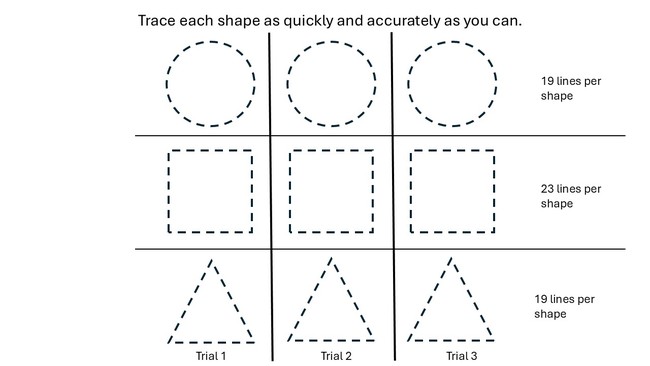
Example images for line tracing with total number of lines.
Figure 2. Example task of tracing experiment to assess fine motor skills.
- Count the number of lines in each shape before starting. During the motor assessment, use a colored marker to trace the lines to track the accuracy of the fine motor skills. Make sure to use the same-sized marker tip for each condition.
- Record the baseline fine motor skills for both hands.
- Trace the lines of each shape as quickly and accurately as possible with your dominant hand. If you use the printable PDF included in this procedure, this will include 3 circles, 3 squares, and 3 triangles. Trace the shapes in the same order for each hand.
- For example: Trace the first circle for trial 1, trace the second circle for trial 2, and then the third for trial 3.
- Repeat the same task on a separate printout with your non-dominant hand.
- Trace the lines of each shape as quickly and accurately as possible with your dominant hand. If you use the printable PDF included in this procedure, this will include 3 circles, 3 squares, and 3 triangles. Trace the shapes in the same order for each hand.
- Repeat the same task directly after visualization to understand how visualization impacts fine motor function. To perform visualization, close your eyes for 1 minute and imagine accurately tracing the shapes with each hand before tracing them.
- Visualize performing the task with your dominant hand for 1 minute, then repeat the tracing task on a new printout with your dominant hand.
- Visualize performing the task with your non-dominant hand for 1 minute, then repeat the tracing task on a new printout with your non-dominant hand.
/-/https/www.sciencebuddies.org/Files/20974/5/8718-Visualization-PI-Figure2_v2-Printable-PDF-LO.PhD.jpg)
Data Analysis
- Count the number of fully traced lines for each shape.
- A fully traced line is where the marker overlays most of the dashed line. A fully traced line equals 1 point, and an untraced line equals 0 points. See Figure 3 below for reference.
- Calculate the tracing accuracy using Equation 1 below.
- Record your calculations in Table 1.
- Calculate the average accuracy of all three trials and divide by the number of trials using Equation 2 below.
- Record your summary results in Table 2 to answer the questions and conclude your results.
/-/https/www.sciencebuddies.org/Files/20978/5/8718-Visualization-PI-Figure3_LO.PhD.jpg)
Example of counting the number of lines fully traced for each shape including the total number of lines.
Equation 1.
Equation 2.
| Shape | Trial 1 | Trial 2 | Trial 3 | Average Accuracy of 3 trials |
|---|---|---|---|---|
| Circle | ||||
| Square | ||||
| Triangle |
| Shape | Average accuracy for baseline (dominant hand) | Average accuracy after visualization (dominant hand) | Average accuracy for baseline (non-dominant and) | Average accuracy after visualization (non-dominant hand) |
|---|---|---|---|---|
| Circle | ||||
| Square | ||||
| Triangle |
Conclusions
- Is the accuracy lower on any particular shape? Why do you think that is?
- Recalculate your tracing, including any half-traced lines, for 0.5 points. How does this change your calculations of the accuracy of your fine motor skills? Is it more accurate than a binary (0,1) approach to quantifying your motor skill accuracy? Does it better represent what you see visually?
- Was your dominant hand performing better in modeling earth motor performance than your non-dominant hand, the latter of which models space flight conditions?
- Did your or the participant's accuracy improve after visualization compared to the baseline accuracy of each hand? Did one hand perform better than the other overall?

Ask an Expert
Global Goals
The United Nations Sustainable Development Goals (UNSDGs) are a blueprint to achieve a better and more sustainable future for all.
/-/https/www.sciencebuddies.org/Files/19746/5/E-WEB-Goal-03.png)
Variations
- Increase the size or complexity of the images to trace. For example, have participants trace a rocket or a large spiral. How does the accuracy change with size or complexity?
- Does visualization before disorientation impact the accuracy of fine motor skill performance? Test this for yourself by having the participants visualize the task, then do the disorientation spins 30 times before performing the task.
- Could practice also contribute to better performance on the task, not just visualization? Increase the number of trials for each task. Does this improve the overall accuracy? If so, practice is another variable that can also contribute to improved motor skill performance.
- How else can you assess fine motor skills? You could try cutting shapes, reading speeds, zipping a sipper, tying shoe laces, opening a door, typing a pre-set of questions, reading speed of the same paragraph, or other tasks requiring the small muscles of the hand, foot, or eye.
- You can also model how disorientation impacts your fine motor skill performance. To model orientation during space flight, spin around 30 times, then perform the task with your dominant hand. Repeat for your non-dominant hand. Can visualization assist with fine motor performance before or after disorientation?
Careers
If you like this project, you might enjoy exploring these related careers:
/-/https/careerdiscovery.sciencebuddies.org/Files/1698/17/pexels-photo-5699469.jpg)

/-/https/careerdiscovery.sciencebuddies.org/Files/967/17/unsplash-d4KQc-ZqBrc.jpg)
/-/https/careerdiscovery.sciencebuddies.org/Files/1628/18/iStock-1203995945.jpg)

/-/https/img.youtube.com/vi/0KjnJYoIqPA/0.jpg)
/-/https/img.youtube.com/vi/cleXJOqhl6Q/0.jpg)
/-/https/img.youtube.com/vi/j9b8nlaTQY8/0.jpg)