/-/https/www.sciencebuddies.org/Files/21464/5/sb-logo.png)
/-/https/www.sciencebuddies.org/Files/21464/5/sb-logo.png)
Abstract
Have you ever made a leaf rubbing or imprint using paper and crayons? What do you think would happen if you got dirt or sand on the leaf? Would it mess up the result? In this project you will find out and learn about how this is related to the process of making the microchips that run our phones, computers, and other electronic devices. Check out this page for more science projects related to this process.
Summary
None
This project requires fresh leaves.
No issues
/-/https/i.ytimg.com/vi/QYs4oUJEmAA/maxresdefault.jpg)
Objective
Simulate dust contamination in a clean room by adding dirt or sand to crayon leaf rubbings.
Introduction
/-/https/www.sciencebuddies.org/Files/20151/8/crayon-leaf-rubbings.jpg)
Look around you. How many electronic devices do you see? You are probably reading this text on one right now—a phone, tablet, or computer—but there may be more in the room. Nearly all modern electronic devices depend on semiconductors, special materials that can act as both conductors and insulators. Sometimes they conduct electricity, and sometimes they do not.
Semiconductors allow us to make transistors, tiny electrical "switches" that can turn on and off. Improvements in technology have allowed engineers to make smaller and smaller transistors over the years, cramming billions of them into microchips that are barely the size of your thumbnail! That is why today's smartphones have more computing power than early computers that took up an entire room.
Watch this video for an overview of how computers and other devices have gotten smaller and smaller over the years. (Dr. Ben Finio, the author of this project, worked on the Robobee shown around the one-minute mark in the video for his Ph.D. thesis!)
/-/https/i.ytimg.com/vi/gfOD-Qpl6eg/maxresdefault.jpg)
You may have noticed toward the end of the video that some of the devices are even smaller than things like human hairs, red blood cells, or even bacteria. Some are literally smaller than a speck of dust! At that scale, contamination by an actual speck of dust can ruin a microchip (Figure 1). This means that the process of making microchips must be done in an extremely clean environment called a clean room (Figure 2). Clean rooms have powerful air purification systems to help prevent dust contamination, and workers must go through a very careful cleaning and preparation process before they can even enter the room.
Watch the video after Figure 2 to learn more about clean rooms.
/-/https/www.sciencebuddies.org/Files/20247/10/wafer-particulates.jpg)
Figure 1. Dirt on a silicon wafer. Contamination like this can ruin an entire batch of chips. Image used with permission from onsemi.
/-/https/www.sciencebuddies.org/Files/20152/8/clean-room.jpg)
Figure 2. A clean room with workers wearing protective clothing to help prevent contamination.
/-/https/i.ytimg.com/vi/vSS_uJlrvvk/maxresdefault.jpg)
You might be thinking, "OK, but what does all of this have to do with the leaf rubbings mentioned at the beginning of this project?" Watch the following video about the semiconductor manufacturing process. As you watch, think about what would happen if a speck of dust got on top of one of the layers on the silicon wafer. What could happen to the manufacturing process?
/-/https/i.ytimg.com/vi/g8Qav3vIv9s/maxresdefault.jpg)
Since you probably do not have access to a real clean room for your experiment, in this project you will use a model instead. A model is something scientists and engineers can use to simulate another process using different (and usually cheaper) materials. You will make leaf rubbings using crayons and paper to represent the semiconductor manufacturing process. Grains of sand or dirt will represent dust contamination. How do you think the contamination will affect your leaf rubbings? Try the project to find out!
Terms and Concepts
- Semiconductor
- Conductor
- Insulator
- Transistor
- Microchip
- Clean room
- Silicon wafer
- Model
Questions
- How are microchips made?
- How small are transistors?
- How could dust or other contaminants affect the semiconductor manufacturing process?
Bibliography
- Branch Education. (2022, June 17). Technology size comparison 3D animation [video]. YouTube. Retrieved January 31, 2024.
- Lighthouse Worldwide Solutions. (2020, February 26). What is a cleanroom? [video]. YouTube. Retrieved January 31, 2024.
- Interesting Engineering. (2022, January 4). How are microchips made? [video]. YouTube. Retrieved January 31, 2024.
Materials and Equipment
- Fresh leaves (at least 3). Larger leaves will generally work better. Make sure they are not dry or rotten.
- Printer paper
- Crayons
- Marker, pen, or pencil
- Sand or dirt
- Lab notebook
Experimental Procedure
/-/https/www.sciencebuddies.org/Files/20483/6/icon-flask.png)
- Peel the wrapper off a crayon.
- Place one of your leaves on top of a piece of paper with the veins facing up (Figure 3).
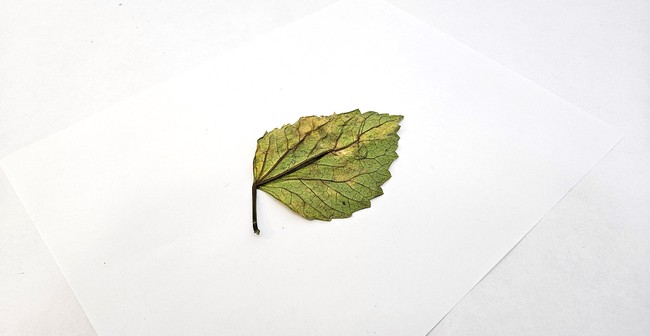
Figure 3. Preparation for the leaf rubbing. - Place another piece of paper on top of the leaf.
- Firmly hold the top piece of paper in place with one hand so it does not slide around. If you need help, ask another person to hold it.
- Using the side of your crayon (not the tip), rub back and forth over the leaf to make an imprint (Figure 4).
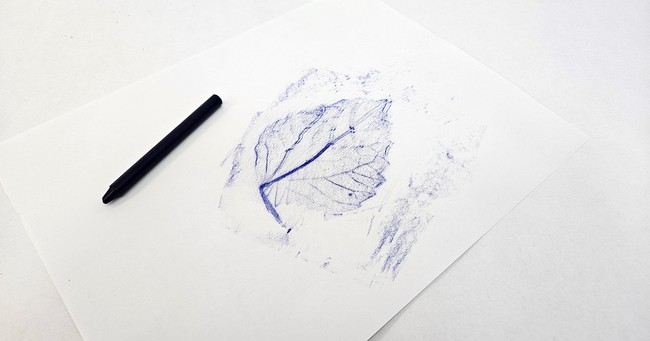
Figure 4. A crayon leaf rubbing. - Remove the top piece of paper from the leaf.
- Using a pen, pencil, or marker (not a crayon), carefully try to trace all the veins that appear in the imprint.
- Count the number of breaks or gaps—areas where the vein failed to trace completely. Record this number in a data table like Table 1.
/-/https/www.sciencebuddies.org/Files/20153/8/leaf-rubbing-setup.jpg)
/-/https/www.sciencebuddies.org/Files/20154/9/crayon-leaf-rubbing.jpg)
| Number of gaps | ||
|---|---|---|
| Leaf number | No sand | Sand |
| 1 | ||
| 2 | ||
| 3 | ||
Table 1. Example data table.
- Sprinkle a small pinch of sand or dirt on top of the leaf (Figure 5). Try to distribute the sand or dirt evenly instead of dumping it all in the middle. Spread it around with your finger if needed.
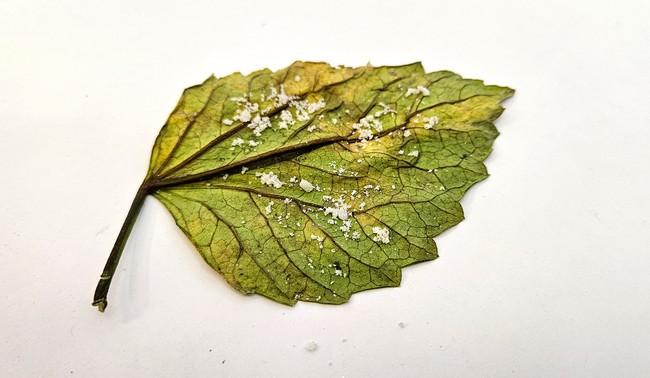
Figure 5. Sand sprinkled on a leaf. - Repeat steps 3–8 with a new piece of paper. What does your leaf rubbing look like this time?
- Repeat steps 2–10 with at least two more leaves, for a total of at least three trials.
- Analyze your results. How does the number of gaps compare in your leaf rubbings with and without contamination? How is this related to dust contamination in the semiconductor manufacturing process?
/-/https/www.sciencebuddies.org/Files/20155/8/leaf-sand.jpg)

Ask an Expert
Global Goals
The United Nations Sustainable Development Goals (UNSDGs) are a blueprint to achieve a better and more sustainable future for all.
/-/https/www.sciencebuddies.org/Files/19752/5/E-WEB-Goal-09.png)
Variations
- Try this project with different contaminants. What happens if you use coarser or finer grains of sand? What about other granular materials or powders, like sugar or flour?
Careers
If you like this project, you might enjoy exploring these related careers:
/-/https/careerdiscovery.sciencebuddies.org/Files/20162/5/SemiconductorProcessorHeroImage.jpg)

/-/https/careerdiscovery.sciencebuddies.org/Files/17365/4/manufacturing-technician-main-Stock-1140837585.jpg)

/-/https/img.youtube.com/vi/4aKOM6Scxhk/0.jpg)
/-/https/img.youtube.com/vi/43Nr2HRCQwI/0.jpg)
/-/https/img.youtube.com/vi/SV2huMdNs9c/0.jpg)