/-/https/www.sciencebuddies.org/Files/21464/5/sb-logo.png)
/-/https/www.sciencebuddies.org/Files/21464/5/sb-logo.png)
Chemical Reactions and Spice Projects for National Chemistry Week
Chemistry projects and resources for National Chemistry Week 2025!
/-/https/www.sciencebuddies.org/Files/21586/4/chemistry-week-2025-spices-chemical-reactions.png)
National Chemistry Week is October 19-25, 2025. The theme of this year's chemistry awareness week, hosted by the American Chemical Society (ACS), is "The Hidden Life of Spices."
Chemistry Projects Exploring Spices and Reactions
Spices do more than just add flavor or heat to our food. The same molecules that make cinnamon smell sweet or peppers taste hot can also reveal invisible ink, change color in acidic or basic solutions, and influence processes like fermentation. The science projects and STEM activities highlighted below help students interested in chemistry and food science experiment with chemical reactions, from acid–base reactions to pH changes. These projects explore how spice connects to chemistry, whether directly or through the science of flavor.
Science Projects & STEM Activities for Chemistry Week
1. Invisible Ink with Turmeric
In the Secret Messages With Invisible Ink! STEM activity, students explore two kinds of chemical reactions to see which works best for writing and decoding secret messages. One approach involves turmeric and baking soda. Turmeric contains curcumin, a natural pH indicator that changes color depending on how acidic or basic the solution is. What color will it turn when brushed on top of invisible writing made with a baking soda and water solution?
2. Spicy Kimchi and Fermentation
In the Kimchi Chemistry cooking and food science project, students make kimchi and investigate changes in pH and glucose as it ferments. Kimchi is often a spicy food. Does the spice affect the fermentation process? (Get inspired! These students made kimchi for their middle school STEM Fair project.)
3. Taste vs. Smell
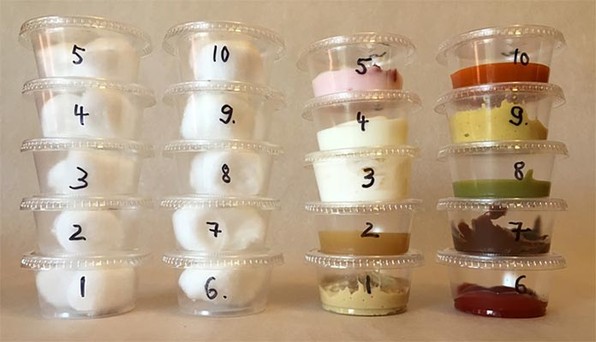
In the Battle of the Senses: Taste Versus Smell cooking and food science project, students put their senses to the test. What matters most, how something tastes or how it smells? Which sense has more influence on how we perceive a food's flavor? The five basic tastes (sweetness, saltiness, sourness, bitterness, and umami) don't fully account for a food's flavor. An individual's sense of smell (or olfaction) plays an important role. If the apple smells like cinnamon, how will it taste? While not focused on a particular spice, this project highlights the chemistry and biology behind how flavor is perceived.
Related projects: To learn more about the human sense of taste, see the Do You Have the Willpower to Taste Something Sour? and The Nose Knows Smell but How About Taste? human biology and health projects.
4. Explore the Making of Kombucha
In the What Sugar And Tea Does a Kombucha Biofilm Prefer? microbiology, chemistry, and cooking and food science project, students make their own kombucha, learn about SCOBY biofilms, and experiment to see how changing the substrate changes the fermentation process. Not all kombucha is spicy, but some is. Spice is usually added in the second fermentation. Why? (Get inspired! This student did this project for the science fair.)
5. Pepper and Soap
In the Use Surface Tension to Make Your Pepper Dance STEM activity, students learn about surface tension and what happens when pepper, which is hydrophobic (which means water is not attracted to it) is added to water. What happens when a bit of dishwashing liquid, glass cleaner, milk, oil, or toothpaste is introduced? Many spices, like pepper, are hydrophobic. This explains why certain spices, like cinnamon, may not mix well with water and even why water may not help relieve the spicy sensation or burning caused by hot peppers. Capsaicin is hydrophobic. Turmeric and paprika are also hydrophobic. But what happens if you add milk?
6. Spicy Foods and Heartburn
In the How Antacids Relieve Heartburn medical biotechnology project, students explore how antacids neutralize stomach acid through an acid–base reaction. While the experiment doesn't use spices directly, spicy foods can trigger heartburn when stomach acid rises.
/-/https/i.ytimg.com/vi/AOVD7WgFP2s/maxresdefault.jpg)
/-/https/www.sciencebuddies.org/Files/21579/4/kimchi-fermentation-ph-project.png)
/-/https/www.sciencebuddies.org/Files/21580/4/chemweek-tastetest.jpg)
/-/https/i.ytimg.com/vi/q0T5Ytp1xik/maxresdefault.jpg)
/-/https/www.sciencebuddies.org/Files/21557/7/pepper-shaker.png)
Green Chemistry Lessons & Resources
Use the resources below to learn more about how green chemistry reimagines chemical processes in ways that are environmentally aware, produce less hazardous waste, reduce pollution, and result in cleaner air and water and safer foods and products for everyone.
- E-factor: Environmental Impact Factor for Chemical Reactions: In this lesson, students do a simple exercise with M&Ms to understand what environmental impact factor (E-factor) is, how it applies to chemical processes, and how waste from chemical reactions can be reduced by applying the principles of green chemistry.
- Using Green Chemistry to Understand Types of Chemical Reactions: In this lesson, students learn to identify composition, decomposition, single-displacement, and double-displacement reactions. After learning about the chemicals commonly used in traditional reactions, they explore safer alternatives based on the Principles of Green Chemistry.
- Reaction Rates: Speed It Up with Temperature!: Using bleach and food color, students experiment to see how temperature affects the rate of the chemical reaction.
- Green Chemistry and the School Science Lab - Safer Chemistry for Today and Tomorrow: Use these lessons to explore the 12 principles of green chemistry with students.
- New Green Chemistry Science Projects—Sustainable Science for Students: Try green chemistry with student science projects, including fabric made from seaweed or kombucha and experiments related to sunscreen and detergent.
- Advanced Materials and "Lab to Table" Sustainability Science Projects: Explore the lab-to-table movement, cellular agriculture, microfluidics, and scientific advanced materials with sustainability-focused student projects.
- New Environmental Science and Sustainability Projects for Student STEM: Cutting-edge student projects support student exploration of real-world environmental science, ecology, and sustainability challenges and solutions.
- Browse all Green Chemistry student projects
- Browse all Green Chemistry lesson plans
Additional K-12 Chemistry Resources
- Teach Chemical Reactions - 20+ Chemistry Lessons and Activities: More than 20 video lessons, lesson plans, activities, and experiments for exploring what happens when you combine reactants.
- 13 Lessons to Teach About the Chemistry of Mixtures and Solutions: Not all substances form a chemical reaction when combined. Some form a mixture. Resources in this collection help students learn about homogeneous and heterogeneous mixtures.
- How to Make Solutions for Chemistry and Biology Experiments
- How to Make Dilutions and Serial Dilutions
- Titration Tutorial: Tips & Tricks for Titrating
/-/https/i.ytimg.com/vi/vJmIJ951p1o/maxresdefault.jpg)
/-/https/i.ytimg.com/vi/AzFERPJeeTM/maxresdefault.jpg)
/-/https/i.ytimg.com/vi/gmeCY7ANrog/maxresdefault.jpg)
Categories:
You Might Also Enjoy These Related Posts:
- Model and Track Virus Outbreaks - Student STEM
- Sun and Solar Science Projects - Solar Energy STEM
- 10 STEM Projects to Get Started Building Circuits on a Breadboard!
- Ocean Science Projects, Lessons, and Experiments
- Women in STEM! More than 60 Scientists and Engineers for Women's History Month
- Black History Month STEM - Learn More About These 40 Scientists for Black History Month!
- 10 Reasons to Do the Ball Run Engineering Challenge
- 40 New and Cutting-Edge Science and Engineering Projects in 2025
/-/https/img.youtube.com/vi/w5Ie1u4KW3o/0.jpg)
/-/https/img.youtube.com/vi/CFP-Kp_enU4/0.jpg)
/-/https/img.youtube.com/vi/sjfjXDOExcU/0.jpg)