/-/https/www.sciencebuddies.org/cdn/Files/21464/5/sb-logo.png)
/-/https/www.sciencebuddies.org/cdn/Files/21464/5/sb-logo.png)
40 New and Cutting-Edge Science and Engineering Projects in 2025
Explore 40 new, hands-on science and engineering projects added to our free STEM project library in 2025.
/-/https/www.sciencebuddies.org/cdn/Files/21741/4/newprojects-2025.png)
Our team of scientists and engineers worked all year to develop engaging, accessible materials that support hands-on K–12 STEM exploration. The projects added in 2025 span disciplines from artificial intelligence and robotics to environmental science, human biology, space exploration, and physical computing, with investigations that range from data analysis and simulation to device design and real-world problem solving.
Projects added to the free library of student science and engineering projects in 2025 appear in the following areas:
- Artificial Intelligence, Machine Learning, and Computer Science
- Electricity and Electronics and Physical Computing with Arduino and micro:bit
- Environmental Science & Agricultural Technology
- Health and Human Biology
- Human Behavior
- Microbiology
- Physics
- Robotics
- Space Exploration
Other new STEM Resources
Student Science and Engineering Projects Added in 2025
Artificial Intelligence, Machine Learning, and Computer Science
- Understanding the Emotions Hidden in Words with Sentiment Analysis: gather text data on a topic and use VADER (Valence Aware Dictionary and sEntiment Reasoner), a sentiment analysis tool, to identify positive and negative sentiments in human text.
- Can AI Classify Stars?: create a boosted tree model to classify celestial objects based on their spectral characteristics.
- Classify Spam Emails with Natural Language Processing: identify common words in spam emails and use natural language processing (NLP) to build a spam detector.
- Detect Litter with Machine Learning: train a model to use computer vision to identify different types of litter.
- Using AI to Detect Proper Exercise Form: use multiple object tracking (MOT) and YOLO (You Only Look Once) for deep learning to train a model to evaluate proper exercise form to prevent injury.
- Teaching Machines to Understand Sign Language: test whether AI can learn sign language gestures or phrases to see if it can be used for interpretation.
- Exploring the Impact of Social Media on Mental Health with Machine Learning: use the Random Forest machine learning algorithm to investigate which variables correlate with mental health scores.
- Predicting Wildfire Intensities and Locations with AI: use the Prophet model, a machine learning algorithm, to predict areas of wildfire susceptibility and their intensities based on multiple years of collected data.
- Can Machine Learning Forecast Future Sea Levels?: use the Prophet model to predict future local relative sea level (RSL) changes.
- Generate Recipes from YouTube Videos with AI: experiment with large language models (LLMs) and prompt engineering to create, compare, and evaluate AI-generated recipes from video transcripts.
Electricity and Electronics and Physical Computing with Arduino and micro:bit
- How Do You Know Where You Are Without GPS? Dead Reckoning and Inertial Navigation*: use Arduino or micro:bit to design an inertial navigation system that uses acceleration measurements to back-calculate position in relation to a known starting point, a navigation method called dead reckoning.
- How Does Distance Affect Wireless Signal Strength?: use micro:bits as transmitter and receiver to explore how distance affects the strength of a wireless signal.
- Build a Haptic Glove with Arduino: design and build a haptic glove with built-in vibration motors to explore how haptics might be used in virtual reality.
(For related projects, see new projects in Space Exploration and Robotics)
Environmental Science & Agricultural Technology
- Test and Change the Air Quality of Your Environment: use an air quality sensor to measure indoor and outdoor air quality and experiment to see how different interventions can influence air quality.
- Removing Microplastics from Water with Ferrofluids: investigate the use of ferrofluid for removing microplastics from waterways.
- Macroinvertebrates as Indicators of Pollution: collect trash and macroinvertebrates from a local water source to better understand how pollution impacts a creek's biodiversity.
- Modeling Your Local Watershed and Nutrient Pollution: learn about sources of nutrient pollution and measure changes in a watershed to see how runoff in a particular region is contributing to the transportation of excess nutrients.
- Comparing Different Types of Irrigation Systems: compare and contrast passive irrigation and traditional surface irrigation systems in terms of impact on overall plant growth.
Health and Human Biology
- Motor Imagery Visualization's Impact on Fine Motor Skills for Space Flight: use a space flight launch scenario to test how visualization impacts fine motor skill accuracy and performance.
- Can Visualization Improve Your Sports Performance?*: design an experiment to explore how visualization can improve performance in sports.
- Wearable Limp Detection Device: program a micro:bit as a wearable device that detects when someone is limping instead of walking normally.
- Can You Walk the Talk? Exploring Distractions and the Timed Up and Go Test: use the Timed Up and Go (TUG) test to evaluate a person's functional mobility when they are focused versus when they are distracted.
Human Behavior
- Make a Mood Tracker: use a micro:bit to create a simple mood tracking device to log mood throughout the day and upload the data for later analysis.
- Improving Focus for People with Neurodevelopmental Disorders: use the Wisconsin Card Sorting Test (WCST) to see if movement during executive function tasks can improve performance for individuals both with and without neurodevelopmental disorders.
Microbiology
- What Modern Microbes Could Survive on Early Earth?: investigate microorganisms from a local natural water source to see if any could have survived the pH conditions of the early Earth's oceans.
- How Can Life Survive on a Planet with Extreme Tidal Locking?: test what extreme temperatures microscopic life can survive to model some of the harsh conditions that life on a tidally locked planet might experience.
Physics
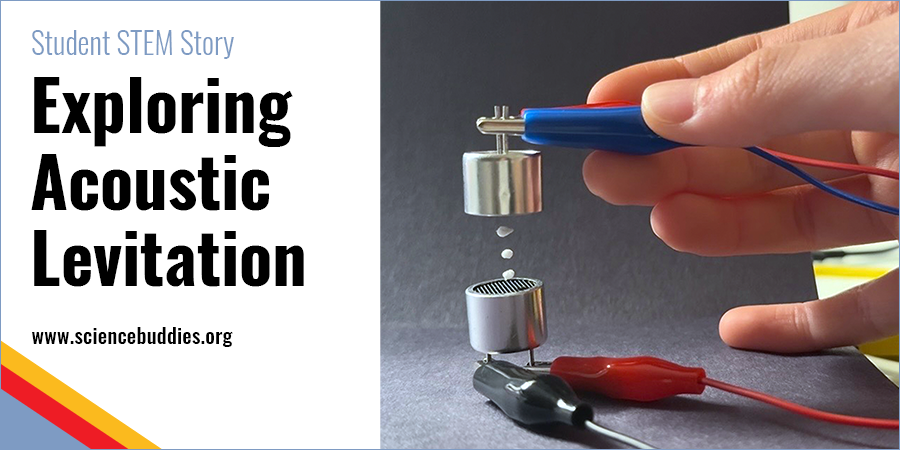
- Build an Ultrasonic Levitator: build an acoustic ultrasonic levitator to make objects float in midair using invisible sound waves.
- Feel Sound With Your Fingertips - Ultrasonic Haptics : build a device that lets you feel invisible sound waves in midair.
- See Air Currents with Shadowgraphs and Schlieren Images: explore flow visualization using shadowgraphy and schlieren imaging to visualize air currents.
Robotics
- A Robot Waiter That Can Carry Drinks: build and program a self-balancing robotic platform with a proportional controller that uses a servo motor and an accelerometer.
- Make Soft Robotic Skin: make artificial robotic skin using flexible rubber with an embedded conductive fabric.
- Soft Robots with Built-In LEDs*: experiment with making soft robots with embedded LEDs.
- Control Motors with Your Muscles!*: explore the use of electromyography (EMG) sensors interfaced with Arduino to control LEDs or motors.
Space Exploration
- Rocket Catcher Challenge: build a device to catch a falling rocket so it lands vertically. (This was the 2025 Science Buddies Engineering Challenge.)
- A Simulator for Suborbital Spacecraft: simulate the physics of a suborbital spaceflight and compare the simulation to data from a real flight.
- Build a Wearable Device Using an Arduino to Keep Astronauts Safe on Mars: design a system that uses geofencing technology and biosensors to ensure astronaut safety.
- Motorized Arduino Cable-Driven Spacecraft Motion Simulator: build a miniature, motorized version of a full-sized motion simulator to move model spacecraft around in a controlled manner.
- Asteroid! Identify Space Hazards with Computer Vision: train a machine learning model to identify different space-related objects and write a Scratch program that reacts to them.
- Satellite Collision Detection: A Hands-On Coding Experience: use real satellite data to model orbits, calculate collision risks, and visualize satellite paths while testing to see how small changes in orbital parameters can prevent or cause potential satellite collisions.
- Simulating the Kessler Syndrome: simulate the conditions under which space debris grows uncontrollably due to satellite collisions and test how cleanup or policy changes could create a safer, more sustainable future in space.
Educator Lesson Plans
The following lesson plans were added to our educator resources in 2025:
- Rocket Catcher Challenge for Grades K-5
- Rocket Catcher Challenge for Grades 6-8
- Rocket Catcher Challenge for Grades 9-12
- Modeling Biologic Manufacturing
To find additional lessons to support your STEM teaching:
Categories:
You Might Also Enjoy These Related Posts:
- Model and Track Virus Outbreaks - Student STEM
- Sun and Solar Science Projects - Solar Energy STEM
- 10 STEM Projects to Get Started Building Circuits on a Breadboard!
- Ocean Science Projects, Lessons, and Experiments
- Women in STEM! More than 60 Scientists and Engineers for Women's History Month
- Black History Month STEM - Learn More About These 40 Scientists for Black History Month!
- 10 Reasons to Do the Ball Run Engineering Challenge
- 40 New and Cutting-Edge Science and Engineering Projects in 2025

/-/https/img.youtube.com/vi/W1DVEtzrl9g/0.jpg)
/-/https/img.youtube.com/vi/OKJmI8Ap5L8/0.jpg)
/-/https/img.youtube.com/vi/xx5ou6n0GEU/0.jpg)