/-/https/www.sciencebuddies.org/Files/21464/5/sb-logo.png)
/-/https/www.sciencebuddies.org/Files/21464/5/sb-logo.png)
Reusable Energy Projects for Earth Day
Get hands-on exploring alternative and reusable energy with one of these student projects, just in time for Earth Day.
/-/https/www.sciencebuddies.org/Files/21170/6/2025-earthday-windturbine-blog.png)
Exploring Reusable and Clean Energy
The theme of Earth Day 2025 is Our Power, Our Planet, with a focus on the importance of clean and reusable energy. Students can explore strategies for obtaining energy from wind, the Sun, the ocean, and more with projects like the ones highlighted below.
Sustainability and Reusable Energy Projects
1. Energy from Wind
Use the Make the Wind Work for You! project to make a small model wind turbine to explore how wind can be used to generate energy. Question: Which rotor design produces the most energy?
2. Energy from the Sun
In the Build a Solar Updraft Tower activity, students learn about solar thermal collector technology and building a simple model solar updraft tower to see if it can make a propeller spin. Question: What happens when hot air inside the tower rises?
3. Energy from Mud
Can you use mud to generate electricity? With a microbial fuel cell, students can investigate this question and the potential for using microbial fuel cells as an alternative power source. In this project, students build their own microbial fuel cell. Questions: Does the type of soil make a difference? What changes do additives like salt or urine bring?
4. Energy from Shaking
In the Human-Powered Energy project, students explore magnetic induction, the process in which the magnetic field of a magnet moved near a conductor creates a current in the conductor. A generator uses this principle to generate electricity. In the project, students build a small electrical generator with magnets and a wire coil that creates electricity when it is (vigorously!) shaken. Question: What is the relationship between the number of magnets and the amount of power generated?
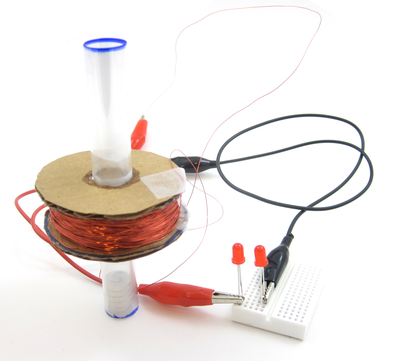
Note: This project uses the Shaking Up Some Energy Kit.
5. Energy from the Ocean
In the Wily Waves: Build an Oscillating Water Column to Extract Energy from Ocean Waves project, students build a model oscillating water to see how energy can be harnessed from waves. For a related project, see Tireless Tides: Extracting Energy from Ocean Tides. Question: How many of these model oscillating water columns would be needed to power a lightbulb?
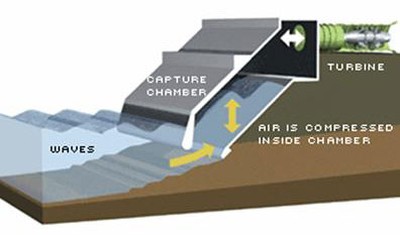 Image: Energy Futures: MIT Energy Initiative, 2009.
6. Energy from Compost
In the Extracting Heat Energy from a Compost Pile project, students experiment to see if energy can be harvested from the heat created in a compost pile as waste decomposes. Question: Can a compost bin generate enough energy to heat water?
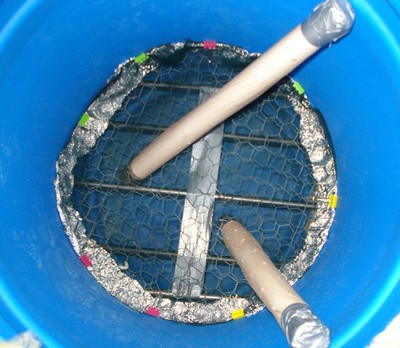 Image: Courtesy of Max Keller.
7. Build a Solar Oven
In the Now You're Cooking! Building a Simple Solar Oven project, students use a cardboard box to build a solar oven that can be used for cooking. For another approach to building a solar oven, see the Build a Pizza Box Solar Oven activity (shown in the video below). Question: How does a solar oven compare to a standard kitchen oven?
8. Build a Solar-Tracking Robot
In the Build a Solar-Tracking Robot project, students build and program a robot that can autonomously orient itself towards a light source. Question: What might be a benefit of a robot being able to track the Sun? (This project uses the BlueBot Robotics Kit plus an Arduino and additional parts.) For another solar-powered car project, see Build a Solar-Powered Car.
Question: What does it take to make a robot autonomously stay aligned with a light source?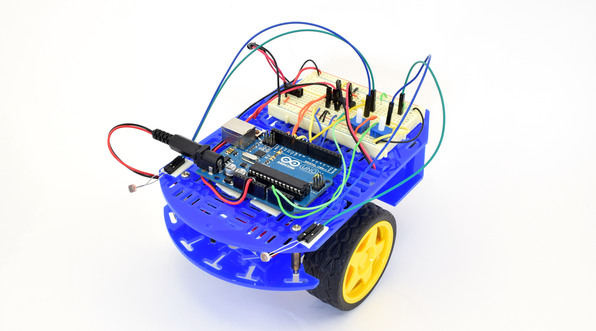
9. Build a Solar Panel that Follows the Sun
In the Build and Test a Sun-Tracking Solar Panel project, students use Arduino to make a solar panel system that tracks the movement of the Sun through the day. (For a similar project using micro:bit, see Design a Mini Solar Tracker System. Question: How much more power does a solar-tracking panel produce compared to a stationary panel?
/-/https/i.ytimg.com/vi/zJyByg2kEnU/maxresdefault.jpg)
/-/https/i.ytimg.com/vi/rbhzoCb0xWM/maxresdefault.jpg)
/-/https/www.sciencebuddies.org/Files/21167/5/advanced-shaking-up-some-energy.png)
/-/https/www.sciencebuddies.org/Files/4073/5/Energy_img062.jpg)
/-/https/www.sciencebuddies.org/Files/3916/5/Energy_img059.jpg)
/-/https/i.ytimg.com/vi/nhgNh3BdMsc/maxresdefault.jpg)
/-/https/www.sciencebuddies.org/Files/19692/4/solar-bluebot.png)
/-/https/i.ytimg.com/vi/nkPoRdrsRHE/maxresdefault.jpg)
/-/https/i.ytimg.com/vi/oPuld-ki4lw/maxresdefault.jpg)
Other Projects About Sustainability, Renewable Energy, and Environmental Science
- The Power of Heat Is Right Under Your Feet with Geothermal Energy
- How to Extract Energy from Grass
- Use the Sun's Energy to Heat Your Own Water
- Free Power from the Sun!
- The Speed of Light: Explore Solar Energy with a Supercapacitor Car Motor!
Related Resources and Lessons
- 26 Science Projects and Experiments To Teach About Types of Energy
- Earth Day Science Projects and Activities
- 16 Science Projects & Experiments to Teach About Electricity
- Plastics and Earth Day STEM
- Solar-Powered Cars for Junior Solar Sprints
- Zero-Energy Housing
- Solar Power
Related STEM Careers
Students interested in the kinds of projects highlighted above may want to learn more about the following career paths:
Categories:
You Might Also Enjoy These Related Posts:
- Model and Track Virus Outbreaks - Student STEM
- Sun and Solar Science Projects - Solar Energy STEM
- 10 STEM Projects to Get Started Building Circuits on a Breadboard!
- Ocean Science Projects, Lessons, and Experiments
- Women in STEM! More than 60 Scientists and Engineers for Women's History Month
- Black History Month STEM - Learn More About These 40 Scientists for Black History Month!
- 10 Reasons to Do the Ball Run Engineering Challenge
- 40 New and Cutting-Edge Science and Engineering Projects in 2025


/-/https/img.youtube.com/vi/aLYXJaEAJEE/0.jpg)
/-/https/img.youtube.com/vi/wG3OVpaHGkc/0.jpg)
/-/https/img.youtube.com/vi/mabHwDuuLfU/0.jpg)